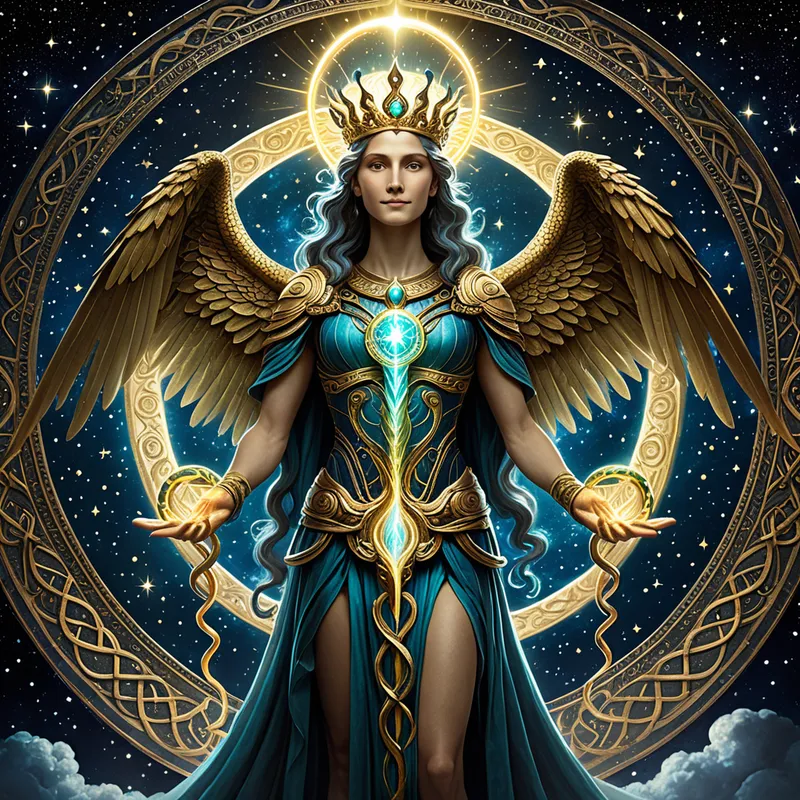
Mercurius Myth Meaning & Symbolism
The volatile spirit of transformation, the alchemical trickster who dissolves and unites opposites, guiding the soul's transmutation.
The Tale of Mercurius
Listen, and hear the tale not of a god, but of a ghost in the glass, a whisper in the crucible. In the beginning, before the work, there was only the prima materia—the black, formless mass, the leaden sleep of the world. It lay heavy in the vessel of creation, a silent, dead thing.
Then, from the very heart of that darkness, a shiver. A breath. It was not born, but awoke. They called it Mercurius. It was the first movement in the stillness, a quicksilver thought in the mind of matter. It had no single form. To the seeker peering into the flask, it was a shimmering vapor, coiling like a serpent. In the heat of the furnace, it was a weeping, metallic tear. In the cool of the moon, it was a cold, mirror-bright pool.
This spirit was a creature of profound paradox. It was the water that could not wet the hands, the stone that was not a stone. It fled from fire, yet was born in its heart. It was the messenger, the psychopomp, dancing between the realms of the fixed and the volatile, the celestial and the chthonic. Its great conflict was with itself, for it contained all opposites in its mercurial nature: male and female, young and old, living and dead, poison and medicine.
The alchemist, the human partner in this dance, sought to catch it. But to grasp Mercurius was to hold moonlight. It would slip away, leaving only a stain of doubt. It would lead the seeker on with promises—the glint of gold in the retort, the sudden sweet smell of the philosophical spring—only to vanish, leaving behind the ash of failure. This was the nigredo, the blackening, the despair. The spirit was the trickster, the thief of certainty.
Yet, for the one who persisted, who learned the patience of the salts and the fire, a change would occur. Not by force, but by a kind of sacred courtship. The spirit, this Mercurius, would begin to cooperate. It would no longer flee, but circulate. It would become the medium, the divine water, in which the fixed soul (Sulfur) and the enduring body (Salt) could finally meet and converse. In this sacred marriage, the conjunctio oppositorum, the spirit was both the priest and the wedding chamber.
And in that union, resolved in its own liquid embrace, Mercurius would complete its arc. It would give itself up, becoming the very gold it promised. The volatile would become fixed, the spirit made body, the messenger become the king. The tale ends not with an apotheosis, but with a quiet, radiant stillness in the glass—the Lapis achieved, where the once-fleeing spirit now rests, eternal and whole.
Cultural Origins & Context
The myth of Mercurius is not found on temple walls, but in the coded scripts and cryptic illustrations of European alchemical manuscripts, spanning from the late medieval period through the Renaissance and into the early modern era. This was a clandestine culture, operating in the shadowy borderlands between proto-chemistry, mystical philosophy, and heretical spirituality. The "myth" was passed down not by bards, but by adepts to their apprentices, through symbols like the Ouroboros and the Rebis.
Its societal function was deeply subversive. In an age of rigid religious and philosophical dogma, alchemy provided a hidden, experiential path to the divine within matter and the psyche. The story of Mercurius was the core narrative of this path. It was a practical guide disguised as allegory, teaching that transformation required engaging with a chaotic, intelligent, and paradoxical principle inherent in nature and the self. It functioned as a map for inner experience, where the laboratory vessels were the soul, and the chemical processes were stages of psychological ordeal and revelation.
Symbolic Architecture
Mercurius is the archetypal symbol of the unconscious psyche in its dynamic, transformative aspect. It represents the autonomous, living spirit of the depths that initiates all psychic change.
He is the spirit of the beginning and the end, the prima materia and the lapis. To seek him is to seek the soul's own hidden, animating principle.
Psychologically, Mercurius embodies the trickster archetype, but one of cosmic significance. He is the personification of the transcendent function—the psychic process that arises from the tension of opposites and leads to the emergence of a new, third position. He is volatile because the unconscious is not under ego's control; he is dual-natured because the psyche contains both creative and destructive potentials. His metallic nature symbolizes the cold, factual, "non-human" reality of the psychic substrate, while his luminosity represents the spark of consciousness it can generate.
He is the union of opposites made flesh (or rather, made quicksilver): spirit/matter, conscious/unconscious, male/female, good/evil. He does not reconcile these opposites logically, but contains them in a paradoxical, living tension, which is the only medium in which true transformation can occur.

The Dreamer's Resonance
When the myth of Mercurius activates in the modern dreamscape, it signals a period of profound psychic liquefaction. The dreamer may encounter:
- Elusive Figures: A shape-shifting person who gives crucial advice then disappears, a guide who is also a thief, a lover who is terrifyingly unknown.
- Mercurial Environments: Rooms that change layout, mirrors that show alternative selves, pools or rivers of reflective, metallic liquid.
- The Sensation of the Volatile: Dreams of flying or falling uncontrollably, of being a vapor or smoke, representing the dissolution of old ego structures.
- The Vas: Recurring dreams of a specific vessel, container, or room (the vas) where a mysterious process is underway.
Somatically, this can feel like nervous energy, restlessness, or a feeling of being "ungrounded." Psychologically, it is the often-distressing phase where entrenched attitudes, identities, and complexes lose their solidity. The dream-Mercurius does not bring peace; it brings the ferment that precedes rebirth. The dreamer is in the solve (dissolve) phase of the alchemical solve et coagula.

Alchemical Translation
For the modern individual, the myth of Mercurius models the core of individuation: one cannot will transformation; one must court the transformative spirit within.
The initial "blackening" (nigredo) is the necessary depression, confusion, or sense of meaninglessness that arises when the ego's old methods fail. Mercurius appears here as the agent of this decay, the thief of our certainty. The temptation is to fight this spirit, to try to solidify the volatile, to repress the disturbing thoughts and moods. This only makes it flee or turn poisonous.
The work is not to conquer the spirit, but to provide the vessel—the conscious attention and endurance—where it can perform its own work.
The alchemical translation is one of engaged observation. It is to hold the tension of our inner opposites—our ambition and our laziness, our love and our hatred, our spirituality and our materialism—without rushing to decide for one side. This creates the sealed vas of the psyche. In that container, Mercurius circulates. He mediates between the fiery passion of the soul (Sulfur) and the crystallized patterns of habit and body (Salt).
The triumph of the myth is not the ego's victory, but its marriage. When the ego stops chasing or fleeing the mercurial unconscious and instead provides a steady, patient vessel, the spirit itself completes the work. The volatile insight becomes integrated wisdom (the fixed Mercury). The fleeting image becomes a lasting symbol. The leaden weight of the unresolved self is transmuted into the gold of a personality that has made peace with its own paradoxical, living spirit. One becomes, in a sense, a humble vessel for the enduring, mercurial dance of consciousness itself.
Associated Symbols
Explore related symbols from the CaleaDream lexicon: