Merchant Caravans Myth Meaning & Symbolism
A mythic tale of caravans traversing perilous deserts, guided by celestial forces, where trade becomes a sacred act of cosmic connection.
The Tale of Merchant Caravans
Listen. The wind does not merely blow across the Taklamakan. It sings. It sings of bones bleached white and of treasures buried deep. It sings of the long, slow breath of the camels and the shorter, sharper breath of men whose eyes are fixed on the horizon. This is the song of the caravan.
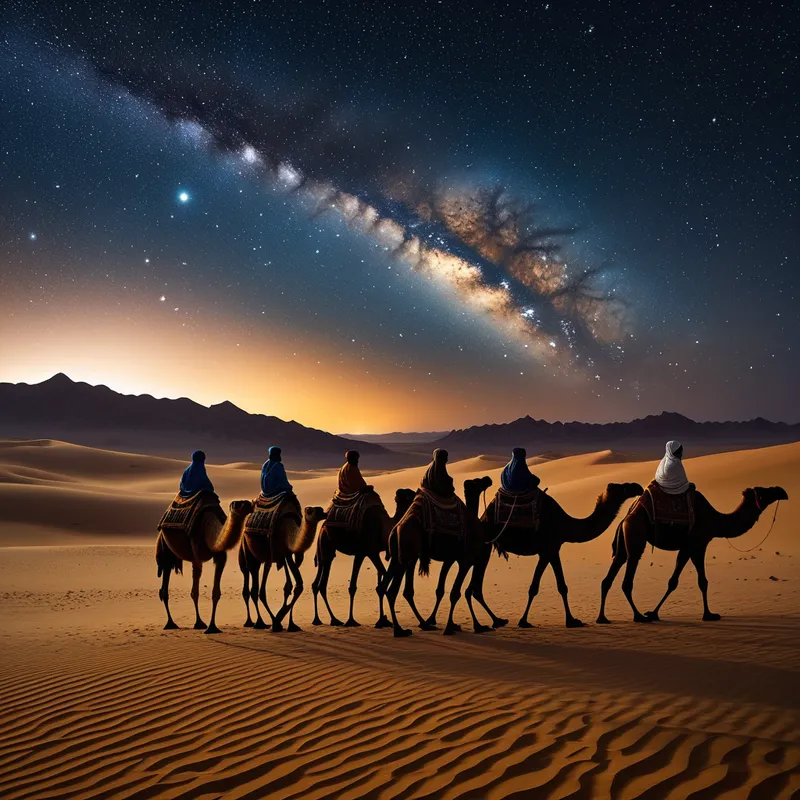
Before the first step is taken, the Kervanbashi consults the old ones and the new stars. He reads the heavens not as a map, but as a contract, a covenant written in the scatter of stars known as the Caravan of Heaven. The journey is a prayer. The loading of the Bactrian camels with bolts of silk, sacks of spice, and bundles of indigo is a ritual. Each knot tied is a wish for safety; each balanced load, a hope for fair exchange.
Then, they step into the silence. The world shrinks to the creak of leather, the soft thud of padded feet on sand, and the eternal, watchful sky. Days melt into a haze of heat and thirst. The desert is not empty. It is full of presences. Whispers on the wind become the voices of Djinn, casting mirages of cool lakes and lush groves to lure the weak from the path. The shifting dunes are said to be the restless bodies of giants, sleeping fitfully.
The true test is not the sun, nor the sand, nor even the bandits who watch from distant rocks. It is the silence within. In that vast emptiness, a person meets their own soul, stripped bare as the landscape. Some break, seeing only endless gold and the weight of their burden. They become like the Lost Cities, buried by their own greed or fear.
But for the caravan that remembers the covenant, guidance comes. A lone eagle circles, becoming a pointer to a hidden seep of water. A strange, phosphorescent moss glows on rocks at night, marking a safe passage. These are the blessings of the Daimon of the road, paid not with coin, but with respect, with endurance, with the sheer stubborn act of keeping faith with the journey itself.
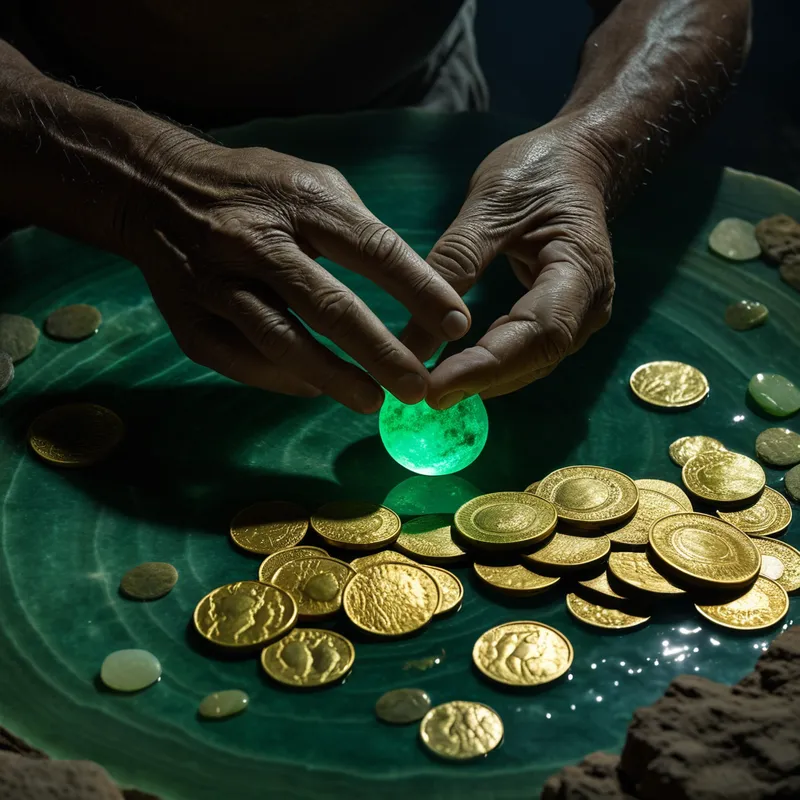
The climax is not a battle, but an arrival. It is the moment the high, cold passes of the Roof of the World give way to the sight of green valleys and the smoking hearths of a distant caravanserai. The exchange that follows is solemn. Silk for glass, jade for gold, spice for scripture. Hands touch, not just in trade, but in recognition. The man from Chang'an looks into the eyes of the man from Antioch and sees, mirrored, the same dust of the same long road. The goods are merely the body; the journey is the soul. And in that moment of connection across the abyss of the world, the caravan is no longer a line of beasts and men. It becomes a living artery, and the earth’s blood—story, song, and soul—begins to flow once more.
Cultural Origins & Context
This mythic narrative is not a single story from a single text, but a composite soul-print of the Silk Road, emerging from a thousand fireside tales, traveler’s logs, and merchant epics. It was born in the space between empires—between Han China, Parthia, Kushan, and Rome—and was carried on the tongues of Sogdian traders, Nestorian monks, Buddhist pilgrims, and Persian adventurers. Its tellers were the Kervanbashi themselves, the scribes in caravanserais, and the singers who turned ledger entries into legend.
Its societal function was multifaceted. Practically, it was a repository of survival knowledge, encoding routes, warning of dangers, and glorifying the virtues necessary for the trade: trust, astronomical skill, endurance, and shrewdness. Spiritually, it sacralized the profane act of commerce. In a world where religions preached detachment from material wealth, this myth reframed the merchant’s journey as a perilous pilgrimage. The caravan became a mobile monastery, its discipline a form of asceticism, and its successful exchange a moment of divine grace that connected civilizations. It justified and elevated a life that was otherwise seen as rootless and risky, making the merchant not just a profiteer, but a cosmic courier, a bearer of more than goods.
Symbolic Architecture
At its heart, the myth of the Merchant Caravans is a grand metaphor for the psyche’s journey toward consciousness and connection. The caravan itself symbolizes the integrated Self—a fragile, yet purposeful community of disparate parts (instincts, thoughts, talents, fears) moving in concert toward a distant goal. The Taklamakan desert represents the arid, uncharted territories of the unconscious, a place of potential death (psychic stagnation) and potential discovery (hidden treasures of the soul).
The desert does not create the mirage; it reveals the thirst already within.
The Djinn and mirages are manifestations of the personal and collective shadow—the seductive, destructive illusions born from unmet needs, greed, or unresolved trauma. The Daimon of the road, conversely, represents the guiding function of the unconscious itself, the synchronicities and intuitions that emerge when one is aligned with one’s deeper purpose. The goods—silk, spice, jade—are not mere commodities. They symbolize the unique, precious contents of an individual’s soul: one’s talents, experiences, and inner wealth, which are worthless if hoarded and only gain value through perilous journey and authentic exchange.
The Dreamer's Resonance
When this mythic pattern stirs in the modern dreamer, it often signals a profound transition or a call to undertake a psychological "long journey." Dreaming of leading or being part of a caravan suggests the ego is attempting to organize and mobilize various complex aspects of the personality toward a conscious goal. The somatic feeling is often one of weighted movement, a trudging determination mixed with anxiety.
Dreams of being lost in a desert, desperately seeking the caravan, speak to a feeling of alienation from one’s own inner community—a dis-integration where instincts, values, and intellect are no longer cooperating. The haunting image of the Lost Cities represents talents, relationships, or life paths that have been abandoned and "buried" under the sands of neglect, compromise, or fear. Conversely, the moment of exchange in the dream—handing something over, receiving something strange and beautiful—can feel deeply numinous. It marks a point of psychic transaction where an old attitude is surrendered, and a new piece of the world-soul is integrated. The process is one of re-membering the scattered parts of the self through the disciplined, perilous work of consciousness.
Alchemical Translation
The myth models the alchemical Nigredo and Rubedo with stark clarity. The arduous, desiccating journey through the desert is the Nigredo: the necessary dissolution of the ego’s familiar comforts and assumptions. One is reduced to essence—thirst, direction, faith. In this crucible of sand and sky, the base metal of naive identity is broken down.
The treasure is not carried by the caravan; it is forged within the caravan during the crossing.
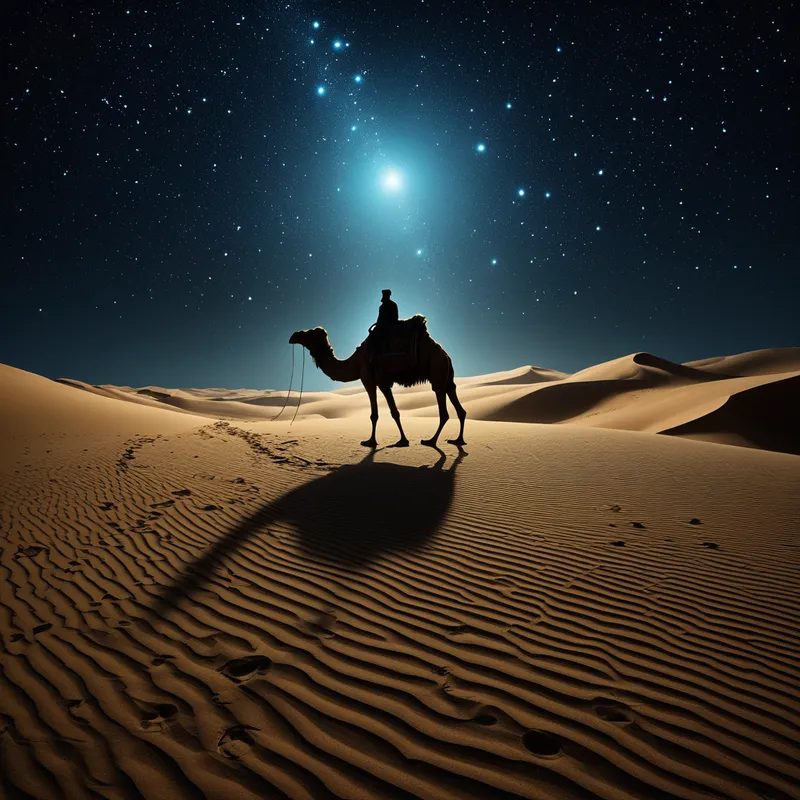
The guiding stars and the final exchange represent the Rubedo. This is not a return to the beginning, but an arrival at a new synthesis. The "gold" produced is not material wealth, but the capacity for connection. The modern individual undergoing this process is not seeking geographical frontiers, but the frontiers of their own being. They must become their own Kervanbashi, learning to read their inner heavens (intuition, values) and endure the inner deserts (depression, doubt, meaninglessness). The ultimate "trade" is the act of bringing one’s deepest, most authentic self into communion with the "other"—be it another person, a community, or the world itself. The myth teaches that wholeness (individuation) is not a state of solitary completion, but a state of being sufficiently integrated and "wealthy" in soul that one can engage in the sacred, perilous, and glorious exchange that makes a world.
Associated Symbols
Explore related symbols from the CaleaDream lexicon: