Memento Mori Myth Meaning & Symbolism
A mythic injunction to remember death, transforming mortal fear into a sacred urgency for living with purpose and authenticity.
The Tale of Memento Mori
Listen. The world is a corridor of whispers, and the loudest whisper is the one we spend our lives trying not to hear. It is not a shout from a mountaintop, nor a decree from a throne. It is the soft, insistent sound of sand falling through the narrow neck of an hourglass, the quiet crack of a rose petal as it browns at the edge, the final, fading echo of your own name on the lips of those who will one day forget it.
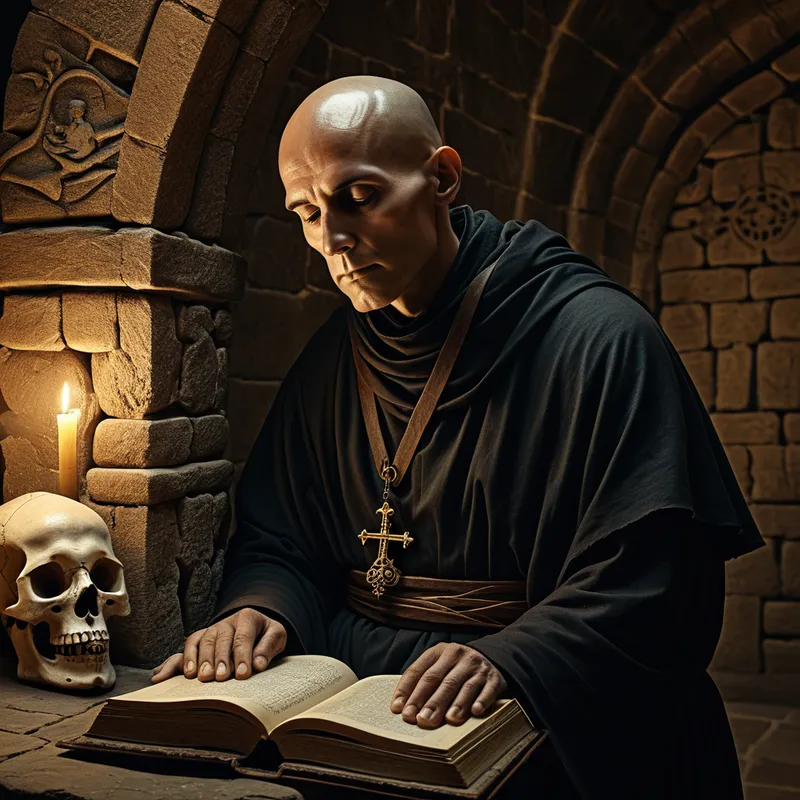
In the high, cold scriptoriums of medieval monasteries, where the only warmth came from a single candle and the fervor of faith, a young monk toiled. His name is lost to us, and that is the first lesson. His world was parchment and prayer, the scent of ink and incense. He was copying the Psalms, his hand tracing the sacred illuminated letter, when a shadow fell across his page. It was not the shadow of a cloud, but of a thought—a chilling, undeniable truth that slipped between the verses of eternal life.
The figure who brought this shadow was not a demon with a scythe, but his own Abbot, an old man whose face was a map of wrinkles, each one a road traveled in devotion. In his hands, he did not carry a book of law, but a simple object. A human skull, polished smooth by time and handling, empty sockets staring into eternity.
“Brother,” the Abbot said, his voice like dry leaves. “What do you see?”
The young monk saw horror. He saw the end of beauty, the silence of song, the dissolution of the hand that now held the quiver. He saw the grinning mockery of all his efforts.
The Abbot placed the skull on the corner of the scribe’s desk, beside the inkpot. “No,” he whispered, as if reading the terror in the young man’s soul. “You see your most faithful companion. You see the truth that walks beside you from your first breath. It is not your enemy, but your guide. Look. Remember.”
And so the skull remained. Day after day, it sat. The monk would glance at it as he penned “vanitas vanitatum, omnia vanitas” (vanity of vanities, all is vanity). At first, it filled him with a dread that chilled his fingers. But as the seasons turned, witnessed only through the narrow window, a slow alchemy began. The dread did not vanish; it transformed. The hollow gaze no longer spoke of an end, but of a limit. The silent teeth no longer grinned in mockery, but in a silent, urgent question: What will you do with the sand that remains in your glass?
The conflict was not against a beast, but against the sleeping denial within his own heart. The rising action was the daily, courageous act of looking at the skull—really looking—until he saw not death, but life framed by its inevitable closing bracket. The resolution was not a victory over mortality, but a sacred treaty with it. One evening, as he finished a particularly glorious illumination of a heavenly city, his hand did not shake with fear as he looked at his silent companion. Instead, he felt a profound and piercing clarity. The beauty of his work was not diminished by the skull; it was made meaningful by it. Every stroke of gold was a defiance of the void, a testament crafted in the full, aching awareness of its temporary custodian. He remembered, and in remembering, he began to truly live.
Cultural Origins & Context
The phrase Memento Mori is not a single myth from a sacred text, but a pervasive, living motif that permeated Christian ascetic and artistic tradition, particularly from the early desert fathers through the height of the medieval period and into the Vanitas movement. Its origins are less in a story and more in a practiced discipline.
It was a core tenet of early monasticism, inspired by the sayings of the Desert Fathers. Anecdotes tell of monks being instructed to dig their own graves and spend time in them daily in contemplation. By the medieval period, it had become a formalized spiritual exercise. Thomas à Kempis’s The Imitation of Christ, a central devotional text, is saturated with its spirit. It functioned as a societal and psychological corrective to worldly pride, ambition, and the libido dominandi (lust for domination). In a world of plague, war, and short lifespans, it was not a morbid obsession, but a practical and sacred technology for re-orienting the soul away from transient glories (temporalia) and toward eternal things (aeterna). It was told in sermons, carved on tombs, painted in murals, and enacted in rituals like the feast of All Souls. It was the whisper behind the throne of the king and the peasant’s plough alike.
Symbolic Architecture
At its heart, Memento Mori is a myth of radical re-framing. The skull, the hourglass, the extinguished candle—these are not symbols of nihilism, but of the ultimate context. They represent the immutable boundary that gives shape to the territory of a life.
The hourglass does not measure time; it measures attention. The skull does not pronounce a sentence; it asks the only question that matters.
Psychologically, the figure of Death in this myth is not the terrifying Grim Reaper of later folklore, but a silent, patient sage. It represents the repressed knowledge of our own finitude—the shadow we cast into the future. To integrate this figure is to perform the most profound act of ego-relativization. The ego, which operates under the illusion of its own permanence and centrality, is confronted with its absolute contingency. This confrontation is the necessary catalyst for moving from an ego-driven life to a Self-oriented life, where actions are measured not by their accumulation of status, but by their alignment with one’s deepest values and essence.
The Dreamer's Resonance
When this myth stirs in the modern unconscious, it rarely appears as a monk with a skull. It manifests in dreams of being late for a crucial, unnamed journey; of teeth falling out (the body’s memento mori); of finding forgotten, decaying rooms in one’s own house; or of standing on a stark, beautiful cliff edge with a mix of terror and exhilaration.
These dreams signal a somatic and psychological process of liminal awakening. The dreamer is at a threshold where a previous identity or life phase is dying. The anxiety present is not purely fear, but the tremoring of the psyche as it prepares to shed an outworn skin. The dream is an invitation from the Self to stop postponing life. It asks: What part of you is already dead but you haven’t buried? What vital action are you deferring until a “later” that is not guaranteed? The somatic feeling is often a clutch in the chest or a hollow in the stomach—the visceral truth of limitation knocking at the door of consciousness.
Alchemical Translation
The alchemical process mirrored in Memento Mori is Nigredo—the blackening, the putrefaction, the confrontation with the prima materia of one’s own mortal nature. This is the essential first step in the opus of individuation. One must willingly descend into the truth of one’s limits, not to be trapped there, but to find the genuine foundation upon which an authentic life can be built.
The gold of a meaningful life is not found by denying the leaden weight of mortality, but by transmuting it into the very crucible of purpose.
For the modern individual, the “alchemical translation” is the practice of conscious mortality. This is not about making bucket lists, but about engaging in a daily, gentle remembrance that frames every choice. It asks: If I knew my time was short, would I spend this hour in resentment, in distraction, or in hollow pursuit? This awareness acts as the alchemist’s fire, burning away the dross of trivial concerns, social posturing, and inauthentic living. What remains after this burning is not ash, but clarity. The triumph in this myth is not over death, but over the sleep of forgetting. The individual who remembers death ceases to live on autopilot and begins to author their days with the poignant, precious ink of conscious presence. They become, in the truest sense, a philosopher—a lover of wisdom—for whom the ultimate wisdom is that the art of living well is inseparable from the conscious acceptance of dying. The soul is thus individuated, not as an eternal, untouchable monument, but as a vibrant, fleeting, and utterly authentic flame, burning all the more brightly because it knows the wind will one day come.
Associated Symbols
Explore related symbols from the CaleaDream lexicon: