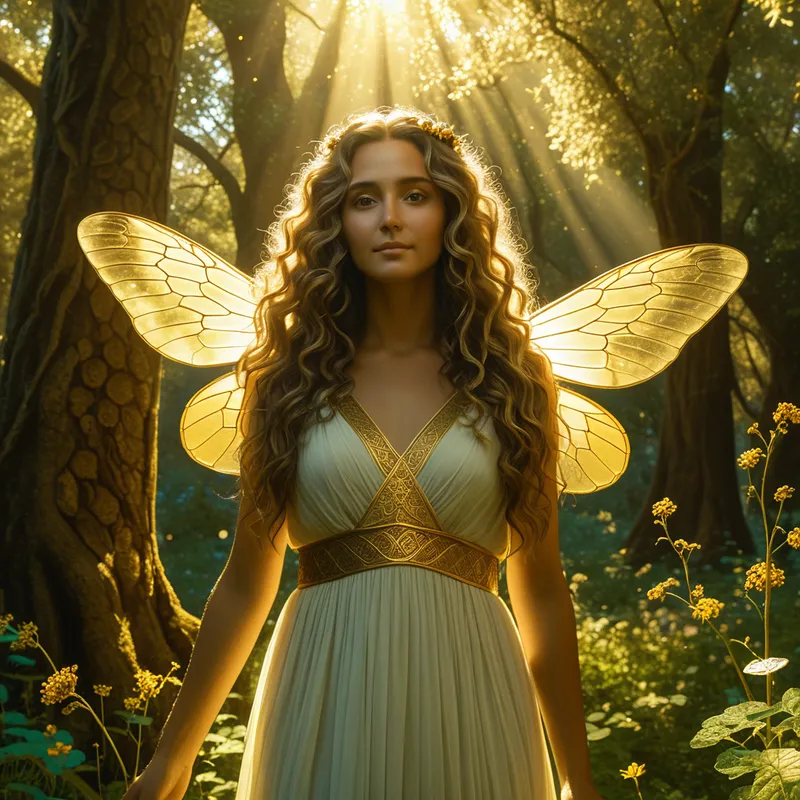
Melissa / The Bee-Nymphs Myth Meaning & Symbolism
A myth of nymphs who discovered honey and became the sacred bees, embodying the soul's secret wisdom and the ecstatic, stinging pain of transformation.
The Tale of Melissa / The Bee-Nymphs
Listen, and let the drone of the ancient world fill your ears. In the time when gods walked the hills in the guise of shepherds and every spring was a nymph’s sigh, there existed a sisterhood not of the deep sea nor the high mountain, but of the sun-warmed [thyme](/myths/thyme “Myth from Greek culture.”/) and the whispering oak. They were the [nymphs](/myths/nymphs “Myth from Greek culture.”/) of the wildflowers, daughters of [the earth](/myths/the-earth “Myth from Hindu culture.”/)’s green breath. Among them were those with a particular grace, a stillness that drew not just butterflies, but a more profound, humming vibration from [the world](/myths/the-world “Myth from Tarot culture.”/) itself.
Their story begins not with a roar, but with a questing hum. It is said that the great goddess Hera, in her majesty, desired a substance of pure essence, a sweetness untouched by mortal hand, to feed her divine son [Hephaestus](/myths/hephaestus “Myth from Global/Universal culture.”/). The world then knew only the crude sap of trees or the pulp of fruit. True honey, the condensed gold of sunlight and flower-song, was a secret locked within the heart of the wild.
The chosen nymphs were sent into the deepest, most silent parts of the forest, places where the air itself tasted of resin and damp stone. They searched until their feet were stained with earth and their hair tangled with vine. The breakthrough came not from force, but from profound listening. One nymph, her ear pressed to the hollow of an ancient oak, heard it: a low, resonant thrum, a collective heartbeat from within the tree’s dark belly. With careful hands, she peeled back the bark.
There it was. A [labyrinth](/myths/labyrinth “Myth from Various culture.”/) of perfect hexagons, gleaming with a viscous, living gold. The scent that rose was not merely sweet; it was the perfume of a thousand meadows distilled into one divine breath. This was meli—honey. The nymphs, in their awe and duty, gathered this sacred treasure. But the discovery was not without its price. The guardians of the gold arrived—a living cloud of buzzing fury. The bees, creatures of Artemis and of the sun, descended. Their stings were not mere pain; they were injections of ecstatic fire, a burning initiation.
And here, the miracle occurred. The nymphs did not flee or perish. They transmuted. Stung by the divine fury of [the hive](/myths/the-hive “Myth from Various culture.”/), touched by the essence of the honey they carried, they began to change. Their skin took on a golden hue, their whispers became a collective hum, their very souls aligned with the rhythm of the colony. They became the first [Melissae](/myths/melissae “Myth from Greek culture.”/)—the Bees. No longer merely nymphs who tended bees, they were the bee-nymphs, the living bridge between the wild soul of nature and the structured, productive mystery of [the hive](/myths/the-hive “Myth from Various culture.”/). They became the sacred attendants of the Great Mother, of Demeter and of [Persephone](/myths/persephone “Myth from Greek culture.”/) in her dark realms, their humming a chthonic hymn. They fed the gods with ambrosia and whispered the secrets of the earth to those who dared listen in the right, silent way.

Cultural Origins & Context
The myth of the Melissae is woven from the oldest threads of Minoan and Mycenaean culture, where the bee was a potent symbol of priestly power and regality. This was not a tale for the grand amphitheaters, but for the inner sanctums—the telesterion of Eleusis and the caves of the [Pythia](/myths/pythia “Myth from Greek culture.”/). The Melissae were primarily figures of mystery cults, particularly those of Demeter, Artemis, and Dionysus.
Priestesses in these rites were often called Melissae, embodying the myth through their roles. They were the keepers of hidden knowledge (mystai), and like bees, they were believed to travel between worlds—gathering the “pollen” of divine insight from the upper world and “fermenting” it into the intoxicating “honey” of wisdom in the dark hive of the initiation chamber. The myth functioned as an etiological story for the sacredness of priestesses and explained the dual nature of their power: the nourishing sweetness of revelation and the painful, necessary sting of the transformative ordeal required to receive it.
Symbolic Architecture
At its core, the myth of [Melissa](/myths/melissa “Myth from Greek culture.”/) is an [allegory](/symbols/allegory “Symbol: A narrative device where characters, events, or settings represent abstract ideas or moral qualities, conveying deeper meanings through symbolic storytelling.”/) for the [soul](/symbols/soul “Symbol: The soul represents the essence of a person, encompassing their spirit, identity, and connection to the universe.”/)‘s encounter with numinous, organizing intelligence. The bee is [nature](/symbols/nature “Symbol: Nature symbolizes growth, connectivity, and the primal forces of existence.”/)‘s ultimate alchemist, transforming the ephemeral (flower pollen) into the eternal ([honey](/symbols/honey “Symbol: A sweet, viscous substance produced by bees, symbolizing natural sweetness, reward, and nourishment.”/), wax). The [nymph](/symbols/nymph “Symbol: Nymphs are nature spirits embodying specific aspects of the natural world, often associated with beauty and allure.”/)’s transformation mirrors this process psychologically.
The [Hive](/symbols/hive “Symbol: A symbol of collective society, organized productivity, and communal interdependence, often representing both harmonious cooperation and potential loss of individuality.”/) represents the complex, structured totality of the [psyche](/myths/psyche “Myth from Greek culture.”/)—the Self. It is a perfect, geometric society where every [cell](/symbols/cell “Symbol: The symbol of a ‘cell’ represents confinement, structure, and the essence of individuality within a larger system, often reflecting themes of restriction or protection in the dreamer’s life.”/) has a [purpose](/symbols/purpose “Symbol: Purpose signifies direction, meaning, and intention in life, often reflecting personal ambitions and core values.”/). The Honey is the distilled essence of lived experience, the golden wisdom, the libido or psychic [energy](/symbols/energy “Symbol: Energy symbolizes vitality, motivation, and the drive that fuels actions and ambitions.”/) transformed into something nourishing and eternal. The Sting is the inevitable pain of [initiation](/symbols/initiation “Symbol: A symbolic beginning or transition into a new phase, status, or awareness, often involving tests, rituals, or profound personal change.”/) into deeper self-[knowledge](/symbols/knowledge “Symbol: Knowledge symbolizes learning, understanding, and wisdom, embodying the acquisition of information and enlightenment.”/). You cannot access the honey without risking the sting of the guardians—your own defenses, fears, and the shocking touch of the unconscious.
The bee does not question the geometry of the hive; it builds it from an innate, divine blueprint. So too, the soul knows its own hidden architecture, revealed only through the sweet and stinging labor of becoming.
The nymph’s passive existence in nature (a state of potential) is disrupted by the call (Hera’s demand). Her [journey](/symbols/journey “Symbol: A journey in dreams typically signifies adventure, growth, or a significant life transition.”/) into [the cave](/myths/the-cave “Myth from Platonic culture.”/) or hollow [tree](/symbols/tree “Symbol: In dreams, the tree often symbolizes growth, stability, and the interconnectedness of life.”/) is a descent into the unconscious. The [discovery](/symbols/discovery “Symbol: The act of finding something previously unknown, hidden, or lost, often representing personal growth, new opportunities, or hidden aspects of the self.”/) of the [honeycomb](/symbols/honeycomb “Symbol: Honeycomb symbolizes productivity, community, and the sweetness of life.”/) is the finding of [the Self](/myths/the-self “Myth from Jungian culture.”/)’s latent [structure](/symbols/structure “Symbol: Structure in dreams often symbolizes stability, organization, and the framework of one’s life, reflecting how one perceives their environment and personal life.”/). The subsequent stinging and transformation signify [the ego](/myths/the-ego “Myth from Jungian culture.”/)’s surrender to a larger, more complex [pattern](/symbols/pattern “Symbol: A ‘Pattern’ in dreams often signifies the underlying structure of experiences and thoughts, representing both order and the repetitiveness of life’s situations.”/) of being. She becomes a function of a greater whole—an individuated part of the hive-Self.

The Dreamer’s Resonance
When this myth stirs in the modern unconscious, it manifests in dreams of intricate structures, humming vibrations, and potent, golden substances. To dream of bees in a calm, productive hive suggests the dreamer is in a phase of psychic integration, where disparate experiences are being woven into a coherent wisdom. A dream of being stung, especially repeatedly or in a sacred context, points to an active, painful initiation—a breakup, a career change, a spiritual crisis—that feels assaultive but is fundamentally transformative.
Dreams of discovering a hidden hive or [honeycomb](/myths/honeycomb “Myth from Natural culture.”/) in a wall, attic, or within one’s own body are profound. They signal the emergence of the Self’s innate structure into consciousness. The somatic resonance is key: a literal buzzing in the ears (tinnitus as mythic hum), a feeling of warmth or golden light in the chest (the heart as honeycomb), or a sharp, localized pain that brings clarity (the sting as acupuncture of the soul). The dreamer is being invited to recognize themselves not as a solitary individual, but as a cell in a vast, intelligent, and sweet-producing organism—their own complete psyche.
Alchemical Translation
The alchemical process mirrored here is coagulatio—the making solid, the embodiment. The nymph’s journey is the soul’s work of taking the volatile, airy [spiritus](/myths/spiritus “Myth from Alchemical culture.”/) (the pollen of fleeting impressions, ideas, and emotions) and through the opus (the labor), condensing it into the fixed, tangible corpus (the honey and wax of character, wisdom, and lasting creation).
For the modern individual, the myth models the path from diffuse potential to organized purpose. We all begin as “nymphs”—possessing innate qualities but unformed by a central, demanding call. The “call of Hera” is any deep, non-negotiable demand from life or the Self: have a child, write the book, start the venture, face the trauma. It forces us into the “dark wood” of research, therapy, or sheer struggle.
The alchemy occurs in the hollow tree, the vessel of transformation. There, we must listen not for answers, but for the hum of the system already at work within us.
Discovering our “honeycomb” is recognizing our innate pattern—our true talents, our core values, the unique geometry of our soul. The “stings” are the sacrifices, the criticisms, the failures, and the ego-deaths required to fully inhabit that pattern. The final transformation into “Melissa” is not about becoming someone else, but becoming fully what you are: a conscious, productive part of your own inner hive. You become both the worker gathering experience and the priestess offering the distilled honey of that experience back to the divine within. The sweetness of a life lived with meaning is always guarded by the sting of the trials that made it possible. The myth of Melissa assures us that this pain is not punishment, but the precise mechanism of sacred becoming.
Associated Symbols
Explore related symbols from the CaleaDream lexicon: