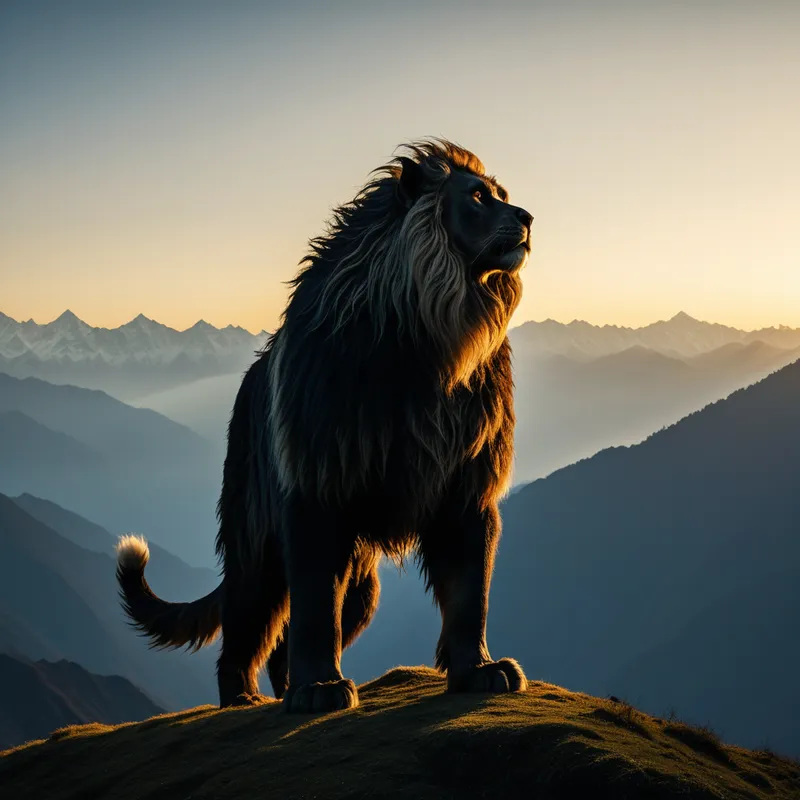
Meh-Teh Myth Meaning & Symbolism
A myth of a primal being, cast from heaven, who becomes the wild guardian of the mountains and the shadow of the human soul.
The Tale of Meh-Teh
Listen. Before the world was fully awake, when the sky was a bowl of polished lapis and the mountains were the bones of the earth still pushing through the skin of the world, there was a being in the high halls. He was not a god, but a child of the high air, a spirit of the untamed peaks. His name was Meh-Teh. His form was mighty, a bridge between worlds: the strength of the rock and the cunning of the snow leopard, wrapped in a coat of thick, sun-warmed fur. He walked with the cloud-herds and sang with the wind that scours the passes.
But in the high halls, order was the supreme law. Every star had its path, every spirit its duty. Meh-Teh’s heart was too wild. His songs were storms; his footsteps started avalanches. He questioned the silent, immutable laws of the celestial court. He longed not for the static perfection of the heavens, but for the raw, changing heart of the world below—the smell of pine after rain, the taste of first snow, the struggle of life in the thin air.
A great council was called. The voices of the high ones were like ice cracking. “You are disorder,” they intoned. “You are a song out of tune with the eternal hymn. You cannot stay.” There was no battle, no fury. Only a profound, chilling silence. Then, a casting out. Not downwards in a fall of fire, but sideways, through the veil that separates the timeless from the time-bound. He was exiled not to hell, but to the very roof of the world he longed for.
He landed not with a crash, but with a sigh that became the first mist in a new valley. The impact was in his soul. The celestial light faded from his eyes, replaced by the stark, beautiful, and brutal light of the sun on snow. He was alone. The language of the wind was different here—harsher, carrying the cries of eagles and the groans of glaciers. He was a giant in a world of immense, indifferent scale. For ages, he wandered the lapchas, a ghost in his own life. He was a monster to the few hardy creatures, a myth to the nothingness.
But a slow alchemy began. The very indifference of the mountains became a kind of communion. He learned the paths of the bharal. He drank from meltwater pools that mirrored only the sky and his own, lonely face. He shed not his form, but his grief. He stopped being an exile from above, and began becoming the guardian of the here. His mighty strength was no longer for celestial songs, but for moving rocks to shelter newborn goats from blizzards. His terrifying roar became a signal that turned avalanches away from hidden valleys where life clung on.
He never spoke again, not in any tongue we know. But the herders who came later, pressing their flocks to the high pastures, would sometimes find strange, deep footprints in the mud at the edge of the snow. They would find a lost child, asleep and warm in a cave where no wind howled. They felt a presence, vast and watchful, that was not a threat, but a part of the mountain’s breath. And so they named what they could not see: Yeti. But in their oldest stories, whispered around fires that fought the immense dark, they remembered his true name, and knew he was not a monster. He was the one who chose the wilderness, and in doing so, became its soul.
Cultural Origins & Context
The myth of Meh-Teh is not a single, codified scripture, but a living breath in the oral traditions of various Himalayan peoples, including the Sherpa, Lepcha, and Bhutia communities. It exists in the space between folklore and sacred geography. It was never told in temples, but around hearths, in yak-hair tents pitched against the screaming wind, and in the long, rhythmic pauses of a high-altitude trek. The storytellers were often the elders, the lamas who understood the land as a mandala, and the hunters who had seen things in the mist that they dared not speak of plainly.
Its societal function was multifaceted. On a practical level, it served as an ecological parable, instilling a deep, respectful fear of the high, uninhabited reaches. The Meh-Teh was a reason not to wander too far, not to exploit sacred spaces, to understand that humanity is a guest in a realm governed by older, more powerful presences. On a spiritual level, it explained the presence of the sacred in the terrifying. The mountains were not just physical barriers; they were the abode of spirits, gods, and beings like Meh-Teh. The myth thus sacralized the entire landscape, making every cliff and glacier part of a cosmological order where even an outcast had a sacred role. It was a story that taught belonging through the very narrative of exile, binding the community together in a shared understanding of the powerful, animate world they inhabited.
Symbolic Architecture
At its core, the Meh-Teh is the archetype of the Shadow made flesh and exiled to the wilderness. He represents all that is deemed too primal, too emotional, too untamed, and too questioning to be allowed in the "high halls" of our conscious, ordered selves—our personas, our societal roles, our need for control and perfection.
The wildness that is cast out does not die; it becomes the landscape of the soul.
His physical form is a perfect symbol of this liminal state: neither fully animal nor fully divine, a bridge that was shattered, leaving him stranded in the in-between. The Himalayas themselves, in this myth, are not just a setting but the manifested form of this psychic exile—the breathtaking, beautiful, and deadly realm of the repressed. Meh-Teh’s transformation from a grieving outcast to a silent guardian is the key. He does not conquer his new realm; he integrates with it. His power, once a disruptive force in the ordered heavens, becomes a protective, nurturing force in the chaotic, living earth. This symbolizes the profound Jungian truth that the integrated shadow does not vanish; its energy is transmuted from a source of fear and projection into a source of strength, resilience, and instinctual wisdom.

The Dreamer's Resonance
When the pattern of Meh-Teh stirs in the modern dreamer, it often manifests not as a literal hairy giant, but as a profound sense of being an outsider, a misfit in one's own life. The dreams may feature being cast out of a gleaming, cold city or a sterile room into a vast, overwhelming natural landscape. One might dream of discovering huge, unfamiliar footprints leading into a mist-shrouded forest, or of hearing a deep, resonant sound that is neither animal nor human—a call from a part of the self that has been silenced.
Somatically, this process can feel like a heavy loneliness, a "weight of the mountains" on the chest, or conversely, a strange exhilaration in vast, empty spaces. Psychologically, it is the ego's confrontation with its own exiled contents—the raw grief, the untamed anger, the primal creativity, or the spiritual yearning that was deemed "too much" for the family system, the workplace, or the social self. The dreamer is undergoing the first, terrifying stage of shadow-work: the realization that a vital part of them has been living in a self-imposed wilderness, and that the journey to reclaim it is a solo trek into high, unknown territory.
Alchemical Translation
The individuation journey modeled by Meh-Teh is not one of heroic conquest, but of humble integration through exile. The modern seeker often begins in their own "high hall"—a state of identified perfectionism, rigid ideology, or adapted personality that feels orderly but lifeless. The call comes as a disruptive urge, a "wild song" that questions everything. The ensuing crisis—loss of job, relationship, faith, or identity—is the casting out. It feels like a brutal fall from grace into a psychological wilderness of depression, confusion, and alienation.
The mountain does not care for your former glory; it demands only your present, authentic footprint.
This wilderness, however, is the lapcha of the soul, the necessary barren ground. Here, one must wander, bereft of old labels, and learn the new language of this inner landscape. This is the slow, painful, alchemical work: to stop mourning the lost "heaven" of approval and order, and to begin tending to the life that exists here and now in the raw self. The strength that once served ambition becomes resilience. The voice that once sought to be heard in the chorus learns to sing a solo hymn to the wind. One becomes the guardian of one's own fragile, wild spirit.
The triumph is not in returning to the old hall or becoming master of the mountain. It is in achieving what Meh-Teh achieved: a state of belonging to the wilderness itself. The integrated individual no longer fights their own depth or strangeness. They become a bodhisattva to their own soul, a protective presence for their own vulnerability. They understand that their true home was never the sterile heights of perfection, but the whole, rugged, and breathtaking range of their being, shadow and light alike. They become, at last, human—not by shedding their inner Yeti, but by giving it a sacred place to dwell.
Associated Symbols
Explore related symbols from the CaleaDream lexicon: