Mead of Poetry Myth Meaning & Symbolism
A myth of a magical mead brewed from the blood of a murdered god of wisdom, stolen by Odin to grant divine inspiration and poetic skill to mortals.
The Tale of the Mead of Poetry
Listen, and I will tell you of the theft that gave breath to song and edge to saga. It begins not with a god, but with a truce, sealed in a vessel of spit.
After the great war between the Æsir and the Vanir, the deities gathered to ratify their peace. Each god stepped forward to a great vat and spat into it, mingling their essence. From this mingled spittle, they fashioned a being of such profound wisdom they named him Kvasir. No question existed that he could not answer. He wandered the worlds, a living font of knowledge, teaching all who sought him.
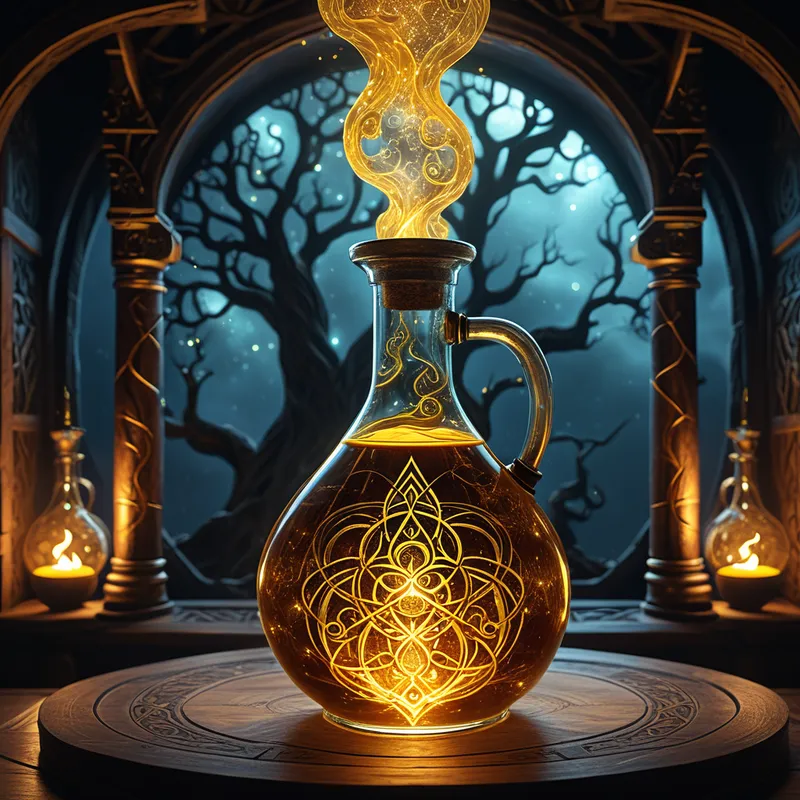
His light drew shadows. Two dwarven brothers, Fjalar and Gjalar, hearts shriveled with envy, invited Kvasir into their stone halls. There, in the deep dark, they slew him. They did not bury him, but brewed him. They drained his blood into three wondrous vessels—the cauldron Óðrerir, and the vats Són and Boðn. They mixed the blood with honey, and a mead was born. A single sip would turn any tongue into that of a skald, any mind into a wellspring of poetry and wisdom. This was the Mead of Poetry.
The dwarves’ treachery spiraled. They drowned a giant, Gilling, and his wife’s wails so plagued them they crushed her with a millstone. But vengeance has a son. Suttungr, the giant’s son, seized the brothers, marooned them on a reef at low tide. For their lives, they ransomed the precious mead. Suttungr bore it home to the mountain Hnitbjörg and set his daughter, Gunnlöð, to guard it within a chamber of living rock.
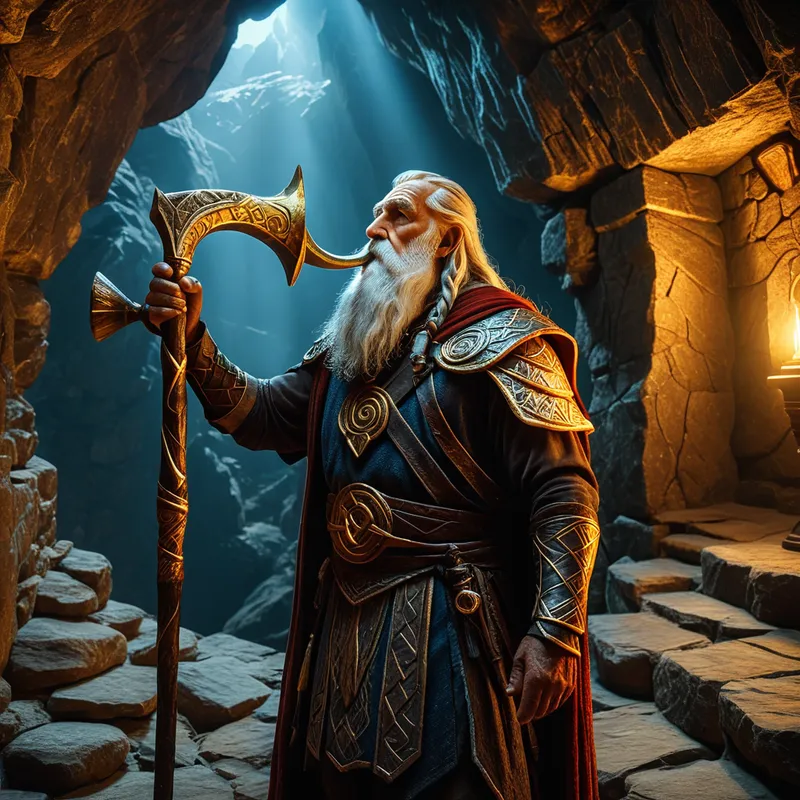
Word of this treasure, this stolen wisdom distilled, reached the ears of the All-Father, Odin. A hunger awoke in him, a thirst no well of Mímisbrunnr could quench. He desired this mead not for himself alone, but to seed it into the world of men. So he set out, not as a god, but as a traveler named Bolverkr—the Worker of Evil.
He came to a field where nine thralls scythed hay, their blades dull. “Your whetstone is poor,” Odin said, and drew from his cloak a perfect stone. He sharpened each blade until they sang. The thralls, desperate, begged to buy it. Odin tossed it high into the air. In their frenzy to catch it, they turned their scythes on each other, and all nine lay dead. Their master, Suttungr’s brother Baugi, was left without laborers. Odin offered to do the work of nine men for a single price: a sip of Suttungr’s mead. Baugi agreed, knowing his brother would never consent.
Odin worked the summer, a titan in the field. When winter came, he demanded his wage. Baugi, bound by oath, went with him to Hnitbjörg. He drilled into the mountain with an auger, claiming the rock was pierced. Odin blew into the hole. Stone dust blew back into his face. He knew deceit. “Try again, brother,” he said, his one eye glinting. Baugi drilled until the bit broke through. This time, Odin’s breath passed through cleanly.
In that instant, the god shifted form. He became a serpent, sleek and dark, and slithered into the borehole. Baugi, in rage and fear, stabbed after him with the auger, but struck only stone.
Odin emerged into the inner chamber, a serpent becoming a man once more. There sat Gunnlöð, guardian of the three vessels. For three nights, he stayed with her. For three nights, he spoke, and she, lonely in her stone prison, listened. He offered not force, but a kind of companionship. In return, she allowed him three draughts of the mead.
With the first draught, he drained the vat Són. With the second, the vat Boðn was emptied. With the third and last, he consumed all that was in the great cauldron Óðrerir. The entire Mead of Poetry was now within him.
He transformed again, this time into a great eagle. The mead was a fire in his belly, a storm in his wings. He burst from the mountain. But Suttungr saw and gave chase, himself taking eagle-form. A great race began across the skies, the giant close behind.
As Odin flew over the walls of Asgard, the Æsir saw his peril. They rushed out vessels to catch the mead. Odin, strained to his limit, regurgitated the precious liquid into the jars they held. In his frantic haste, some drops fell backwards, out into the world. This portion became the share of bad poets and clumsy versifiers.
But the mead caught in the gods’ vessels was saved. This, Odin gave to the gods, and they, in turn, gave it to those humans they favored—the skalds, the poets, the speakers of truth. And that is why poetry is called the Óðrœrir, and why it carries within it both the wisdom of a murdered god and the cunning of a thief.
Cultural Origins & Context
This myth is preserved primarily in the Prose Edda of Snorri Sturluson, written in the 13th century but drawing from far older oral traditions. It was not a sacred text for worship, but a skaldic textbook of sorts. Snorri, a Christian scholar and poet, sought to preserve the mechanics of the old Norse poetic diction—the kennings—whose very logic is rooted in myths like this one. To call poetry “Kvasir’s blood” or “Odin’s theft” was to speak in a coded, elevated language that connected the poet to a divine lineage.
The societal function was multifaceted. For the elite skalds who performed for kings, it legitimized their art as a divine gift, not mere entertainment. It explained the source of inspiration (óðr) as something external, seized from the realm of giants (chaos, the unconscious, the other). It also served as a cautionary tale about the price of wisdom (sacrifice, deception, peril) and the dual nature of creativity—it can be a gift of the gods, but its raw source is often a bloody, treacherous process.
Symbolic Architecture
The myth is a profound map of the psyche’s relationship with inspired knowledge. Kvasir represents pure, undifferentiated wisdom born from reconciliation (the Æsir-Vanir truce). His murder by the dwarves symbolizes how raw, living insight must be “killed”—broken down, processed, and distilled—to become a usable, potent form (the mead). The dwarves, master craftsmen of the underworld, are the unconscious forces that perform this necessary, if violent, alchemy.
The mead is not merely inspiration; it is inspiration fermented through trauma, loss, and cunning.
Gunnlöð guarding the mead in a mountain represents the latent creative power locked away in the isolated, often neglected chambers of the self. Bolverkr, Odin’s disguise, acknowledges that retrieving this power often requires morally ambiguous labor, trickery, and a willingness to engage with one’s own shadow. The eagle flight is the terrifying, exhilarating moment of bringing that raw creative charge into conscious awareness, with the risk of losing it all to the pursuing giants of resistance, fear, or inflation.
The Dreamer's Resonance
When this myth stirs in modern dreams, it often signals a profound engagement with the process of claiming one’s authentic voice. Dreaming of a hidden, precious fluid (honey, wine, golden oil) in a cavern or vault points to the discovery of untapped creative or emotional reserves. The figure of a lonely guardian (often an anima/animus figure like Gunnlöð) suggests a part of the psyche that holds the key to these reserves but requires relationship, not force.
Dreams of frantic transformation—into a serpent to enter a narrow passage, or an eagle in a desperate flight—mirror the somatic reality of psychological transmutation. It is a claustrophobic, then expansive, experience. The dreamer may feel the “pursuit” of old identities or responsibilities (the Suttungr figure) threatening to reclaim the newly seized energy. To dream of spilling or carefully pouring such a liquid reflects the anxiety and responsibility of giving form to this inner inspiration.

Alchemical Translation
The journey for the Mead of Poetry is a perfect allegory for Jungian individuation—the process of psychic integration and self-realization. The initial state is the spittle of the gods: a potential for wholeness (the Self) born from reconciling opposites (conscious and unconscious, Æsir and Vanir). The murder of Kvasir is the necessary nigredo, the darkening, where this potential is sacrificed to the depths (the dwarven unconscious) to be broken down.
The long labor as Bolverkr is the arduous, often thankless work of the ego engaging with the shadow—doing the “dirty work” of consciousness. Drilling into the mountain is active imagination, the disciplined effort to penetrate the defenses of the psyche.
The prize is not seized by conquest, but received through a kind of sacred intimacy with the guarded contents of the soul.
The three nights with Gunnlöð symbolize a sacred union, a hieros gamos between the seeking consciousness (Odin) and the soul-guardian (the anima). The three draughts represent the complete assimilation of this transformed substance. Finally, the eagle flight and regurgitation is the rubedo, the reddening, where the integrated substance is brought back to the “city of the gods” (the mature conscious personality) and offered to the world. The spilled drops acknowledge that not all of this process yields gold; some parts remain unintegrated or poorly expressed. But the portion saved becomes the true, authentic voice—the poetry of one’s own lived truth, fermented in darkness, won through cunning, and delivered in flight.
Associated Symbols
Explore related symbols from the CaleaDream lexicon: