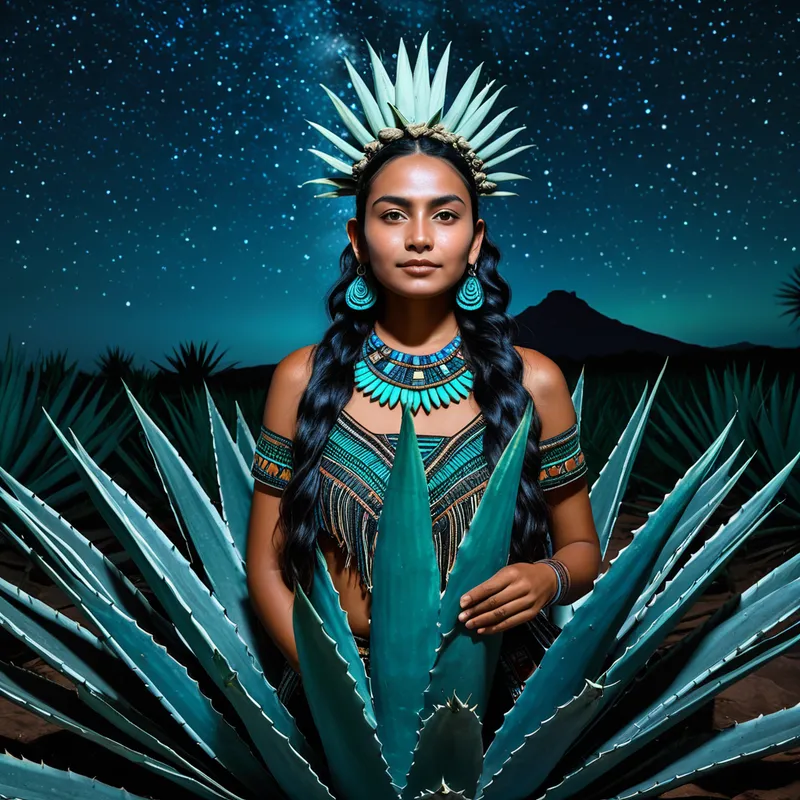
Mayahuel Goddess of Maguey Myth Meaning & Symbolism
A celestial goddess becomes the maguey plant, her body sacrificed to gift humanity with sacred nourishment, intoxication, and the fluid wisdom of the earth.
The Tale of Mayahuel Goddess of Maguey
In the time before time, when the sky was a dark cloak sewn with cold, watchful stars, there lived a young goddess named Mayahuel. She was kept in the celestial vault, a jewel among the Tzitzimitl, her grandmothers, fierce star-demons who hungered for the light of the world. Mayahuel was their treasure, sequestered from the green breath of the earth below. She knew only the chill of the void and the glittering, jealous eyes of her kin.
But the wind, which knows no barriers, whispered of her beauty. The wind, in the form of the great plumed serpent Ehecatl-Quetzalcoatl, heard these whispers and ascended. He beheld Mayahuel, a vision of potential life trapped in sterile heaven, and his heart—the heart of a creator—stirred with a plan both daring and tender. He spoke to her of the world below: of the smell of damp soil, the touch of rain, the chorus of life that grew, died, and was reborn. In her, a longing awoke, a root seeking earth.
Together, they fled. A streak of wind and starlight, they plummeted from the sky-vault. As they fell, they intertwined, becoming one form, a single being of escape and desire. They landed softly upon the living skin of Tlaltecuhtli, and immediately, to hide from the pursuing fury of the star-demons, they transformed. They became a great, forked tree, its branches reaching with hope toward the very sky they had abandoned.
The Tzitzimitl descended in a rage, scouring the land. The grandmother-star, Mayahuel’s guardian, possessed of a terrible sight, saw through the disguise. She recognized the branch that was her granddaughter. With a shriek that cracked the air, she tore that branch asunder. The other demons fell upon the remaining wood, splintering it, scattering it to the four winds, believing they had destroyed the wind-god too.
Silence returned. The demons, sated with their vengeance, retreated to the cold sky. But from the ravaged earth where Mayahuel’s branch had fallen, something began. A slow, green pushing. A tender, thorny leaf unfurled. Then another, and another. A magnificent maguey plant grew with impossible speed, its heart a well of sweet, milky sap. This was Mayahuel’s new body, her scattered essence gathered and transformed by the earth that received her.
And Ehecatl-Quetzalcoatl, who had become the other branch, reconstituted himself from the scattered pieces. Grief-stricken, he found her new form. He wept, and his tears fell upon the maguey. Then, with profound understanding, he taught the people of the land the sacred secret. He showed them how to tap the plant’s heart, to collect the aguamiel (honey-water), and to ferment it into pulque, the drink of gods, a nectar of joy, poetry, and communion. Mayahuel, through her sacrifice, had become the mother of nourishment, of sacred intoxication, and of the community that gathers to share her gift. Her body was no longer in the sky; it was the earth itself, offering its vital, transformative blood.

Cultural Origins & Context
This myth was not mere entertainment; it was a sacred narrative central to the Mexica worldview, passed down through generations by priestly custodians and elders. It functioned as an etiological myth, explaining the divine origin of the maguey plant, a cornerstone of Mesoamerican life. The maguey provided fiber for rope and cloth, needles, fuel, and construction material. But its most sacred product was pulque, a fermented beverage reserved for rituals, elders, and specific festivals.
The story of Mayahuel was likely recited during ceremonies related to pulque, agriculture, and fertility. It framed the act of harvesting the maguey’s sap not as destruction, but as a participation in a divine drama of sacrifice and gift. The consumption of pulque was thus a ritual communion with the goddess, a means of accessing altered states of consciousness deemed necessary for connecting with the divine, for poetic inspiration, and for mediating the harsh realities of a cosmos in constant peril. The myth reinforced the idea that life’s essential nourishments—both physical and spiritual—are born from a primordial act of violence, love, and metamorphosis.
Symbolic Architecture
At its core, the myth of Mayahuel is a profound allegory of incarnation and the price of becoming. Mayahuel begins as a pure, potential archetype—the innocent, the beloved—trapped in a static, "perfect" celestial state (the Tzitzimitl representing order without life). Her descent with Ehecatl is the plunge of spirit into matter, of consciousness into the unconscious, of the potential into the actual.
The sacred intoxicant is born from the shattering of the perfect form; wisdom flows only after the heart of the ideal is pierced by the world.
Her transformation into a tree symbolizes the unio mystica, the sacred marriage of opposites (celestial feminine and earthly/wind masculine) that creates new life. Yet, this union is violently destroyed. This is the critical alchemical moment: the mortificatio or dismemberment. The self must be broken apart by the demands of reality (the grandmother’s wrath, societal constraints, trauma) for its true, more resilient essence to be revealed. She does not return to her old form; she becomes the maguey—rooted, nourishing, resilient. The goddess becomes a plant; spirit becomes substance. The pulque that flows from her is the distilled essence of this transformation—a fluid wisdom that dissolves boundaries, connecting the individual to the communal, the human to the divine, and the conscious mind to the depths of the unconscious.
The Dreamer's Resonance
When this myth stirs in the modern psyche, it often manifests in dreams of profound transformation preceded by rupture. One might dream of being a beautiful, fragile object in a sterile room (the celestial vault) that is suddenly broken or stolen. This can evoke somatic feelings of vulnerability and shock. Alternatively, dreams of becoming a plant—feeling roots grow from one’s limbs into the earth, or leaves sprouting from one’s skin—directly mirror Mayahuel’s metamorphosis. These are not nightmares of loss, but somatic visions of a deeper, more authentic embodiment trying to emerge.
The dreamer may also encounter the figure of the vengeful grandmother or a pursuing force that seems to destroy a cherished union or creative project. Psychologically, this represents the necessary "defeat" of the ego’s idealized self-image or a cherished fantasy. The dream is orchestrating the shattering so that a more grounded, fertile, and truly generative identity can take root in the rich soil of the actual self. The grief felt in the dream is Ehecatl’s grief, the part of us that mourns the lost ideal, even as we are being remade into something capable of giving real nourishment.
Alchemical Translation
For the individual on the path of individuation, Mayahuel’s journey is a map for psychic transmutation. The process begins with the recognition of a talent, a potential, or a soul-quality that is kept "in the sky"—idealized, intellectualized, or protected from the messy engagement with life. This is the "inner Mayahuel," our latent creativity or unique essence.
Individuation demands the descent. The spirit must consent to be broken upon the earth of experience to find its true, rooted form.
The wind (Ehecatl-Quetzalcoatl) is the animating spirit, the call to adventure, the creative impulse that says, "You must embody this." The union and subsequent flight represent the courageous, often romantic, commitment to bringing this potential into the world. Then comes the inevitable confrontation with the "Tzitzimitl"—the internalized critics, familial expectations, societal pressures, or sheer life events that shatter the initial, fragile form of our endeavor.
The alchemical work is in the aftermath. It is the patient, often grief-filled tending of the "scattered pieces." One does not try to reassemble the broken tree. Instead, one must discover what new life is sprouting from the place of wounding. What "maguey" is growing in you? What resilient, nourishing capability has been born from your failures, losses, or sacrifices? The final stage is learning to tap this new "plant"—to draw out its aguamiel, your unique offering—and ferment it into "pulque," the intoxicating wisdom you can share with your community. Your deepest gift to the world is not your perfect, untouchable potential, but the sacred, fermented nectar distilled from your lived, broken, and resurrected experience.
Associated Symbols
Explore related symbols from the CaleaDream lexicon:
- Goddess — The divine feminine principle, here specifically manifesting as the source of vegetative life, nourishment, and sacred intoxication, transitioning from a celestial to an earthly form.
- Tree — Represents the initial, unified form of the lovers, a symbol of life, connection between heaven and earth, and the potential that is sacrificed to create something new.
- Sacrifice — The core dynamic of the myth; the violent dismemberment of Mayahuel is not a meaningless death but the necessary precondition for her transformation into a life-giving plant.
- Transformation — The entire narrative arc, depicting a radical change in state from celestial goddess to plant deity, modeling the psyche's capacity for fundamental metamorphosis.
- Blood — Symbolically represented by the sap of the maguey and the pulque; the vital, life-giving fluid that is the direct result of the sacrificial act, connecting the divine to the human.
- Earth — The receptive, transformative matrix that receives Mayahuel's scattered essence and allows her new, rooted form to emerge; the realm of embodied existence.
- Spirit — Embodied by Ehecatl-Quetzalcoatl as the wind; the animating, creative, and mobile force that instigates the journey from potential to actualized, embodied form.
- Dream — The state of potential and longing Mayahuel experiences in the sky, and the altered state of consciousness induced by her gift, pulque, serving as a bridge to the divine.
- Rebirth — The definitive outcome of the myth; Mayahuel is not resuscitated but entirely reborn as a new type of entity, the maguey plant, with a new function and relationship to humanity.
- Heart — The central organ of the maguey plant that is tapped for its sap; symbolizing the core essence, vulnerability, and generative center that must be pierced to release its gift.
- Ritual — The human action of harvesting maguey and fermenting pulque, which is framed by this myth as a sacred re-enactment of and participation in the divine drama.