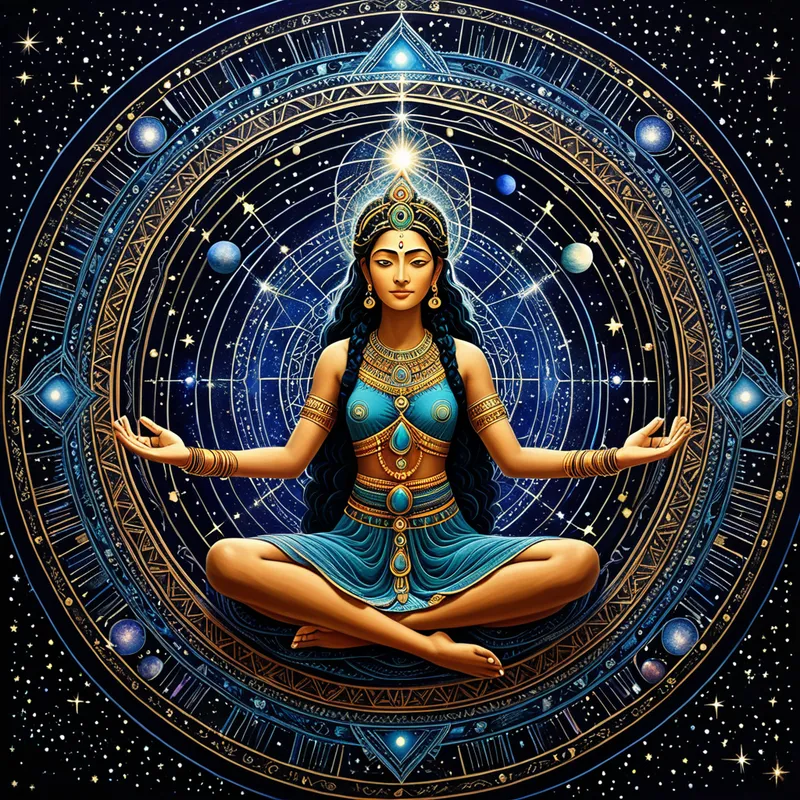
Maya Myth Meaning & Symbolism
The cosmic dance of illusion, where reality is a divine dream woven by the gods, challenging perception and revealing the ultimate truth behind the veil.
The Tale of Maya
In the time before time, when the universe was a single breath held in the silence of Brahman, a stirring began. It was not a sound, but a potential for sound; not a form, but a longing for form. From this stillness arose the great dreamer, Brahma. He opened his eyes upon the void and saw—nothing. Yet within that nothing, he sensed a rhythm, a pulse of creative desire. It was the whisper of Maya.
She did not appear as a goddess might, in splendor and light. She was the shimmer on the edge of vision, the echo in the hollow of the ear. She spoke without voice: "O Creator, you gaze upon the canvas of the absolute. Shall it remain blank?" And from her essence, she offered him the threads—threads of Sattva, bright as moonlight; threads of Rajas, fiery as the sun’s core; threads of Tamas, deep as the abyss.
Brahma, the architect of worlds, took the threads. With the shuttle of his mind, he began to weave. Where a thread of Sattva crossed one of Rajas, a star was born, singing a pure, high note. Where Tamas entangled itself, dark matter pooled, forming the silent, waiting spaces. He wove mountains that scraped the heavens and oceans that cradled the deep. He wove the dance of the seasons, the rush of rivers, the slow growth of forests. He wove the forms of creatures, from the lumbering elephant to the fleeting mayfly. And to each, Maya breathed the great enchantment: the belief that this woven reality was solid, separate, and utterly real.
The masterpiece of his weaving was humanity. Into them, he wove the most complex pattern: the sense of "I." The thread of selfhood was the most potent of all. A man looked upon his reflection in a woven river and thought, "That is me, alone." A woman held a woven child and felt a love so sharp it seemed the only truth. They built cities from the illusion, fought wars for its territories, loved and grieved within its confines. They were born into the tapestry, lived upon it, and died, their threads unraveling only to be gathered and woven anew.
Yet, in every age, a strange ripple would pass through the cloth. A seeker, a sage, would pause. They would feel a tug, not from the world around them, but from the warp and weft beneath their feet. They would look at a mountain and see, for a fleeting second, not rock, but a knot of dark thread; they would hear the song of a bird and perceive the hum of a luminous strand. These were the ones who began to suspect the weaver. They turned their gaze not outward upon the tapestry, but inward, following the thread of the "I" back, back, back toward the source of the loom.
And there, in the deepest meditation, the greatest of them—like the ancient Rishis—would witness it. The magnificent, terrible, beautiful truth. The mountain, the child, the sorrow, the joy—all were perfect, divine, and utterly insubstantial. The tapestry was real as an expression, but not real as a separate thing. The seeker would see their own body, their own mind, as just another exquisite pattern in the grand design. With that sight, the enchantment broke. The world did not vanish, but it became transparent. They saw the weaver, Brahma, diligently at work. And behind the weaver, they felt the serene, silent presence of Maya, the power that makes the impossible seem possible, and the presence of the boundless Brahman, in whom the weaver, the weaving, and the woven are one.
The loom never stops. The weaving continues, age after age. The choice for every soul woven into the pattern is the same: to be lost in the picture, or to discover the picture-maker.

Cultural Origins & Context
The concept of Maya is not a single myth from one text, but a foundational philosophical thread woven through the entire tapestry of Hindu thought. Its earliest seeds are found in the mystical speculations of the Upanishads (c. 800–200 BCE), which ponder the nature of reality and the Self. Here, Maya begins as a term for the "measuring out" or the creative power of the divine, the force that projects the manifold universe from the singular Brahman.
The idea was systematized and elevated to central doctrine by the philosopher Adi Shankara in his school of Advaita Vedanta. For Shankara, Maya is the inexplicable principle that explains the world. It is not a literal goddess in a story, but the very mechanism of existence. It was passed down not merely as a tale for entertainment, but as the core subject of guru-disciple teachings, meditative inquiry, and philosophical debate. Its societal function was profound: to provide a metaphysical framework that explained suffering, impermanence, and duality, while pointing toward liberation (Moksha). It was the ultimate answer to the question of "why does the world seem so real if the Divine is all there is?"
Symbolic Architecture
Maya represents the fundamental architecture of human experience. She is not "falsehood" in a cheap sense, but the divine creative capacity that generates the phenomenal world. Psychologically, she is the principle of projection and identification.
Maya is the mind's innate capacity to take the seamless whole and carve it into subject and object, self and other.
The woven tapestry symbolizes the constructed nature of reality. Every belief, identity, emotion, and sensory perception is a thread in this personal and collective fabric. The "I"-thread is the most crucial; it is the central knot around which our entire world-pattern coalesces. The mountain of rock is real on the level of the tapestry (the relative, empirical world), but its substantial, separate existence is the illusion. The seeker who feels the "tug" represents the awakening of consciousness to its own conditioned nature—the first crack in the consensus trance. The loom itself is the mind, and the weaver, Brahma, symbolizes the creative, formative intellect that constantly builds our world-model.
The Dreamer's Resonance
When this mythic pattern stirs in the modern unconscious, it manifests in dreams of profound disorientation and revelation. One may dream of living in a house where the walls are made of gauze or moving pictures, realizing they have no substance. Another may dream of looking in a mirror to see their face as a intricate mask, or worse, a blank space, provoking not horror but a deep, curious emptiness.
Somatically, this can feel like a subtle "groundlessness"—a fleeting sensation that the floor is not solid, or that one's body is a faint hologram. Psychologically, it marks the beginning of de-identification. The dream-ego is starting to separate from the roles, traumas, and self-concepts (the woven patterns) it has mistaken for its core identity. It is a frightening but necessary dissolution, the psyche's intuitive recognition that the persona is a garment, not the wearer. This process often precedes or accompanies major life transitions, where an old, stable sense of self must die so a more authentic one can be glimpsed.

Alchemical Translation
The journey from being a figure in the tapestry to perceiving the tapestry as a tapestry is the alchemical opus of individuation. It is the transmutation of leaden, literal identification into the gold of conscious awareness.
The first stage is Nigredo: the "dark night" where the constructed world loses its meaning. This is the seeker feeling the tug, the disillusionment with conventional success, the existential crisis. The solid world turns to ash. The second is Albedo: the purification, where one begins to discern the threads. This is the practice of self-observation—watching thoughts, emotions, and sensations arise without immediately claiming them as "mine." Meditation and therapy are the looms where this work occurs.
The goal is not to destroy the tapestry, but to become the space in which it is woven. To be the witness, not the witnessed.
The final stage, Rubedo, is the red dawn of integration. Here, the illusion is seen through, but the beauty of the play is fully embraced. One participates in life—loves, works, creates—but with a fundamental lightness, knowing the mountain is both majestic and a pattern of divine energy. The individual self is not annihilated but is understood as a temporary, beautiful expression of the whole, like a unique wave on the ocean. The psychic transmutation is complete when one lives from the silent source (Brahman), while fully engaging with the divine play (Lila) of the woven world. The magician archetype is fulfilled: one gains the power to shape reality by first understanding its illusory, dream-like nature.
Associated Symbols
Explore related symbols from the CaleaDream lexicon:
- Reality
- Model
- Version
- Apparently
- Actress
- Chameleon Color
- Stack of Magazines
- Hologram
- Virtual Meeting
- Patchwork Jacket
- Blowing Bubbles
- Grand Theater
- Merging Realities
- Illusory Landscape
- Fractured Reality
- Shattered Illusion
- Illusory Bridge
- Abstract Portrait
- Chameleon
- Mindful Mirage
- Fleeting Glimpse
- Illusionary Paintbrush
- Actor's Script
- Game Controller
- Arcade Machine
- Sandcastle
- Kaleidoscope
- Film Reel
- Illusive Still Life
- Holographic Art
- Digital Mirage
- Impressionist Canvas
- Cinematic Journey
- Boundless Imagination
- Virtual Reality Plot
- Projector
- Rapidly Spinning Media Spinner
- VR Gaming Room
- Glitching Camera
- Illusory Animation
- Puppet Theater
- Experimental House
- Art Deco Theater
- Veiled Mirage
- Maze of Perception
- Phantom Reality
- Veil of Reality
- Veil of Perception
- Abstract Concept
- Temporal Mirage
- Immaterial Conceptions
- Chameleon Mind
- Warped Lines
- Optical Illusions
- Smoke Rings
- Augmented Overlay
- Virtual Community
- Dissociation Wave
- Virtual Echo
- Glitching Avatar
- Pixel Glitch
- Quantum Foam
- Wave Function
- Quantum Superposition
- Holographic Principle
- Simulation
- Meta
- Spandrel
- Framing
- Screenplay
- Chiffon
- Parallax
- Flicker
- Schema
- Distraction
- Falseawakening
- Abstract
- Presupposition
- Hitbox