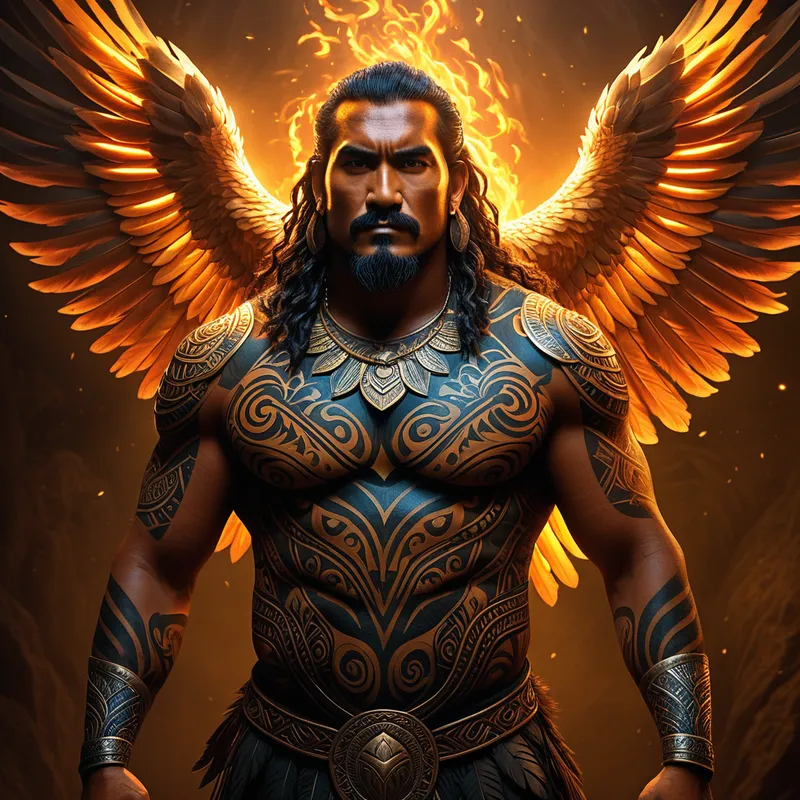
Maui's transformations Myth Meaning & Symbolism
The trickster hero Maui transforms into birds to steal fire from the underworld goddess Mahuika, a myth of cunning, sacrifice, and elemental power.
The Tale of Maui's transformations
Listen, and hear the story of fire, stolen from the belly of the world.
In the days when the world was young and damp, the people knew only the cold sun and the raw fish. They shivered in the long nights, their hearths dark, their spirits dim. It was Maui who watched them, his heart stirred not by pity, but by a fierce, cunning love and an insatiable curiosity. "Why should my people live in the chill?" he asked the silent stars. "The secret of warmth lies elsewhere. I will find it."
He went to his father, Ranginui, and his mother, Papatūānuku, but they offered only warnings. The fire was not theirs to give. It belonged to Mahuika, the ancient one, who dwelled deep in the underworld, in caves where the very rock pulsed with heat. To go there was to invite annihilation.
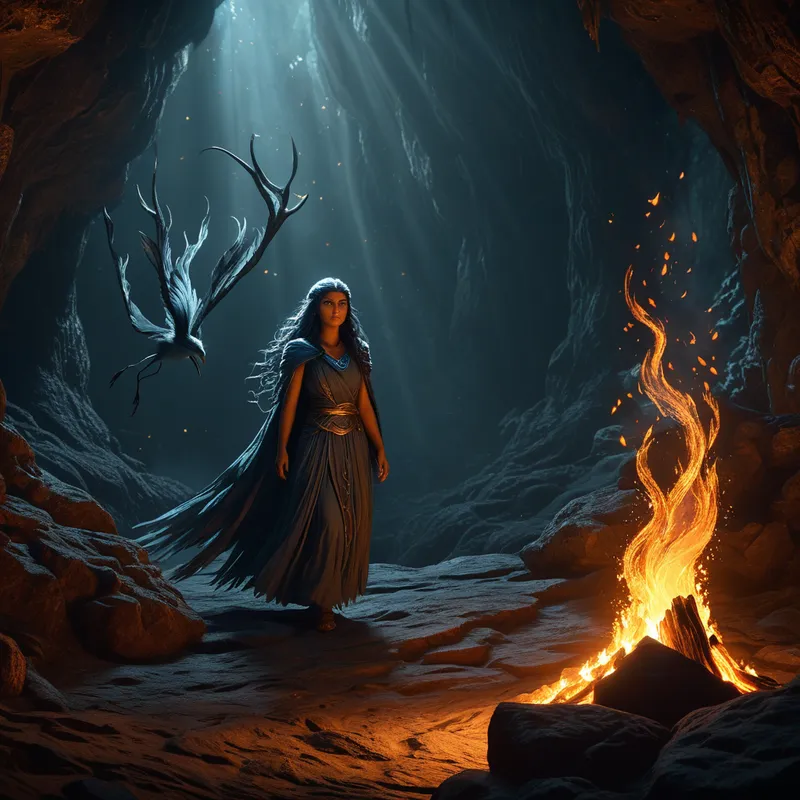
But Maui-tikitiki-a-Taranga, the last-born, the bound-by-his-mother's-topknot, was not one to heed warnings. He descended. The air grew thick and sulphurous, the light fading to a bloody gloom. He found Mahuika in her cavern, a figure of terrifying power, her hair not hair but a cascading waterfall of living flame, each strand a flickering tongue of orange and blue. Her eyes were coals.
"Grandmother," Maui spoke, his voice a model of respect. "My people are cold. Will you grant them a single spark of your fire?"
Mahuika, perhaps amused by his boldness, perhaps moved by his plea, nodded. She reached into her fiery mane, plucked a single fingernail—which was not a fingernail but a burning brand—and gave it to him. "Take this. Use it wisely."
Maui took the flame and turned to leave. But a thought, sly and treacherous, entered his mind. What if it goes out? What if one is not enough? And so, in a moment of trickster's doubt, he dipped the brand into a pool of water. It hissed and died.
He returned to Mahuika. "Grandmother, forgive me. A gust of wind stole it."
She gave him a second fingernail of fire. He extinguished it again. And a third. And a fourth. With each request, Mahuika's amusement curdled into suspicion, then into a dawning, volcanic rage. By the time he asked for a fifth, she understood. This was no accident. This was theft.
Her wrath erupted. She screamed, and the cavern shook. She tore the last fingernail from her hand and hurled it to the ground, igniting the very earth. Fire, her true and final child, roared to life and began to chase Maui, a ravenous, crackling tide seeking to consume him utterly.
Maui fled. The fire was faster. He called upon his mana, his inherited power of transformation. As the flames licked at his heels, he changed. His body shrank, his arms stretched into wings, his form became light and swift. He became a karearea, the hawk, and shot upward through a crevice. The fire followed, transforming into a great burning vine, climbing after him.
He burst onto the surface world, the fire close behind, setting the forests ablaze. Desperate, Maui transformed again, into a smaller, quicker bird—a riroriro. Still, the fire pursued. He saw the great rain clouds of Tāwhirimātea and cried out for aid. In answer, the skies opened. A deluge fell, quenching the vengeful flames of Mahuika, saving the world from total conflagration.
But from the sodden, smoking earth, a single ember survived, hidden in the heart of a certain tree. Maui revealed this secret to humanity: to rub the wood of the māhoe was to call forth the fire once more. Warmth was theirs, but it was born of cunning, theft, rage, and a saving rain.
Cultural Origins & Context
This myth, in its many local variations, is a cornerstone of the Polynesian narrative universe, stretching from Aotearoa (New Zealand) to Hawaiʻi and across the Pacific. It was not written but carried in the kauwa, the sacred chants and oral histories recited by tohunga and storytellers. Its function was multifaceted: it was an etiological myth explaining the origin of fire-making via friction, a moral tale about the consequences of deception and the value of perseverance, and a cosmological map. It delineated the relationship between humanity (the surface world), the ancestors/deities (the underworld), and the elemental forces.
The telling was a communal act of remembering, often performed in the marae, binding the people to their environment and their past. Maui, as a figure, embodies the Polynesian explorer's spirit—audacious, ingenious, and constantly testing boundaries. His actions, while often disruptive, ultimately progress human culture, moving it from a state of nature to one of technology and comfort, albeit at a cost.
Symbolic Architecture
At its heart, this is not a simple hero's quest. It is a profound drama of negotiation with the primal source. Maui does not conquer fire; he negotiates with it, fails, is chased by it, and ultimately brokers a fragile truce mediated by another elemental force (water/rain).
The hero does not create the fire; he midwifes it from the underworld of the unconscious into the conscious world, a process always bordering on catastrophe.
Mahuika is not a villain but the guardian of a raw, undomesticated power. Her fiery hair represents the unbound, creative/destructive energy of life itself. Maui's initial approach—asking politely—acknowledges this. His subsequent trickery represents the human ego's attempt to control and secure this power, to make it permanent and safe. This attempt inevitably provokes a backlash, the "rage of the source," which threatens to destroy the very seeker.
The transformations are the key. They symbolize the fluidity of identity required to navigate a crisis. When one rigid form (the human hero) is insufficient, the psyche must access other "shapes"—the hawk's strategic altitude and speed, the warbler's unnoticed subtlety. Each transformation is a tactical adaptation, a shedding of a previous self to meet a new phase of the challenge.
The Dreamer's Resonance
When this mythic pattern stirs in modern dreams, it often manifests as sequences of chase and metamorphosis. The dreamer may be pursued by a consuming heat or light, or find themselves spontaneously changing form to escape a threat. Somaticly, this can correlate with periods of intense stress, creative ferment, or a feeling of being "burned out" by a passion that has turned against you.
Psychologically, it signals a profound negotiation with one's own primal energy—a repressed anger, a stifled creative drive, or a sexual passion. The dream-ego, like Maui, has gone "down" into the underworld of the personal unconscious to retrieve this fire. The subsequent chase signifies the terror of integrating that raw power into a conscious life that feels too small, too fragile, to contain it. The transformations in the dream are the psyche's innate, healthy capacity to not be rigidly identified with a single state of being, to adapt and flee in order to survive the integration process.
Alchemical Translation
For the individual on the path of individuation, Maui's journey is a perfect model of psychic alchemy. The goal is not to eliminate the fiery, chthonic aspects of the self (Mahuika), but to establish a conscious relationship with them.
The first stage is recognizing the lack—the "cold hearth" of a life without authentic passion or warmth. The descent is the courageous, or foolhardy, act of introspection, of confronting what has been kept in the dark. The polite request for a "fingernail" is the ego's first, tentative approach to this deep power, hoping for a manageable piece.
The act of repeatedly extinguishing the gift is the crucial, painful stage of resistance. We are afraid of the very thing we seek, and so we sabotage it, forcing a confrontation with its full, untamed force.
The ensuing conflagration is the psychic crisis—the depression, the explosive anger, the creative block that feels like being consumed. This is where rigid ego-identity must dissolve. The transformations are the alchemical solve (dissolution). The old, fixed self-concept ("I am this job, this role, this personality") must become fluid. One must become the hawk—able to see the larger pattern of one's life from above—and then the warbler—able to move through the thickets of complex emotion with subtlety.
The saving rain of Tāwhirimātea represents the reconciling third, the transcendent function that emerges when the conflict between the seeking ego (Maui) and the primal power (Fire) reaches its peak. It is often an unexpected insight, a moment of grace, or the intervention of a forgotten aspect of the self (like compassion or patience, symbolized by water).
The final gift is not the raging wildfire, nor the single, fragile brand, but the secret ember hidden within the common wood. This is the alchemical coagula (coagulation). The transformative power is no longer external, nor is it a raging inferno within. It has been integrated, tempered, and translated into a usable, sustainable technology of the soul. The individual discovers that the power to generate warmth, light, and creativity was always latent within the very substance of their ordinary life, waiting for the right friction to bring it to life.
Associated Symbols
Explore related symbols from the CaleaDream lexicon: