Maui's Fishhook Myth Meaning & Symbolism
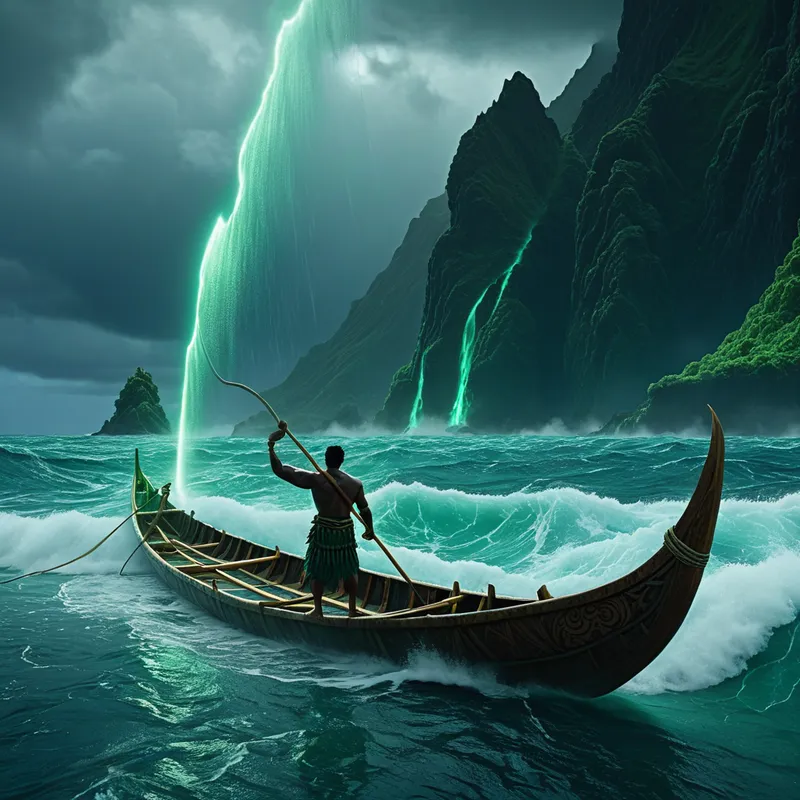
The demigod Maui uses a magical fishhook to pull the North Island of Aotearoa from the ocean depths, a defiant act of creation.
The Tale of Maui's Fishhook
Listen. The sea was not always dotted with islands. Once, the great ocean Te Moana-nui-a-Kiwa stretched in an unbroken, hungry blue. The people lived on what little land they had, crowded, their canoes knowing only the horizon's empty promise.
Then came Maui-tikitiki-a-Taranga. He was not like other men. Born premature, cast into the sea by his mother, he was saved by his ancestor Tama-nui-ki-te-Rangi, who wrapped him in seaweed and raised him in the ocean's deep halls. When Maui returned to his family, he was a boy of magic and fire, with the jawbone of his grandmother as his first treasure.
But Maui's heart chafed. He saw his brothers return from fishing with only enough for a day. He heard the elders speak of the great land, Te Ika-a-Maui, that lay sleeping in the depths. "Why do we not fish for land?" he asked. His brothers scoffed. "The sea is for fish, not dreams."
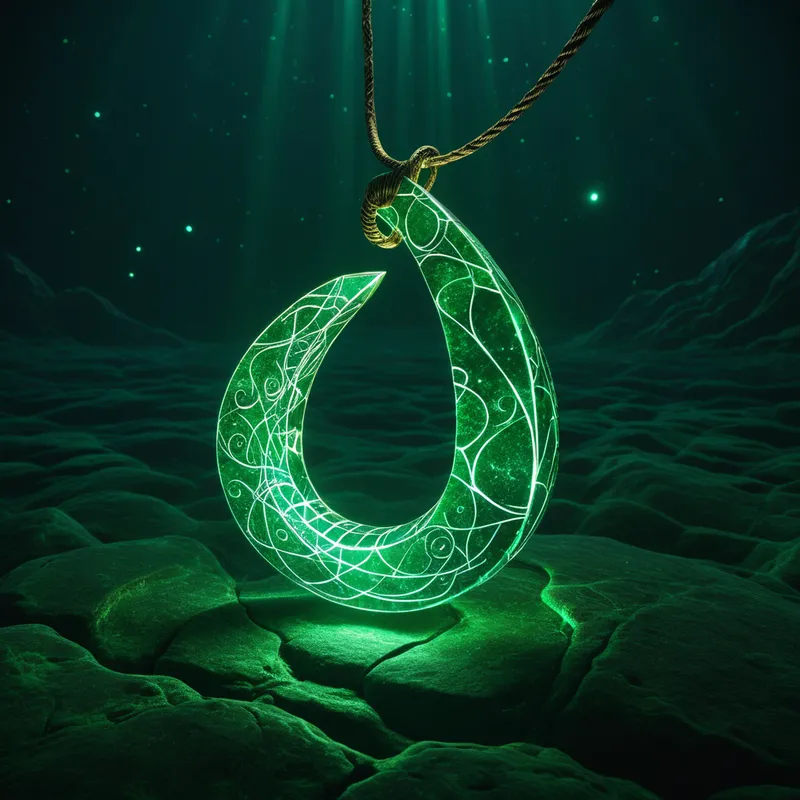
Undaunted, Maui prepared. He took the sacred jawbone and fashioned from it a mighty fishhook, Manaiakalani. He chanted incantations over it, binding it with his own mana and the blood of his own nose for bait. He then tricked his brothers into taking him on their fishing voyage, hiding in the hull of their waka until they were far from shore.
When they could see no land, Maui revealed himself. His brothers were angry, but Maui's presence commanded silence. He cast his line, the hook sinking through layers of dark, cold water, past where light lives, down to the very floor of the world. He felt it catch—not on coral or stone, but on something vast, slow, and ancient. The line grew taut.
"Pull!" Maui commanded. His brothers, now caught in the spell of the act, hauled with all their might. The ocean began to boil. The waka groaned. Great geysers of steam and spray erupted as the sea resisted this theft from its bed. Birds wheeled in screaming clouds. With a final, earth-rending heave, they broke the surface. Not a fish, but the forest-clad peaks, the steaming valleys, the very backbone of a land—Te Ika-a-Maui—was hauled gasping into the sun. Maui warned his brothers not to touch the gift, to let the atua of the land settle. But in their awe and greed, they did. The great fish thrashed, carving valleys and mountains with its agony, becoming not a smooth prize, but the rugged, living island we know.
Cultural Origins & Context
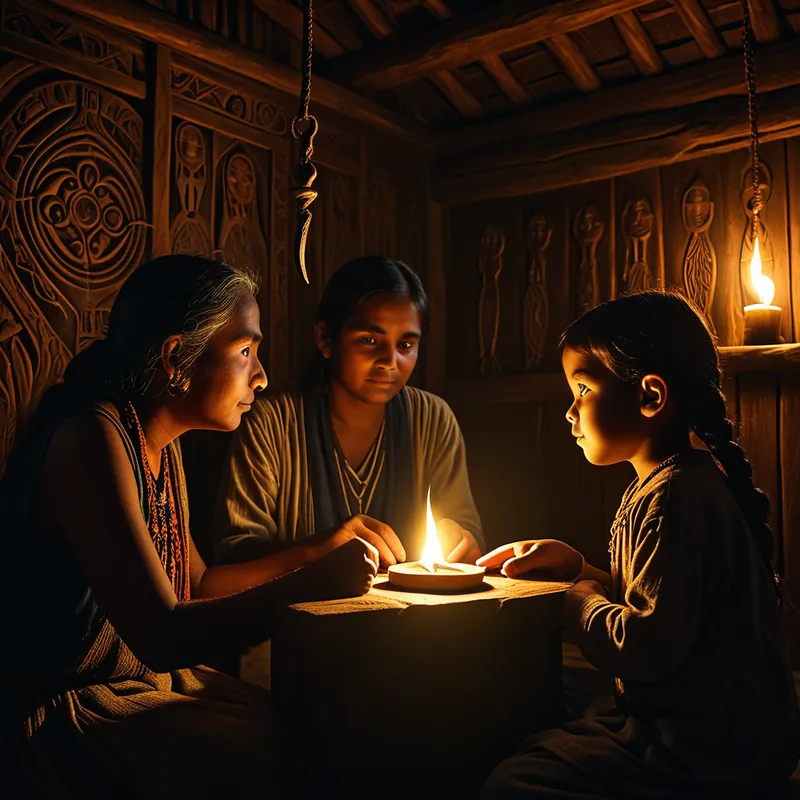
This is not merely a story of a strong man fishing. It is a foundational pūrākau of the Polynesian world, a narrative thread woven into the very identity of peoples from Hawai'i to Aotearoa. Passed down through generations by tohunga and storytellers, it was recited in the meeting houses, its rhythms matching the slap of waves on the hull. Its function was multifaceted: it was a cosmological map explaining the origin of specific landforms, a charter for human ingenuity and defiance, and a sacred reminder of the proper relationship between humanity and the elemental forces.
The myth served as a psychological and social anchor. It explained the "why" of the landscape—that mountain is where the fish's head lay; that lake is the eye socket. More profoundly, it encoded values. Maui, though a trickster, acts for the community's benefit. His success relies on both his inherited magic (the jawbone) and his cunning and will. The story validates the act of striving against apparent limits, of using intellect (whakaaro) and sacred knowledge to transform the world. Yet, the brothers' disobedience, which causes the land to become rugged, is a crucial cautionary element. It teaches that even in triumph, tapu must be observed; human arrogance can mar the perfection of a divine gift.
Symbolic Architecture
At its core, the myth of Maui's Fishhook is a profound allegory of conscious creation emerging from the unconscious depths. The ocean is the primordial, undifferentiated psyche—the collective unconscious teeming with latent forms and possibilities. The hidden land is the potential for a new, stable structure of consciousness, a "ground of being" that does not yet exist in the individual's lived experience.
The hero does not fight a monster from the deep; he fishes for a continent. His task is not destruction, but a perilous act of drawing forth.
Maui himself represents the emergent ego-consciousness, the heroic aspect of the psyche that dares to venture beyond the known shores (conscious boundaries) to engage the depths. His magical hook, Manaiakalani, is the symbol of focused intent—a crafted tool that combines ancestral wisdom (the jawbone) with personal life-force (his blood as bait). It is the hook of consciousness that can "catch" and articulate something from the formless deep. The act of pulling is the immense effort of integration, of bringing a massive, unconscious content into the light of day. The resulting turmoil—the boiling sea, the thrashing—is the psychic upheaval that necessarily accompanies any major act of self-realization or life change.
The Dreamer's Resonance
When this myth stirs in the modern dreamer, it often manifests as dreams of fishing in deep, dark waters, of pulling on a line attached to something immense and unseen, or of discovering new land. Somatically, one might feel a profound tension in the arms and back—the strain of the "pull." Psychologically, this signals a process of drawing a foundational aspect of the Self up from the depths of the unconscious.
The dreamer is in the position of Maui's brothers as much as Maui himself. There is the exciting, awe-filled potential of a great catch (a new career, a creative project, a psychological insight), coupled with the anxiety of the unknown and the sheer effort required. The warning not to touch the new land translates as an internal caution against premature claim or ego-inflation. To "touch it too soon" in a psychological sense is to try to claim a nascent, unintegrated insight as a finished part of one's identity before it has fully surfaced and taken its own shape, leading to inner conflict (the land's thrashing) rather than stable ground.
Alchemical Translation
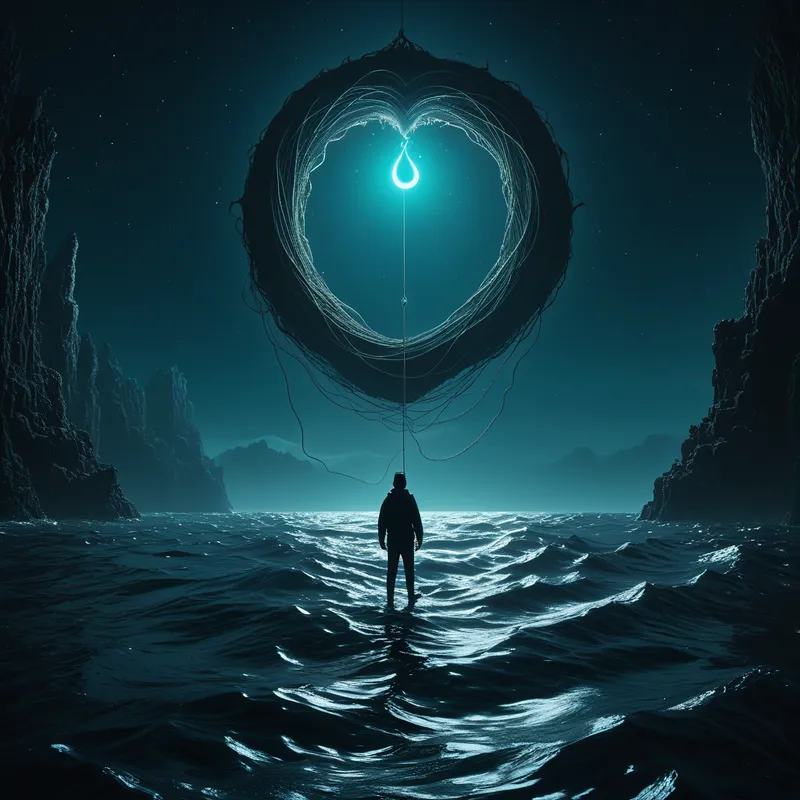
The alchemical journey mirrored in Maui's feat is the opus magnum—the great work of transforming the massa confusa (the chaotic sea) into the lapis philosophorum (the philosopher's stone, the stable land). For the individual on the path of individuation, the myth models the process of psychic transmutation.
First, the nigredo: the dark voyage far from the familiar shores of the persona. This is the descent, the willingness to be "hidden in the hull" of one's own unconscious. Next, the crafting of the hook: the albedo. This is the refinement of one's unique tool—be it a skill, a therapeutic insight, or a spiritual practice—forged in the fire of intention and consecrated with one's own vital essence (the blood). The casting of the line is the act of directed attention into the unconscious, the question posed to the depths.
The catch is never what you expect. You fish for a meal and pull up a world.
The citrinitas is the dawning realization, the first breaking of the new land through the surface—the "aha" moment that reshapes the internal landscape. Finally, the rubedo is the integration, though never perfectly smooth. The brothers' flaw ensures the new consciousness is rugged, textured, and real, not a flat, idealized fantasy. The completed work is not a calm paradise, but a habitable, fertile, and authentic territory of the Self, pulled from the void and now solid underfoot. The fishhook remains, a permanent symbol of the effortful, sacred act of creation that is the ongoing task of becoming who we are.
Associated Symbols
Explore related symbols from the CaleaDream lexicon: