Maui Myth Meaning & Symbolism
The story of the trickster demigod Maui, who fished up islands, stole fire, and sought immortality, embodying human ingenuity and its profound limits.
The Tale of Maui
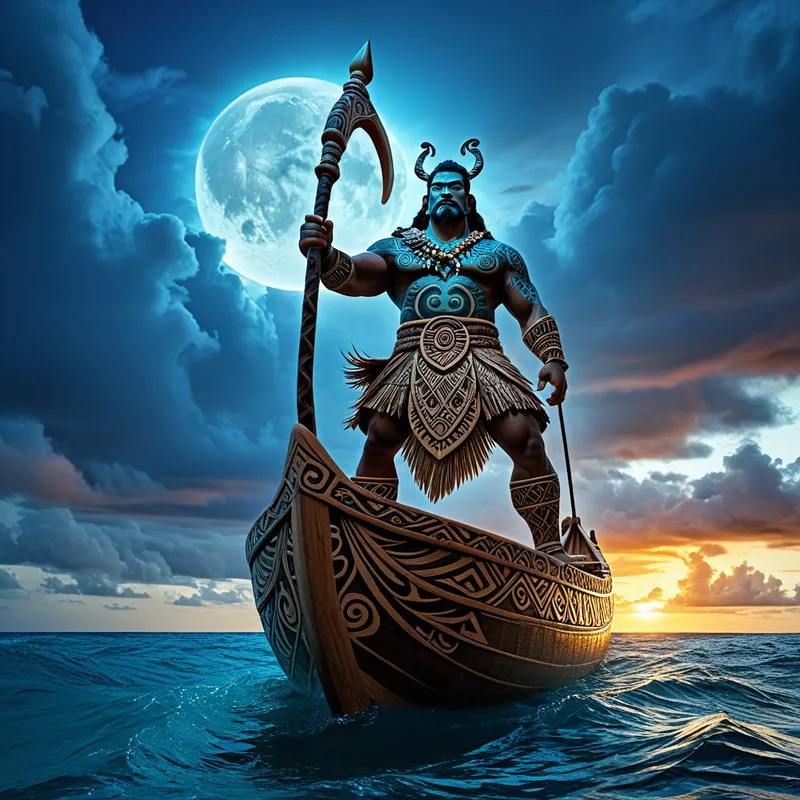
Listen. The world was younger then, its edges still soft. The great ocean, Te Moana-nui-a-Kiwa, stretched in every direction, and the sky, Rangi, pressed close upon the earth, Papa. In this world of giants and gods, a child was born. He was cast into the sea by his mother, Taranga, wrapped in a tress of her own hair. The ocean did not claim him. The waves carried him to the shore, where his ancestors, the atua of the deep, took him in. They named him Maui-tikitiki-a-Taranga, and they taught him the arts of shape-shifting and magic.
He returned to his people not as a cast-off, but as a master of tricks. His brothers saw only a nuisance, but Maui saw a world unfinished. He heard his mother sigh as the sun, Tama-nui-te-rā, raced across the sky, leaving the days too short for work, for fishing, for life. So Maui took the jawbone of his ancestor, Murirangawhenua, and wove a mighty rope from his sister's hair. He hid in the darkness at the pit of the world and, as the sun climbed out, he ensnared its fiery legs. "Slow!" he commanded. And beaten, the sun agreed, limping across the sky ever after, granting the gift of long days.
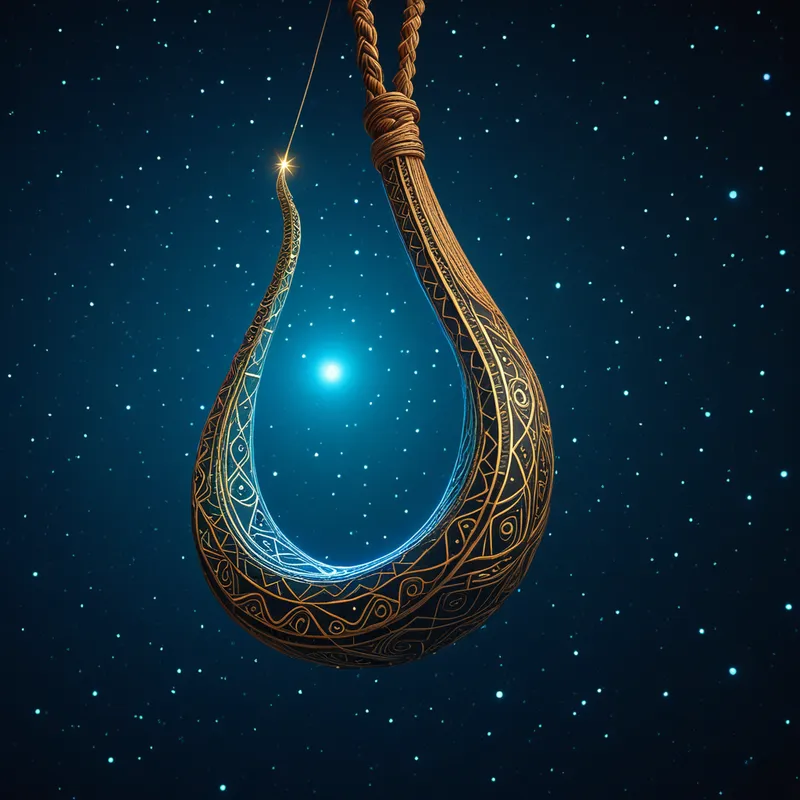
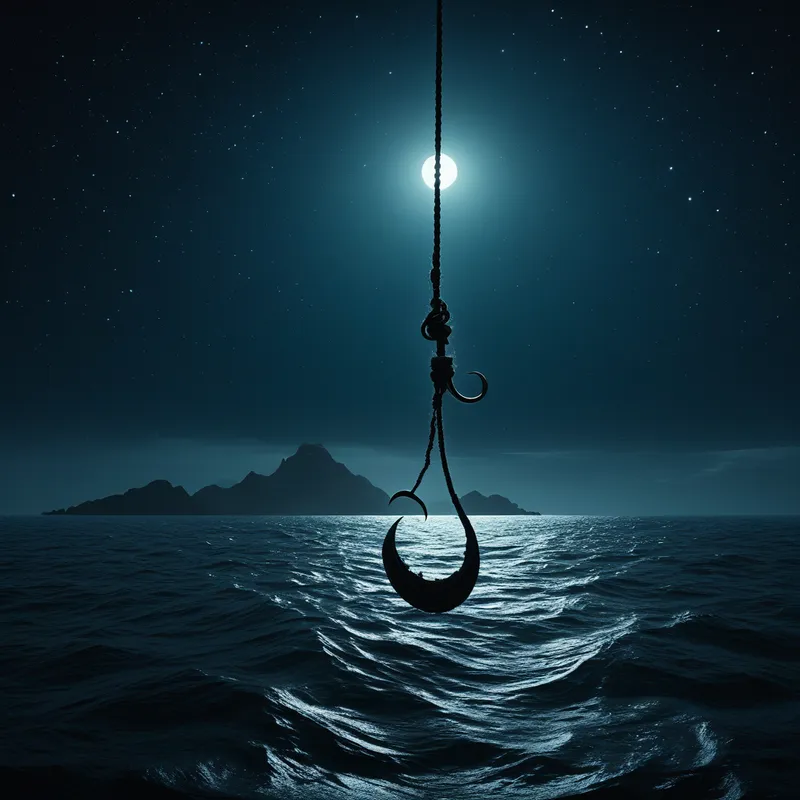
But Maui was not done. He saw the vast, empty sea and dreamed of land. He convinced his reluctant brothers to take him fishing far beyond the horizon. There, in the sacred deep, he took his magical fishhook, Manaiakalani, baited it with his own blood, and cast it down. The line ran out, down to the home of the great ancestor, Tumu-nui. Maui chanted the ancient karakia, his muscles straining against the canoe. "Heave!" he cried, and his brothers pulled, not knowing what they raised. From the primal depths, they hauled not a fish, but land itself—the great Te Ika-a-Māui, the Fish of Maui. His hook can still be seen in the sky, as the constellation Scorpio.
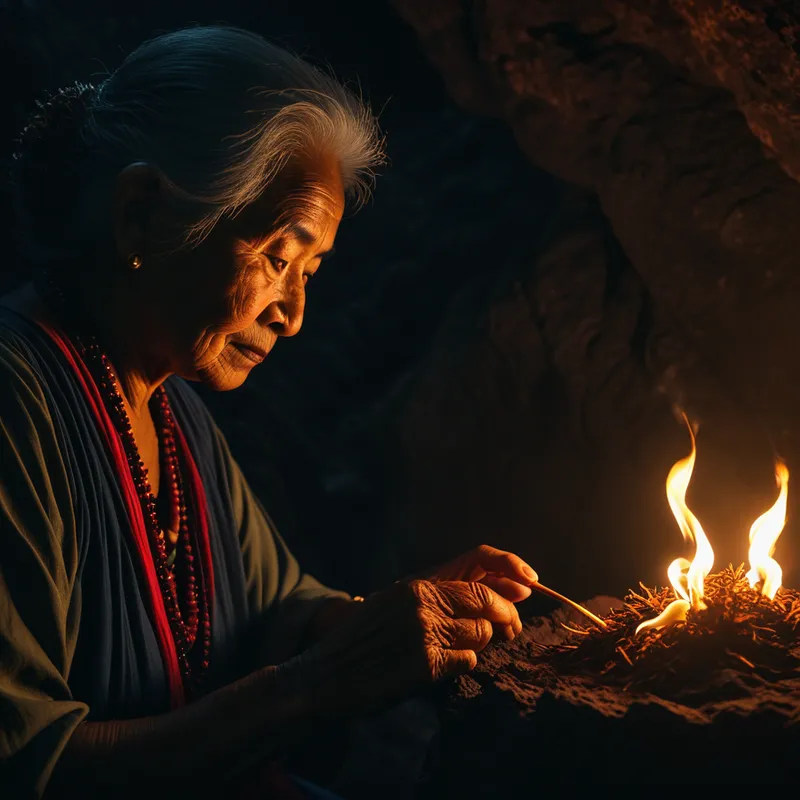
His greatest trick was for his people's warmth. In the cold, humans shivered. Fire belonged only to the fire goddess, Mahuika. Maui journeyed to her volcanic home and, with clever words, begged a single flame for his mother. She gave him a fingernail of fire. He let it die, and returned again and again, until she, enraged, hurled her last fiery nail at him. Maui, in the form of a hawk, fled, but the world was set ablaze. To save it, he called upon the rain and the rivers to quench the flames. Only a few embers hid in certain trees—the kaikōmako, the māhoe—gifting fire forever to humanity, but only if they work to draw it forth.
Yet one feat remained. Maui saw the sorrow of death. He sought to conquer it by entering the goddess of death, Hine-nui-te-pō, as she slept, and passing through her body to tear out her heart. He warned the birds to keep silent, but as he entered, the sight of his nakedness made the fantail laugh. The goddess awoke, clenched her obsidian teeth, and crushed Maui. Thus, the greatest trickster met his end, and death remained forever in the world. His quest for immortality failed, but his deeds shaped the very fabric of life.
Cultural Origins & Context
The myths of Maui are not a single story, but a constellation of tales that span the vast Polynesian triangle, from Hawaiʻi to Aotearoa (New Zealand) to Tahiti. These narratives were the living encyclopedias of a voyaging people, transmitted orally by tohunga and storytellers. They were not mere entertainment; they were cosmological maps, historical records, and pedagogical tools. To recite Maui's feats was to explain why the sun moves as it does, how the islands were formed, where fire comes from, and, most importantly, why humans must die. The stories encoded vital survival knowledge—the right seasons, the origins of resources, and the boundaries of human ambition. Maui, as a liminal figure born of the gods but raised by humans, served as a bridge between the divine realm of the atua and the human world, modeling both incredible ingenuity and the fatal consequences of overreaching sacred tapu (prohibitions).
Symbolic Architecture
Maui is the archetypal Trickster, but his tricks are not for mere mischief. They are acts of world-shaping creation. He represents the emergent human consciousness itself—the restless, inventive, and often rebellious ego that seeks to improve its condition, to master its environment, and to defy its limitations.
The hero is not the one who accepts the world as given, but the one who dares to re-negotiate its terms with the gods.
His tools are symbolic extensions of this consciousness: the fishhook is the focused will that pulls latent potential from the unconscious depths (Te Moana-nui-a-Kiwa); the jawbone represents ancestral wisdom and raw power; shape-shifting is the adaptability of the psyche. His theft of fire is the Promethean seizure of transformative energy—technology, spirit, enlightenment—from a jealous, unconscious realm (Mahuika) to be integrated, at great cost, into culture. His final, failed quest is the ultimate human confrontation: the ego's desperate, impossible bid to conquer the Great Mother of dissolution, Hine-nui-te-pō. His failure is not a tragedy but a profound truth. The trickster's ingenuity, which can slow the sun and fish up continents, must ultimately submit to the cycle of life and death.
The Dreamer's Resonance
When the pattern of Maui stirs in the modern dreamer, it signals a profound activation of the creative, rebellious, and transformative energies of the psyche. To dream of fishing in impossibly deep waters, or of possessing a magical tool that can "hook" something monumental, speaks to a somatic pull from the unconscious. The dreamer is in the process of "fishing up" a new potential, a new piece of psychic land from within themselves. This process is felt as a deep, somatic tension—a creative pregnancy that requires both cunning effort and a connection to ancestral wisdom (the jawbone).
Conversely, dreams of failed tricks, of being crushed, or of a laughing bird at a crucial moment, reflect the psychological process of confronting one's own Hine-nui-te-pō—the necessary death of an old identity, an outworn ambition, or a hubristic fantasy. The laughter of the fantail is the sudden, embarrassing intrusion of shadow material—the repressed vulnerability or instinct—that shatters the ego's grand plan for immortality. The dreamer is undergoing a necessary defeat of the heroic ego, a humbling that makes way for a more integrated self.
Alchemical Translation
The myth of Maui is a masterclass in the alchemy of individuation. It maps the entire journey: from the orphaned, rejected child (the nigredo, the initial darkness) to the heroic ego that labors to structure the world (the albedo), to the final, fiery confrontation with the ultimate mystery (the rubedo).
The initial feats—slowing the sun, fishing up land—are the necessary and glorious work of the conscious mind. It builds culture, secures time, and creates a stable "island" of identity from the formless sea of the unconscious. The theft of fire is the critical integration of transformative energy (libido, passion, insight) into that identity. But the process is incomplete if it remains in a state of heroic inflation.
True psychic transmutation occurs not when we conquer death, but when we consciously consent to be transformed by it.
Maui's final quest is the ego's attempt to perform the ultimate alchemy: to render the mortal immortal by force. The individuation process requires the opposite. One must consciously, willingly, and symbolically enter the belly of the Great Mother—the dark, transformative womb of Hine-nui-te-pō—not to destroy her, but to be destroyed and reborn on her terms. The "crushing" is the dissolution of the heroic ego-attitude. For the modern individual, this translates to surrendering the need for total control, accepting limitation and mortality, and allowing a deeper, more soul-centric Self to emerge from the failure of the ego's grandest plan. Maui's legacy, therefore, is dual: he gifts us the fire of consciousness and the islands of achievement, but his death gifts us the wisdom of humility, the final, essential ingredient in the gold of a whole life.
Associated Symbols
Explore related symbols from the CaleaDream lexicon:
- Canoe
- Horizon
- Parrot
- Tropical Fruit
- Tropical Shirt
- Swim Trunks
- Breezy Tank Top
- Giant Footprint
- Riding Waves
- Celestial Navigator
- Surfboard
- Jet-Ski Adventure
- Breezy Kitesurfboard
- Celestial Navigation
- Melodic Bird of Paradise
- Gecko
- Mosaic Gecko
- Clownfish
- Tropical Fish
- Surfing Waves
- Beach Encounter
- Mahi Mahi
- Fanciful Albatross
- Tropical Casuarin
- Resourceful Tarpon
- Distant Horizon
- Kiteboard
- Kayak
- Paddleboard
- Sandy Beach
- Stargazing
- Sunlit Telescope
- Nautical-themed Jewelry
- Moonlit Surfboard
- Inflatable Toy
- Tropical Leaf Prints
- Primitive Net
- Fish Trap
- Muddy Riverbanks
- Route of Ancient Fishermen
- Hand-carved Paddle
- Fishing Revolution
- Clam Digging
- Fish Traps
- Shell Tools
- Fish Hook
- Sun-Kissed Tides
- Navigating
- Tradewind