Matsuo Bashō's Haiku Myth Meaning & Symbolism
A poet's pilgrimage becomes a mythic quest, where a moment of profound stillness births a haiku that captures the soul of the world.
The Tale of Matsuo Bashō’s Haiku
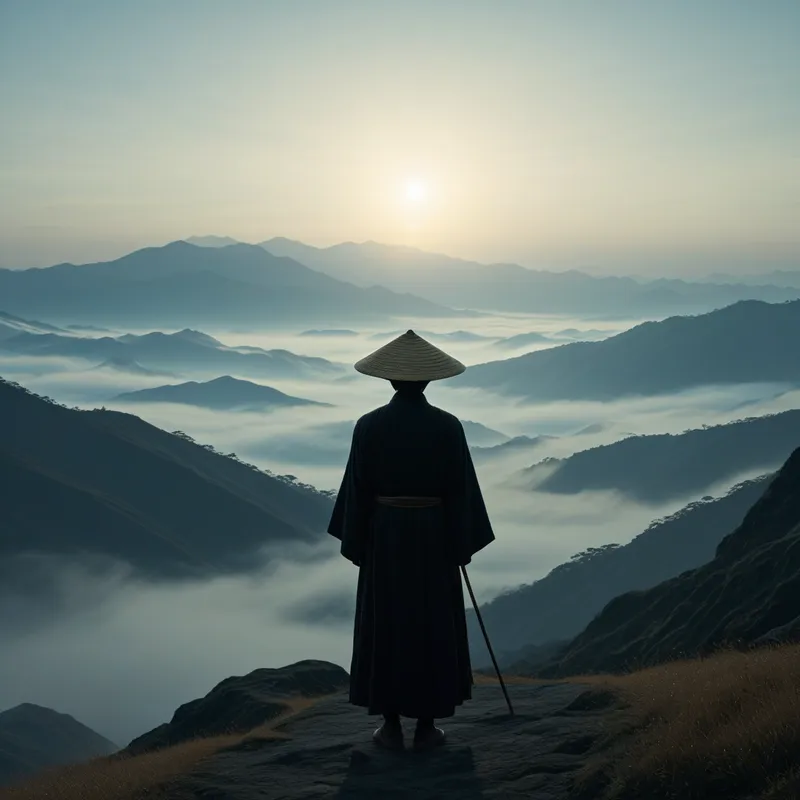
Listen. There is a silence that is not empty, but full. It is the silence between heartbeats, between the in-breath and the out-breath of [the world](/myths/the-world “Myth from Tarot culture.”/). In the Genroku era, when the land was held in a deep, contemplative peace, there walked a man who sought that silence. His name was Matsuo Bashō, but he was a wanderer more than a man, a set of footprints following the whisper of wind through pines.
He had turned his back on the clamor of the floating world, the chatter of tea houses and the rustle of silk. His home was a humble hut, shaded by a bashō plant whose broad leaves caught the rain with a sound like distant drums. But even here, in chosen solitude, the poem he sought eluded him. It was not a poem of words he desired, but a poem of being—a verse so true it would not describe the world, but would become a piece of its soul.
A restlessness took him. He shouldered a pack, took his staff, and let the road decide. He walked until his sandals wore thin, following rivers to their mountain sources, sleeping under stars that watched like ancient eyes. He crossed the Utsunomiya pass where [the wind](/myths/the-wind “Myth from Various culture.”/) screamed, and trudged through the Oku no Hosomichi, the Narrow Road to the Deep North. He was not fleeing, but pursuing—hunting the very essence of things, the shinnyo that shimmered just beneath the surface of stone and stream.
Seasons turned around his journey. Cherry blossoms fell like snow upon his path; summer grasses rose, fierce and green; autumn maples bled their fire into cold rivers. He met farmers, monks, and innkeepers, shared their meager rice, and listened to the stories held in their calloused hands and weathered faces. Yet, the great poem, the one that would crack the world open to show its heart, remained hidden.
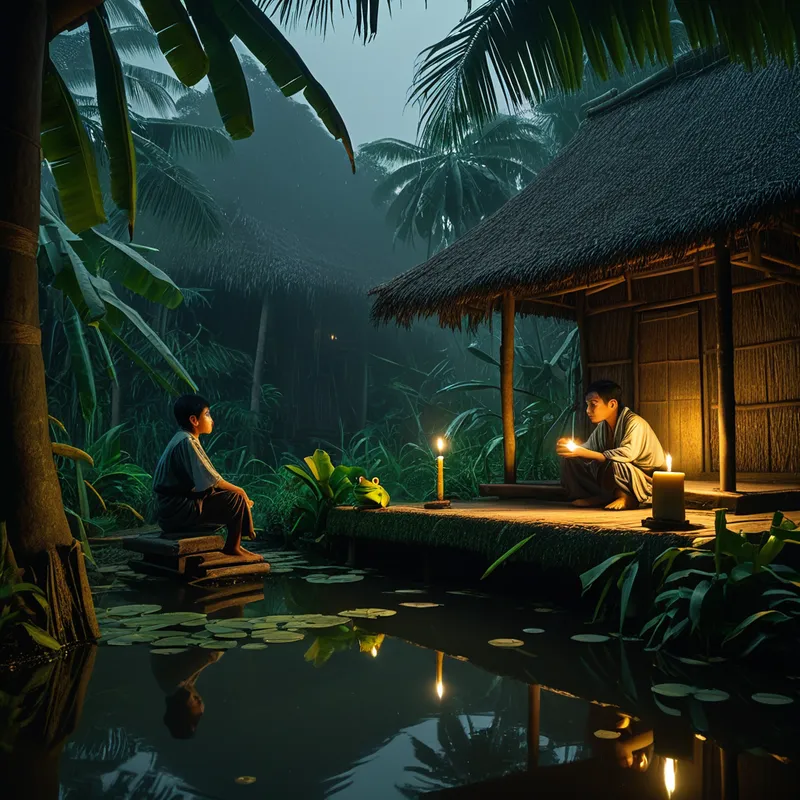
Then came a day of profound stillness, deep in his travels. The air was heavy with the green scent of late spring. He found himself at an old, forgotten pond, its [water](/myths/water “Myth from Chinese culture.”/) dark and mirror-still, fringed with mossy stones and [ferns](/myths/ferns “Myth from Celtic culture.”/). The world seemed to hold its breath. For hours, or perhaps only a moment—for time had lost its meaning—he simply was there. He was the moss, the damp earth, the [water](/myths/water “Myth from Chinese culture.”/) soaking into the roots.
And then, a sound. Not a grand sound, but a small, wet plop.
An old frog, mottled and timeless, leapt from a stone into the black water.
In that instant, the universe contracted and expanded. The journey, the solitude, the longing—all of it coalesced into a single, perfect perception. The sound of water was not an interruption of the silence, but its deepest expression. The words arose not from his mind, but from the pond itself, from the frog, from the space between them:
Furu ike ya kawazu tobikomu mizu no oto.
(An old pond— a frog jumps in, the sound of water.)
He did not write the poem; it wrote itself through him. He was merely the hollow bamboo through which the wind of the world now sang. In that splash, he heard the echo of all creation, and in the returning silence, he found the home he had been walking toward all his life.
Cultural Origins & Context
The myth of Bashō’s [haiku](/myths/haiku “Myth from Japanese culture.”/) is not a folktale of gods and monsters, but a literary and spiritual legend born from the historical figure of Matsuo Bashō (1644-1694). It is rooted in the Haikai no Renga tradition, which Bashō transformed from a playful social pastime into a profound spiritual path. The story is drawn from his own travel writings, particularly Oku no Hosomichi, and from the lore passed down by his disciples.
The societal function of this myth was multifaceted. In a culture that deeply valued harmony with nature (shizen) and aesthetic refinement, Bashō’s journey modeled the ideal of [wabi-sabi](/myths/wabi-sabi “Myth from Japanese culture.”/)—finding profound beauty and truth in the rustic, the imperfect, and the transient. It served as a foundational narrative for the art of haiku itself, teaching that the greatest poetry arises from direct, unmediated experience (kenshō) and disciplined emptiness, not from intellectual cleverness. The myth was told and retold in poetry circles, tea ceremonies, and philosophical discourses, cementing Bashō not just as a poet, but as a sensei of perception.
Symbolic Architecture
The myth is a masterclass in symbolic minimalism, where every element is a [portal](/symbols/portal “Symbol: In dreams, a portal symbolizes a passage to new experiences, dimensions, or aspects of the self.”/) to the infinite.
The Old [Pond](/symbols/pond “Symbol: A pond in dreams represents the unconscious mind, emotions, and tranquility.”/) represents the deep, unconscious self—the collective and personal [psyche](/myths/psyche “Myth from Greek culture.”/) in its primordial, still state. It is the [sunyata](/myths/sunyata “Myth from Buddhist culture.”/) from which all phenomena arise.
The [Frog](/symbols/frog “Symbol: A frog symbolizes transformation, adaptability, and connection to nature.”/) is the catalyst, the unexpected [event](/symbols/event “Symbol: An event within dreams often signifies significant life changes, transitions, or emotional milestones.”/) that breaks the surface of [consciousness](/symbols/consciousness “Symbol: Consciousness represents the state of awareness and perception, encompassing thoughts, feelings, and experiences.”/). It symbolizes the intrusion of the mundane, the accidental, the lively animal [spirit](/symbols/spirit “Symbol: Spirit symbolizes the essence of life, vitality, and the spiritual journey of the individual.”/) that disrupts [meditation](/symbols/meditation “Symbol: Meditation represents introspection, mental clarity, and the pursuit of inner peace, often providing a pathway for deeper self-awareness and spiritual growth.”/) to provide its ultimate subject. It is not a grand [eagle](/symbols/eagle “Symbol: The eagle is a symbol of power, freedom, and transcendence, often representing a person’s aspirations and higher self.”/), but a common [frog](/symbols/frog “Symbol: A frog symbolizes transformation, adaptability, and connection to nature.”/), teaching that awakening is found in the ordinary.
The Sound of [Water](/symbols/water “Symbol: Water symbolizes the subconscious mind, emotions, and the flow of life, representing both cleansing and creation.”/) is the [moment](/symbols/moment “Symbol: The symbol of a ‘moment’ embodies the significance of transient experiences that encapsulate emotional depth or pivotal transformations in life.”/) of [synthesis](/symbols/synthesis “Symbol: The process of combining separate elements into a unified whole, representing integration, resolution, and the completion of a personal journey.”/)—the [poem](/symbols/poem “Symbol: A poem in a dream often symbolizes creativity, emotional expression, and inner thoughts coming to the surface.”/) itself. It is the ripple that connects the frog (event) to the pond (context), the subjective [perception](/symbols/perception “Symbol: The process of becoming aware of something through the senses. In dreams, it often represents how one interprets reality or internal states.”/) to the objective world. It represents the [birth](/symbols/birth “Symbol: Birth symbolizes new beginnings, transformation, and the potential for growth and development.”/) of meaning from the [marriage](/symbols/marriage “Symbol: Marriage symbolizes commitment, partnership, and the merging of two identities, often reflecting one’s feelings about relationships and social obligations.”/) of [stillness](/symbols/stillness “Symbol: A profound absence of motion or sound, often representing inner peace, creative potential, or existential pause in artistic contexts.”/) and [movement](/symbols/movement “Symbol: Movement symbolizes change, progress, and the dynamics of personal growth, reflecting an individual’s desire or need to transform their circumstances.”/).
The journey is not toward the poem, but away from the poet. The self must become as empty as the sky to hear the universe speak its one, perfect note.
The [Pilgrimage](/symbols/pilgrimage “Symbol: A spiritual or transformative journey toward a sacred destination, representing personal growth, devotion, and the search for meaning.”/) is the essential preparation. The [worn sandals](/symbols/worn-sandals “Symbol: Worn sandals often symbolize a journey or pilgrimage taken, representing experience gained through struggles and the paths one has traveled.”/), the [mountain](/symbols/mountain “Symbol: Mountains often symbolize challenges, aspirations, and the journey toward self-discovery and enlightenment.”/) passes, the encounters—these are the rituals of stripping away [the ego](/myths/the-ego “Myth from Jungian culture.”/), the social [persona](/symbols/persona “Symbol: The social mask or outward identity one presents to the world, often concealing the true self.”/), and intellectual pretense. One must be thoroughly lost in the world to be found by the moment.

The Dreamer’s Resonance
When this myth pattern appears in modern dreams, it signals a profound somatic and psychological process: the incubation of a new consciousness. The dreamer may find themselves in a vast, silent landscape, or staring into a mirror-like body of water. There is a feeling of pregnant waiting, of a long and wearying search for an answer that words cannot capture.
The frog’s leap in the dream is the critical moment. It might manifest as a sudden phone notification that holds a crucial message, an animal crossing one’s path, or a small, overlooked object falling and making a sound. This event is rarely dramatic in the dream narrative, but it carries an immense feeling of significance upon waking—a somatic jolt, a sense of things clicking into place.
This dream pattern indicates the psyche is ready to translate a deep, unconscious process (the still pond) into a conscious form (the sound). The dreamer is undergoing a phase where intellectual striving has ceased, and a more receptive, perceptual intelligence is taking root. The conflict is the tension between the desire to make meaning and the need to allow meaning to emerge.
Alchemical Translation
The myth of Bashō’s haiku is a precise alchemical manual for psychic individuation. The process is one of via negativa—achievement through subtraction.
First, the [Nigredo](/myths/nigredo “Myth from Alchemical culture.”/): The voluntary descent into solitude and wandering. This is the burning away of the false self, the [persona](/myths/persona “Myth from Greek culture.”/) attached to status, certainty, and fixed identity. The poet leaves his hut, his reputation, his known world. In psychological terms, this is the confrontation with [the shadow](/myths/the-shadow “Myth from Jungian culture.”/) on a grand scale, experienced not as inner turmoil alone, but as a literal or metaphorical journey into the unknown parts of one’s life.
Then, the Albedo: The purification through exposure to the elements of reality—wind, rock, river, the faces of strangers. This is the washing clean of perception. The ego’s desires are diluted by the vastness of the world until the individual becomes a clear vessel. The long pilgrimage serves this whitening process.
The Citrinitas is the moment at the pond: the dawning of an [inner light](/myths/inner-light “Myth from Buddhist culture.”/), a yellowing that is not yet red. It is the stage of illumination, where the boundary between observer and observed begins to dissolve. The frog is the [lapis philosophorum](/myths/lapis-philosophorum “Myth from Alchemical culture.”/) in its raw, unexpected form—the gift of the unconscious.
Finally, the [Rubedo](/myths/rubedo “Myth from Alchemical culture.”/): The reddening, the completion. This is not the composition of the poem, but the hearing of the “sound of water.” It is the full integration of the experience into consciousness. The momentary perception becomes a permanent alteration of being. The created artifact (the haiku) is merely the proof of the transmutation, the physical evidence that the base metal of seeking has been turned into the gold of authentic existence.
The alchemy is in the listening. The self is not perfected by adding more knowledge, but by becoming perfectly permeable to the world, until the splash of a frog is experienced as the heartbeat of the cosmos.
For the modern individual, the myth teaches that transformation does not come from relentless productivity or self-improvement regimens, but from the courageous act of stopping, of going into [the wilderness](/myths/the-wilderness “Myth from Biblical culture.”/) of one’s own life without a map, and waiting with perfect attention. The “haiku” that results may be a career change, a repaired relationship, a piece of art, or simply a new, unshakable peace. It is the sound of your own life, heard for the very first time.
Associated Symbols
Explore related symbols from the CaleaDream lexicon: