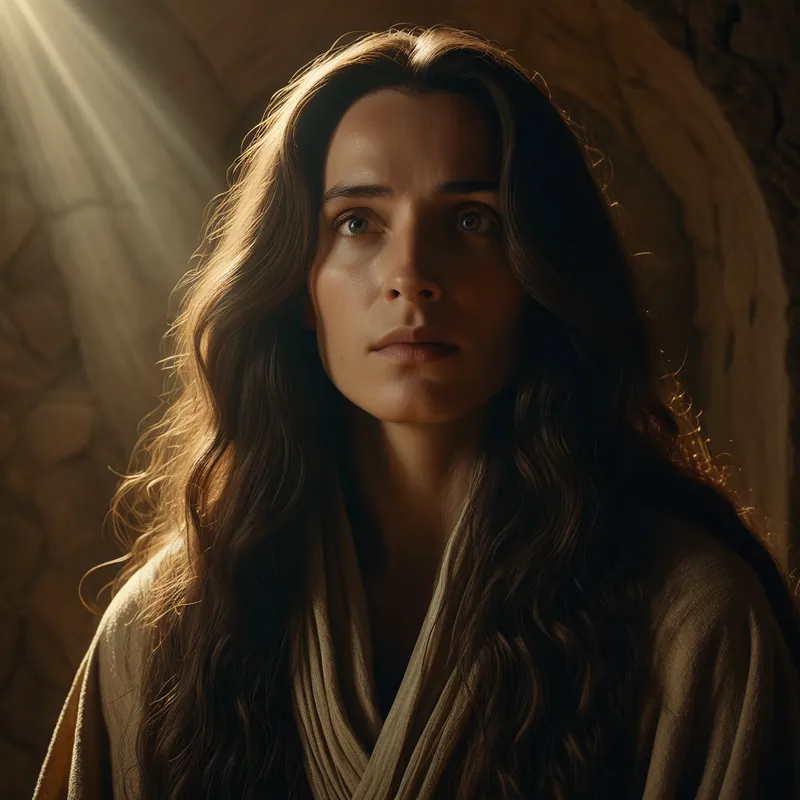
Mary Magdalene Myth Meaning & Symbolism
A woman of seven demons becomes the first witness to resurrection, embodying the alchemy of the soul from darkness to divine revelation.
The Tale of Mary Magdalene
Let the story be told of the one who saw. Not in the temple courts, nor among the scholars, but in the shattered places where the soul meets its end and its beginning.
In the land of Judea, there was a woman from the town of Magdala. Her name was Mary, but the shadow that clung to her was a chorus of seven voices—seven demons that twisted her sight and turned her world to a prison of mirrors reflecting only torment. She was a ghost in her own life, a whisper of chaos in human form. Then, he came. A teacher from Nazareth, whose gaze did not flinch from her darkness but saw, within it, the person buried alive. With a word that was both a key and a command, he shattered the chorus. The demons fled like smoke, and for the first time, Mary Magdalene was silent within herself. She heard the sound of her own breath, felt the solid ground beneath her feet. In that emptiness, a devotion was born, fierce and absolute.
She followed him, this woman of means, with other women who had been healed, providing for him from her resources. She walked the dust-choked roads, sat at the edges of crowds that hung on his parables, and witnessed the slow, gathering storm of opposition. She was there at the foot of the terrible tree on the hill of the skull, where the world’s hope seemed to bleed out into the dirt. She did not look away as the light left his eyes, as the sky tore itself apart. She followed as his broken body was taken down, watched as it was sealed in a tomb hewn from rock. A stone, vast and final, was rolled across the entrance.
Then, in the violet hour before dawn, when the world holds its breath, she returned alone. The stone was rolled away. The tomb was a gaping, empty mouth. Grief, sharp as a blade, twisted inside her. She ran, fetched the men who came, saw their confusion, and was left alone again with her weeping. Peering once more into the shadows, she saw two beings in shining white. “Woman, why are you weeping?” They asked the question of the universe.
“They have taken my Lord, and I do not know where they have laid him.”
Turning, through a veil of tears, she saw a man. The gardener, she thought. Perhaps he knows. “Sir, if you have carried him away, tell me where you have laid him, and I will take him away.”
Then he spoke her name. “Mary.”
One word. A sound she had heard from him before, but now it carried the weight of worlds being remade. It was the same voice that had once cast out her demons, but now it was filled with a life that death could not touch. It pierced the fog of her grief, and she knew. “Rabbouni!” Teacher.
Do not cling, he said. For the love she knew must now become a message. Go. Tell. And Mary Magdalene, the woman once possessed, became the first herald. She ran, not from demons, but towards the trembling, doubting world, her heart a drumbeat of impossible news: “I have seen the Lord.”

Cultural Origins & Context
The figure of Mary Magdalene emerges from the Gospels, texts written in the decades following the death of Jesus, within a complex Second Temple Judaic milieu under Roman occupation. Her story is not a single, unified myth but a constellation of fragments across different traditions. In the canonical Gospels, she is consistently named first among the women followers, a position of honor, and is uniquely singled out as the primary witness to the resurrection in the Gospel of John.
However, her cultural journey is one of profound convolution. By the late 6th century, a homily by Pope Gregory I conflated her with the anonymous sinful woman who anoints Jesus’s feet in Luke 7, and with Mary of Bethany, sister of Lazarus. This theological fusion created the dominant Western image for centuries: Mary Magdalene as the penitent prostitute, a powerful archetype of redeemed sexuality and contrition. This served a societal function, modeling a specific path of female piety—one rooted in repentance from sensual sin.
Alternative threads existed, particularly in gnostic texts like the Gospel of Philip and the Gospel of Mary, where she appears as a companion of Jesus, a recipient of special revelation, and a leader who contends with male apostles. These narratives, suppressed by the orthodox tradition, preserved a different function: she was the apostle to the apostles, the vessel of gnosis. Her myth, therefore, has been told by popes and painters, mystics and reformers, each shaping her to reflect their era’s anxieties and ideals about authority, femininity, and the nature of sacred knowledge.
Symbolic Architecture
Mary Magdalene is the archetype of the transformed witness. Her symbolism is an alchemical map of the soul’s journey from fragmentation to wholeness, from obsession to authentic vision.
She represents the psyche that must first be emptied—the “seven demons” cast out—to become a vessel capable of holding the ultimate mystery.
The seven demons symbolize a totality of possession, a complete alienation from the Self. Her healing is not a gentle cure but an exorcism, a violent clearing of the inner space. This prepares her for her ultimate role: to stand at the threshold of the greatest paradox—death and life—and to see. She is not a passive recipient but an active, grieving, questioning presence at the empty tomb. Her recognition of the risen Christ occurs not through grand spectacle, but through the intimate, personal call of her own name. This is the core of her symbolic power: gnosis arrives through relationship and personal address, not abstract doctrine.
Her later, conflated identity as the anointer adds another layer. The alabaster jar of ointment symbolizes the breaking open of one’s most precious inner substance—one’s life, love, or insight—in an act of devotion that is often criticized by the pragmatic world (represented by the disciples who complain of waste). She embodies the Eros principle in its most sacred form: connective, devotional, and intimately knowing.

The Dreamer’s Resonance
When the pattern of Mary Magdalene stirs in the modern dreamer, it signals a profound process of reorientation at the level of identity and knowing. To dream of being possessed, of hearing conflicting inner voices (the “demons”), often precedes a necessary crisis or breakdown of an old, false self-structure. The dream ego may find itself in a wasteland or a tomb-like space—a job lost, a relationship ended, a deep depression—feeling utterly emptied out.
The pivotal dream motif is the encounter at dawn in a garden or liminal space. The dreamer might be searching for something lost, weeping inconsolably, and then encounter a figure who is at first mundane (a gardener, a stranger, an animal) who then, through a word, a gesture, or a shift in appearance, reveals itself as a profound source of recognition or truth. This is the somatic signal of the Self breaking through. The weeping is not just sadness; it is the liquefaction of old, rigid perceptions. The recognition—the hearing of one’s name—is often accompanied in dreams by a visceral shock, a gasp, or a feeling of warmth flooding the chest. It marks the moment the dreamer shifts from identifying with their grief (I am lost) to realizing they are witnessing a mystery that transforms the meaning of the loss itself. The subsequent impulse in the dream is always to go and tell—to integrate this transformative knowing into the waking world.

Alchemical Translation
The myth of Mary Magdalene is a precise manual for the individuation process. It models the alchemical stages of nigredo, albedo, and rubedo applied to the psyche’s quest for authentic knowledge.
The nigredo, the blackening, is her state of demonic possession—the chaos, depression, and fragmentation that often initiates the spiritual journey. This is not a mistake but a necessary descent. The exorcism is the first separation, the beginning of distinguishing the ego from the compulsive complexes that rule it.
The empty tomb is the supreme symbol of the albedo, the whitening. It is the terrifying, blank slate of the psyche after the old gods (beliefs, identities, certainties) have died. The ego faces the void and weeps.
Here, the critical operation is staying. She does not flee the emptiness. In her steadfast grief and searching, she performs the essential alchemical work: constantia (steadfastness) and meditatio (contemplation) on the mystery. This prepares the vessel.
The recognition—“Mary”—is the rubedo, the reddening, the dawn of the philosophical gold. It is the conjunction of the human soul (Mary) with the transcendent Self (the Risen One). The knowledge gained is not intellectual but relational and immediate. The command “Do not cling to me” is the final, crucial instruction of individuation: do not concretize the numinous experience into a new possession or dogma. The experience must be translated into life, into message.
Thus, the Magdalene process within us is the journey from being possessed by our complexes (demons), through the purification of facing our deepest voids (the tomb), to achieving a knowing grounded in direct, personal experience of the Self (the recognition). Her triumph is to become the Apostola Apostolorum—the apostle to the apostles—meaning the inner authority that has witnessed the transformative mystery must now inform and guide the collective, ruling structures of the psyche (the internalized “male apostles” of logic, tradition, and dogma). She represents the integration of gnostic, experiential knowing into the very heart of one’s being and, by extension, into the world.
Associated Symbols
Explore related symbols from the CaleaDream lexicon: