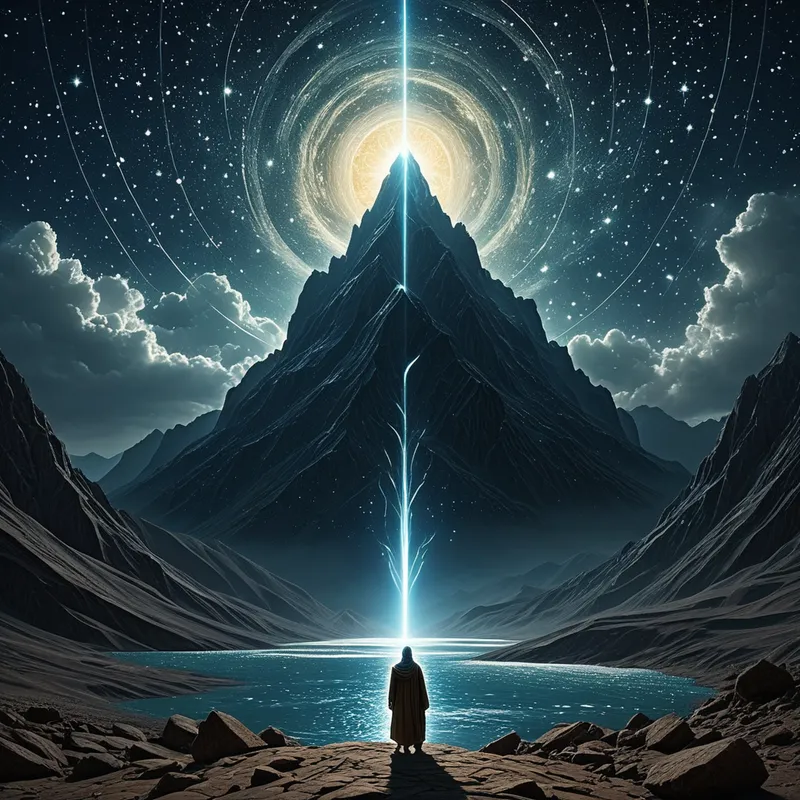
Martyaxwar Myth Meaning & Symbolism
A primordial being of sacrifice whose dismemberment creates the world, embodying the alchemical process of dissolution for the sake of new creation.
The Tale of Martyaxwar
In the time before time, when the cosmos was a silent, formless sea of potential, there existed Martyaxwar. He was not a god who commanded, but a presence who was—a being of immense, concentrated essence, a mountain of spirit adrift in the void. There was no sun to cast his shadow, no wind to stir his form, only the profound stillness of unmanifested possibility.
And in that stillness, a longing arose. Not a loneliness, but a deep, pulsing urge toward expression, toward relationship, toward life. Martyaxwar perceived the infinite blueprint of a world—of soaring peaks that would scrape the sky, of rivers that would sing as they ran, of creatures that would breathe and feel the warmth of a star. He saw the tapestry of existence in its fullness, vibrant and yearning to be woven. Yet the loom was empty. The threads did not exist.
A great tension filled the void, a cosmic inhalation held for an eternity. Martyaxwar understood the contract of creation. To bring the blueprint into being, the source material must be offered. The painter must become the paint; the singer must become the song. There could be no other way.
With a will that was both a command and a surrender, Martyaxwar began the great unbinding. He did not fight it. He embraced it as the ultimate act of love. His head, the seat of cosmic thought and vision, dissolved into the dome of the sky, his mind becoming the vault where the sun, moon, and stars would later trace their paths. His eyes, twin pools of perception, fell as gentle rains, filling the hollows of the earth to become the first seas and lakes, their depths holding the mystery of sight.
His flesh, the substance of his being, did not fall away in decay but in a fertile cascade. It settled and cooled into the rich, dark soil of the plains and the towering, rugged stone of the mountains. The warmth of his life-heat sank deep into the crust, becoming the fiery heart of the world, the forge of future volcanoes. His bones, the architecture of his form, became the hidden veins of ore and crystal, the secret strength buried within the earth.
His breath, the last sigh of his singular existence, did not vanish. It expanded, thinning and quickening, becoming the very air itself—the wind that would one day whisper through leaves, the tempest that would cleanse, the gentle breeze that would carry the scent of blossoms. And his voice, the final vibration of his spirit, fragmented into a thousand thousand echoes, becoming the potential for all sound: the roar of the waterfall, the call of the first bird, the murmur of human speech yet to come.
The void was void no longer. Where one being stood, a universe of interrelation bloomed. The sacrifice was absolute, and from it, the conditions for all life, all struggle, all beauty, and all return were irrevocably established.

Cultural Origins & Context
The mythic figure of Martyaxwar finds its roots in the ancient Iranian cosmological traditions, particularly within the Zoroastrian framework that profoundly shaped Persian thought. While not as centrally narrative as the struggles of Ahura Mazda and Angra Mainyu, the concept of a primordial being whose substance constitutes the world is a profound undercurrent. It is a myth of origins that belongs less to the courtly epic (like the Shahnameh) and more to the realm of philosophical and priestly speculation—the kind preserved in texts like the Bundahishn.
This story was likely transmitted in sacred spaces by Mobeds, not as a simple fairy tale, but as a foundational truth about the nature of reality. Its societal function was ontological and ethical. It answered the fundamental question: "Of what is the world made?" with a startlingly intimate answer: "Of a sacred sacrifice." This imbued the natural world—the stone, the water, the air—with inherent sanctity. It was not inert matter but transformed divinity. This perspective fostered a deep-seated respect for the elements, a core tenet in Zoroastrianism where earth, water, and fire are seen as pure and to be protected. The myth established a cosmos that is, at its heart, a gift, setting a tone of stewardship and reverence that echoed through Persian culture.
Symbolic Architecture
At its core, the myth of Martyaxwar is the ultimate archetype of creative sacrifice. It moves beyond the hero who dies for something, to the being who dies into everything. Martyaxwar represents the primordial unity, the undifferentiated Self before the dawn of consciousness and the inevitable fragmentation into the multiplicity of experience.
The first act of creation is not an assertion of will, but a dissolution of boundaries. The true creator does not stand apart from the creation, but becomes its very substance.
Psychologically, Martyaxwar symbolizes the necessary death of the ego's illusion of separateness. The ego, like the primordial being, often experiences itself as a centralized, autonomous entity. The process of individuation—of becoming a whole, integrated Self—requires this "Martyaxwar moment." It is the painful, yet liberating, recognition that to truly live, to truly create, and to truly connect, we must allow parts of our rigid self-concept to dissolve and be repurposed. Our cherished identities, our defensive armoring, our fixed narratives must fall away like flesh becoming soil, to provide the fertile ground for new growth. The myth asserts that wholeness is not found in perfect, static integrity, but in a willing participation in a cycle of giving oneself over to a larger pattern.
The Dreamer's Resonance
When this myth stirs in the modern unconscious, it often manifests in dreams of profound, voluntary disintegration. A dreamer may find their body turning to sand, blown by a wind to form a landscape. They may dream of a cherished home collapsing, not in terror, but in a strange peace, its bricks rearranging themselves into a beautiful garden. They may see a central, glowing artifact—a jewel, a heart, a book—shattering, with each fragment becoming a star in a new constellation.
These are not nightmares of attack, but somatic visions of alchemical dissolution. The psyche is signaling a readiness for a fundamental restructuring. The "somatic process" is one of release—a feeling of weight falling away, of boundaries softening. It often accompanies life transitions where an old self must die for a new one to be born: the end of a career that defined you, the shifting identity of parenthood, the conscious descent into grief or illness. The dreamer is experiencing the psychological equivalent of Martyaxwar's gaze upon the cosmic blueprint. There is a deep, intuitive knowing that the current form cannot contain the life that wants to emerge. The anxiety present is not about annihilation, but about the terrifying trust required to fall apart without knowing what the reassembled world will look like.
Alchemical Translation
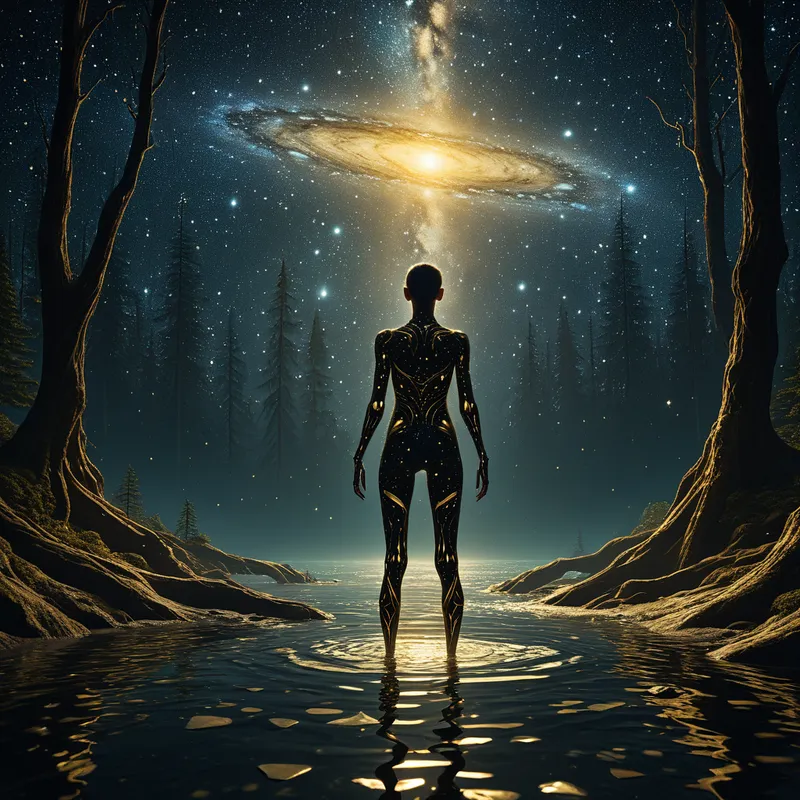
The alchemical journey, mirrored in Martyaxwar's sacrifice, is the Nigredo—the blackening, the putrefaction, the descent into the primal matter. For the modern individual, this is the dark night of the soul, the period of depression, loss, or existential crisis where everything one believed solid melts into air. Martyaxwar does not resist this stage; he is this stage, consciously enacted.
The alchemical translation of this myth is a guide for navigating our own necessary dissolutions. It teaches that transformation is not a battle to be won by the ego, but a surrender to a process larger than the ego. The "work" is to find the Martyaxwar within—the part of us capable of that awe-inspiring, loving sacrifice. We are asked to look at the areas of our life that feel stagnant or constrained and ask: "What part of my current form must I willingly offer up? What identity, what possession, what story am I holding onto that is the very barrier to the richer, more connected life I sense is possible?"
Individuation is the process of discovering that you are both the sacrifice and the resulting world. The pain of dissolution is the labor pain of a more authentic Self being born from the fragments of the old.
The triumph is not in remaining intact, but in discovering that our essence is indestructible precisely because it is transformable. We learn that we are not losing ourselves, but discovering that our true self is far more vast and interconnected than we imagined—it is the sky, the soil, the breath, and the song. The myth of Martyaxwar ultimately offers a paradoxical comfort: in our most profound moments of falling apart, we are, in the most sacred sense, engaged in the ongoing creation of our world.
Associated Symbols
Explore related symbols from the CaleaDream lexicon: