Marsyas Myth Meaning & Symbolism
A satyr finds a divine flute, challenges the god Apollo to a musical contest, and suffers a terrible fate for his hubris.
The Tale of Marsyas
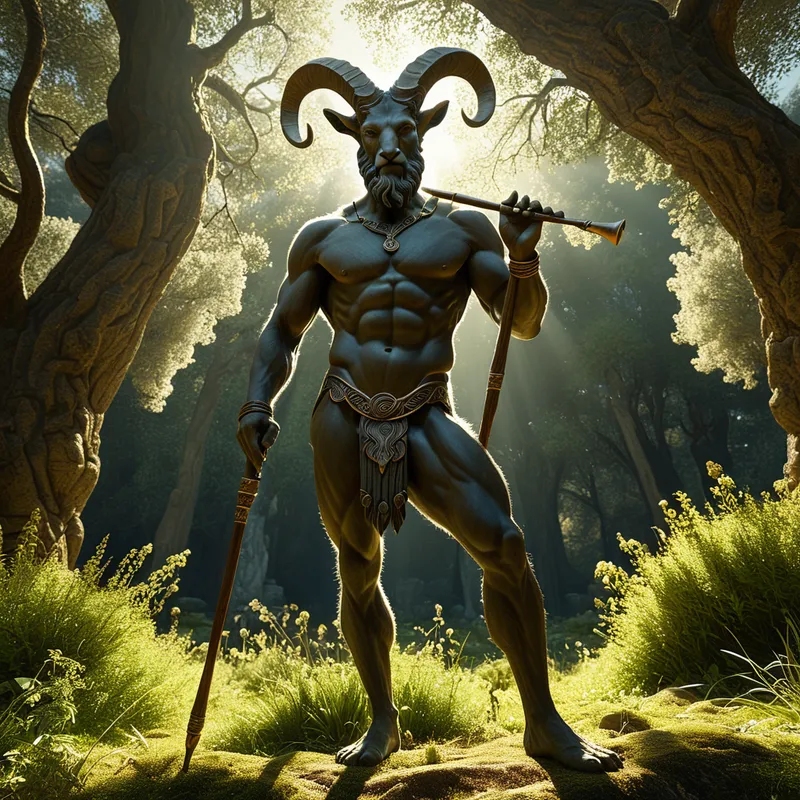
Listen, and hear the song of the mountains, the lament of the river. In the high, wild places of Phrygia, where the pines whisper ancient secrets, there lived a creature of the untamed earth. His name was Marsyas, a satyr—half-man, half-goat, with the quick, clever hands of the former and the restless, cloven hooves of the latter. He was a child of the wild, a follower of the great mother Cybele, and his music was the music of the grotto and the gusting wind.
His destiny was forged not by ambition, but by chance. Wandering by a clear stream, he saw a gleam in the reeds. It was a flute, but no ordinary pipe. This was the aulos, discarded by its first owner, the goddess Athena. She had cast it aside when she saw her cheeks puff grotesquely in a reflecting pool, deeming the instrument unbecoming. Marsyas lifted it. He put the twin reeds to his lips and blew. The sound that emerged was not the orderly melody of the lyre, but something raw, ecstatic, and profoundly moving. It was the cry of the beast and the sigh of the wind through the rocks. It held the frenzy of the maenad and the deep, chthonic pulse of the earth itself. He mastered it completely. The nymphs and satyrs danced to his playing; the very trees seemed to lean in to listen.
His fame grew like a vine, twisting through the valleys until it reached the ears of Apollo, the Far-Shooter, he of the golden kithara. Apollo’s music was the music of the spheres—mathematically perfect, harmonically pure, a celestial architecture of sound that ordered the cosmos. He heard of this satyr whose music stirred the blood and shook the soul, and a cold fire ignited in his divine breast. A contest was declared: Marsyas with his earthy aulos against Apollo with his heavenly kithara. The Muses would judge. The stakes? The winner could do whatever he wished to the loser.
In a sacred grove, beneath the watchful eyes of gods and nature spirits, they played. Marsyas went first. His music was a torrent. It conjured the damp smell of the forest floor, the panic of the hunted hare, the drunken joy of the harvest. It was life, unfiltered and potent. Then Apollo took his turn. His fingers plucked the strings, and a sublime order descended. It was the sound of sunlight on still water, of planets tracing their perfect paths. It was beauty itself, but a beauty that commanded awe, not passion.
The Muses were poised to declare Apollo the victor, as all knew they must. But the Hermes-like cunning of the god was not yet spent. Apollo, with a smile that did not touch his eyes, issued a final challenge: “Let us turn our instruments upside down, and play and sing simultaneously. Can you do that, child of the soil?” Marsyas, bound by the rules of the contest, had to agree. But an aulos cannot be played upside down, and a satyr cannot sing while blowing into the twin pipes. Apollo, however, simply inverted his kithara and sang a hymn of such piercing beauty that the very leaves trembled. Marsyas was defeated. He had lost to divine trickery, but the verdict was final.
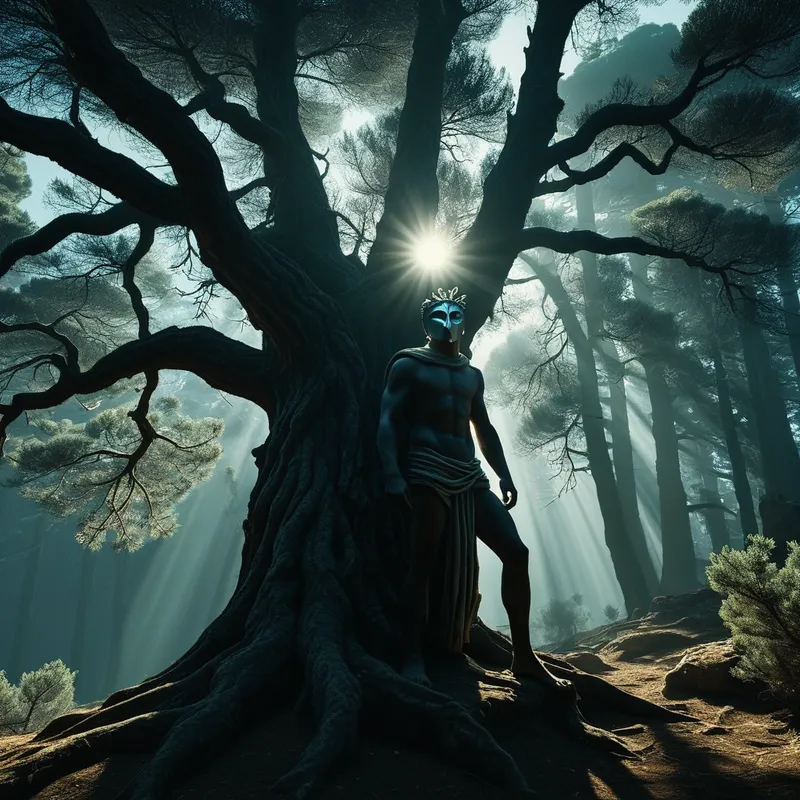
The price of loss was to be exacted. Apollo’s wish was swift and terrible. The radiant god, the patron of order and light, took a knife. The satyr was bound fast to a sturdy pine. There, in that sun-dappled clearing that had heard such glorious sound, Apollo flayed Marsyas alive. He peeled the living skin from the satyr’s body, strip by agonizing strip. The myth tells us that the very earth wept. The tears of the woodland nymphs, the satyrs, and the dryads became a river—the river Marsyas, which flows to this day, its waters singing a perpetual, mournful dirgy. His raw, exposed essence was returned to the wild, his music transformed into an eternal, flowing lament.
Cultural Origins & Context
The myth of Marsyas is not a simple folktale; it is a deep cultural nerve. It emerges from the complex religious and artistic fabric of the ancient world, where Anatolian (Phrygian) earth cults met the Olympian order of the invading Greeks. Marsyas is a figure of the old, chthonic world—a devotee of Cybele, whose worship involved ecstatic drumming and flute music. The aulos itself was central to Dionysian rites, associated with loss of self, frenzy, and primal emotion.
In contrast, Apollo and his lyre represented the new, classical ideals: reason, form, moderation, and the intellectual mastery of art. The contest, therefore, dramatizes a profound cultural conflict. It was told by poets like Ovid in his Metamorphoses and referenced by historians, often in the context of explaining the origins of the river Marsyas in Phrygia. Its societal function was twofold: to explain a geographical feature through aetiology, and more importantly, to reinforce a societal warning about hubris—the dangerous overstepping of mortal boundaries, especially in challenging the divine order. It served as a stark parable about the limits of mortal skill and the absolute, often terrifying, power of the gods.
Symbolic Architecture
At its heart, this myth is an archetypal collision between two fundamental principles of existence.
The raw, instinctual, embodied creativity of the earth (Marsyas) versus the refined, intellectual, celestial order of the spirit (Apollo).
Marsyas symbolizes the untamed creative impulse—the genius that arises unbidden from the unconscious, from the body, from the wild places of the psyche. He is creativity before it is civilized, art in its most passionate and dangerous form. His instrument, the aulos, is breath made manifest, directly connected to the lungs and life force. His fate—flaying—represents the ultimate exposure. It is the stripping away of the persona, the protective skin, leaving the raw nerve of being utterly vulnerable.
Apollo represents the necessary, structuring principle. He is the critic, the editor, the law-giver who attempts to bring the chaotic brilliance of inspiration into a coherent, lasting form. Yet his victory through trickery reveals a shadow: order can be tyrannical; perfection can be cruel and devoid of mercy. The contest is never fair, for the mortal realm can never truly compete with the divine on its own terms.
The river that springs from Marsyas’s death is the key symbol of transformation. His individual, embodied song is gone, but his essence is not destroyed. It is transmuted into a collective, eternal phenomenon—a natural force that continues to “sing.” His art becomes part of the landscape of the soul itself.

The Dreamer's Resonance
When this myth stirs in the modern dreamer, it often signals a profound crisis of creation or expression. To dream of being Marsyas is to feel the exhilarating yet terrifying possession by a creative force. You have found your “aulos”—a project, a passion, a new identity—and its power is intoxicating. But the dream may also carry the chilling presence of an “Apollo”: an internalized critic of impossible standards, a harsh external authority, or the cold, judging gaze of societal expectations.
The somatic sensation is one of exposure. You may dream of your skin feeling thin, transparent, or being removed. Psychologically, this is the process of having your deepest, most authentic self—your raw creative offering—judged and found wanting. The dream speaks to the agony of vulnerability when we dare to share what is most true within us. It is the shadow side of the Rebel archetype, where the act of defiance leads not to liberation, but to a devastating unmasking. The dream asks: What part of you is being flayed by judgment, either your own or another’s? Where have you challenged a power you cannot possibly defeat on its own terms?

Alchemical Translation
The alchemical journey modeled here is not one of integration, but of necessary dissolution and transmutation. In the process of individuation, we all contain both Marsyas and Apollo. The initial, fiery inspiration (Marsyas) must inevitably encounter the structuring, discriminating principle (Apollo). The conflict is innate.
The alchemical mortificatio—the killing and flaying—is the brutal death of identification with the raw talent alone. The ego that says “I am this brilliant creation” must be stripped away.
This is not a punishment, though it feels like one. It is a horrific but necessary stage. The skin, the superficial identity of “the talented satyr,” is removed. What is left is not nothing, but the essential, fluid core of the experience itself. The river that flows from the wound is the symbol of this alchemical translation. The personal agony becomes impersonal wisdom; the individual’s song becomes a universal resource.
For the modern individual, the myth instructs that there is a price for daring to create from the depths. You will be judged, you will be vulnerable, and parts of you will feel flayed alive by the process. The triumph is not in winning Apollo’s contest—that is impossible. The triumph is in the transformation of the experience. Your “river Marsyas” is the legacy of your creative struggle—the empathy, depth, and enduring resonance that flows from having dared to play your most authentic song, even in the face of certain defeat. The art is no longer yours; it becomes part of the world’s soul, a perpetual testament to the raw, beautiful, and costly truth of being alive.
Associated Symbols
Explore related symbols from the CaleaDream lexicon: