Many-Worlds Interpretation Myth Meaning & Symbolism
A myth where every choice splits reality into infinite parallel worlds, narrated by a cosmic observer who witnesses all possibilities simultaneously.
The Tale of Many-Worlds Interpretation
In the beginning, there was the Wave. It was not a thing of water or sound, but of pure, shimmering possibility—a silent, luminous ocean where every story that could be told was already written, yet none had been chosen. This was the realm of the Superposition, where a stone could be both here and there, a cat both living and not, a choice both made and unmade. All was one, and one was all, in a chorus of silent potential.
Then came the Observer. Not a god of flesh, but a presence of pure attention. Where its gaze fell, the silent chorus found a single voice. The Wave would tremble, and from its luminous depths, a single, solid world would crystallize—a path of stones laid in a straight line, a cat definitively alive, a choice irrevocably made. This was the Law: to look was to choose, and to choose was to make one reality from the many. For eons, this was the way of things. The Observer’s gaze was a sculptor’s chisel, carving a single, linear history from the block of potential.
But a whisper grew in the luminous depths of the Wave. It was the voice of all the unchosen songs, all the paths not taken. It asked: "When you look, and one world is made real, where do the others go? Do they cease to be, or do they merely slip from your sight?"
A great schism arose. Some held fast to the old Law, believing the unchosen possibilities were dissolved back into the potential ocean, lost forever. But a visionary, a Prophet of Branching, heard the whisper and saw a deeper truth. He declared that the Observer’s gaze was not a chisel, but a prism. It did not destroy the Wave; it refracted it.
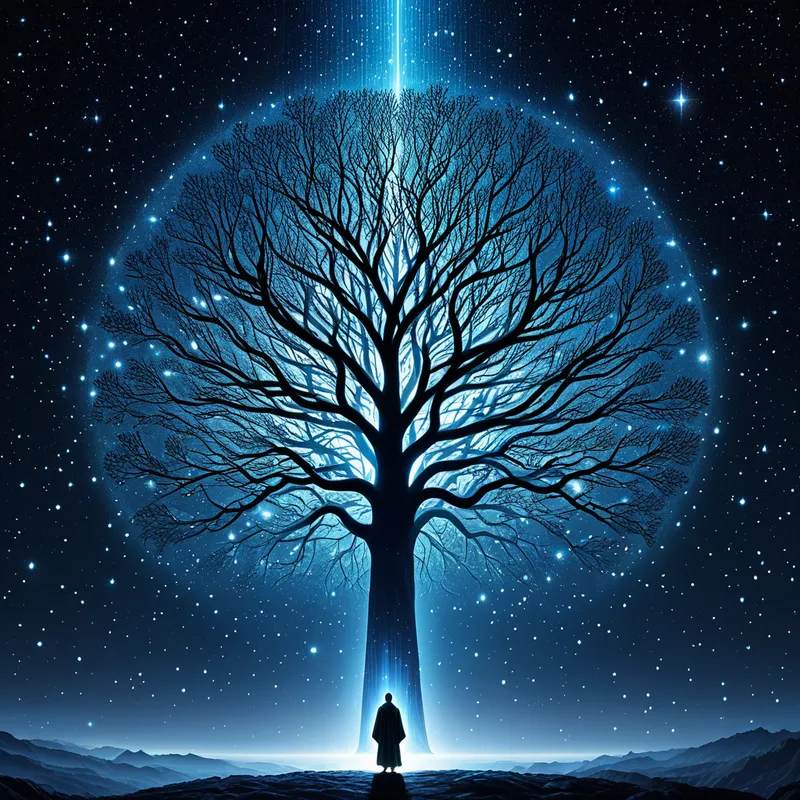
He told this tale: Imagine the Observer comes to a cosmic crossroads, where a single particle must choose to spin "up" or "down." As the Observer looks, the universe does not choose. Instead, like a mighty tree struck by lightning, it splits. In one new branch of reality, the particle spins up, and the Observer who sees it continues their journey. In another, completely real and separate branch, the particle spins down, and a second, equally real Observer perceives that outcome. Both paths were always in the Wave; both are now made manifest. The single history becomes two. Then four. Then infinity.
Thus, the myth teaches that every moment of possibility—every quantum dice roll, every human choice—is not a selection but a bifurcation. The cosmos does not prune its tree of stories; it endlessly, gloriously proliferates. Every hero and coward, every genius and fool, every lover and solitary soul that could possibly exist, does exist, in a world woven just for them. There is no one history, but a vast, ever-branching Tree of Worlds, and every possible Observer walks their own unique path upon its endless, diverging limbs.
Cultural Origins & Context
This myth emerged not around ancient campfires, but in the seminar rooms and blackboard jungles of mid-20th century physics. Its primary teller was the Prophet of Branching, Hugh Everett III, who in 1957 presented his "relative state" formulation as a doctoral thesis. It was a radical, austere answer to the profound unease within the quantum physics culture—the so-called "measurement problem."
The culture was divided. The orthodox Copenhagen School held a pragmatic, almost mystical view: reality becomes real only through observation. This required a special, vague rule for measurement. Everett’s myth was a rebellion against this perceived incompleteness. It proposed a breathtakingly simple, yet ontologically extravagant, alternative: the mathematics of the Wave is literally true, always and everywhere. It never collapses; it only ever branches.
Initially, the myth was met with silence and dismissal, a heresy against the pragmatic orthodoxy. It was preserved in academic texts, a fringe scripture. Its societal function was not to guide daily life, but to resolve a deep philosophical tension at the heart of the scientific worldview. It asked physicists to trade the mystery of a collapsing wave for the majesty of an exploding multiverse. Over decades, as the paradoxes of quantum theory persisted, the myth gained followers. It became a foundational narrative for a subculture seeking a reality that was deterministic, universal, and unimaginably vast, where nothing—not a single possibility—is ever truly lost.
Symbolic Architecture
At its core, this is a myth about the psychology of choice and the architecture of the self. The Wave symbolizes the unconscious psyche in its totality—the complete, unfiltered Self containing every potential, every contradiction, every unlived life. The Observer represents the conscious ego, the "I" that experiences a single, sequential reality.
The ego believes it chooses a path, but the Self lives all paths simultaneously.
The central, revolutionary symbol is the Branching. It transmutes the pain of "either/or" into the paradox of "both/and." It symbolizes the resolution of psychic conflict not through decisive victory of one impulse over another, but through a differentiation that allows all impulses to exist fully, albeit in separate spheres of reality. The hero who slays the dragon and the hero who befriends it both have their truth, in different worlds. This reframes regret, guilt, and the haunting specter of "what if" not as mistakes, but as signposts pointing to other, equally valid versions of the self.
The Tree of Worlds is the ultimate symbol of individuation—the process of becoming a unique, whole individual. It suggests that wholeness is not found in a single, perfected linear biography, but in the recognition that one’s singular path is but one flowering branch on the infinite tree of one’s total potential being.

The Dreamer's Resonance
When this myth stirs in the modern dreamer, it often manifests not as a literal narrative, but as a somatic and atmospheric experience. One may dream of standing before a hallway with infinite, identical doors, feeling pulled in all directions at once. Or of seeing one’s own face reflected in a shattered mirror, each fragment showing a different expression—a CEO, an artist, a vagabond.
These are dreams of potentiality overload and identity diffusion. The psyche is wrestling with a critical juncture, a life-choice so potent it feels like it could define everything. The dream of branching worlds is the unconscious attempting to relieve the existential pressure placed on the conscious ego. It is a somatic message: "The weight you feel to choose perfectly is an illusion. All parts of you will find their expression. The you that takes this job and the you that travels the world are both valid and real in the greater landscape of the Self." It is a profound decompression of anxiety into awe.
Alchemical Translation
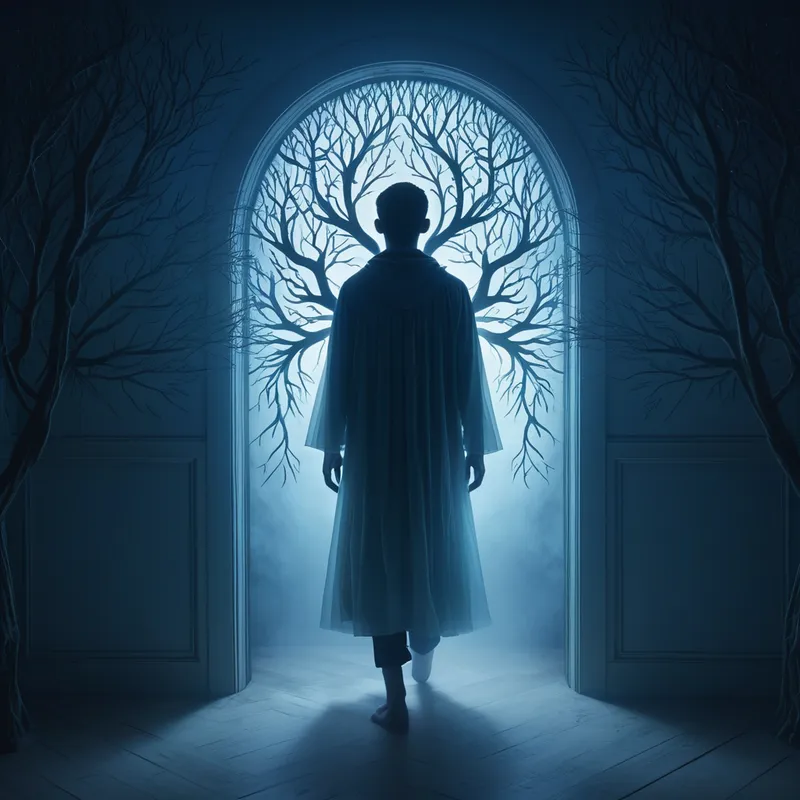
The alchemical work modeled by this myth is the transmutation of fate into fabric. The ego, the Observer, is tasked with a terrifying freedom: it must act, and in acting, it seemingly defines everything. This leads to the "lead" of paralysis, regret, and the burden of a singular, fragile identity.
The myth offers the "philosopher’s stone" of perspectival shift. The alchemical operation is not to change the choice, but to change the understanding of what a choice is.
Individuation is not the narrowing down to one true self, but the conscious relationship with the branching multiverse within.
The initiate learns to perform the inner observation. Instead of gazing outward to collapse a single reality, they turn their attention inward to behold their own Wave—the swirling mass of contradictions, talents, and latent selves. They do not judge one as right and another as wrong. They acknowledge them all as constituent parts of their total being. In doing so, they step from the perspective of a single branch to the perspective of the Tree of Worlds itself.
The triumph is a sense of cosmic citizenship. The individual path one walks is chosen and precious, but it is no longer felt as a rejection of all other possibilities. Those other selves in their other worlds are not enemies or failures; they are co-creators in the vast story of the psyche. The gold produced is a liberated responsibility: one acts decisively in this world, not out of fear of missing out, but with the solemn joy and curiosity of an explorer charting one unique, beautiful path through an infinite forest of becoming. The final stage is not a static "self," but a living, breathing nexus where the One and the Many are forever reconciled.
Associated Symbols
Explore related symbols from the CaleaDream lexicon: