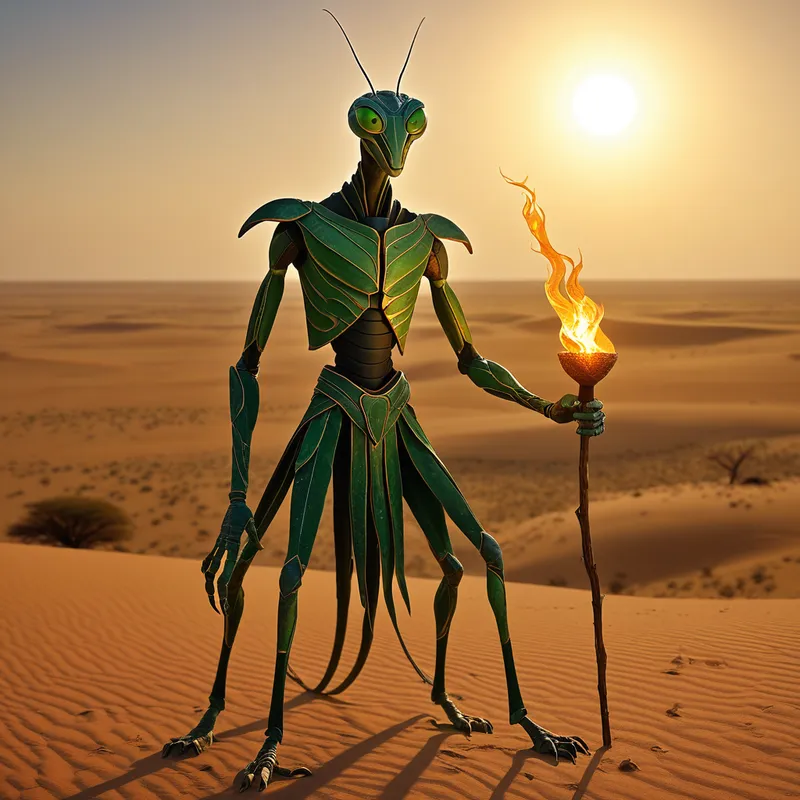
Mantis as Trickster and Creator Myth Meaning & Symbolism
A tiny, cunning mantis, through trickery and theft, steals the secret of fire to create humanity, embodying the paradox of creation through chaos.
The Tale of Mantis as Trickster and Creator
In the time before time, when the earth was soft and the sky was close, the world was a place of giants. The sun, Kaggen, had made the great animals: the mountain-shaking Elephant, the river-long Python, the sky-scraping Giraffe. But the world was silent, save for the wind and the growl of empty bellies. There was no spark, no warmth in the belly of the night, no clever hands to shape the world.
And there was Mantis.
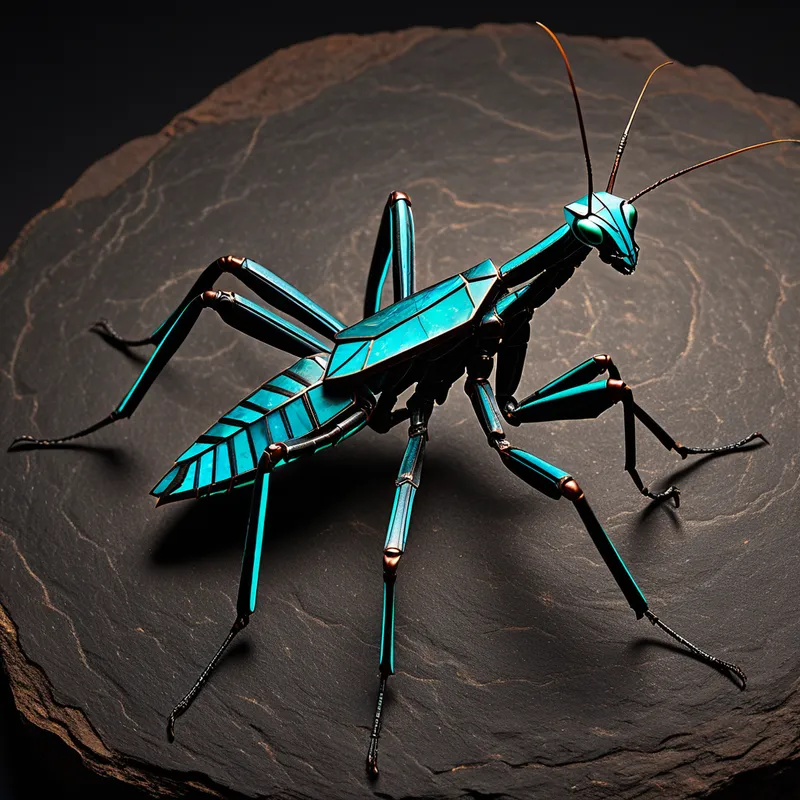
He was not a giant. He was a sliver of green and brown, a creature of delicate limbs and enormous, watchful eyes. To the great ones, he was nothing. A speck. A bit of dust on the wind. But within his tiny form buzzed a universe of cunning. Mantis saw the world not as it was, but as it could be. He saw the cold and the dark, and he dreamed of a different kind of creature. Not one of sheer size, but one of mind. He dreamed of the People.
But to make the People, he needed the one thing Kaggen kept locked away in the very heart of the sun: Fire. The secret of warmth, of tool, of community, of cooked food that would feed a small, weak body and fuel a vast, dreaming mind.
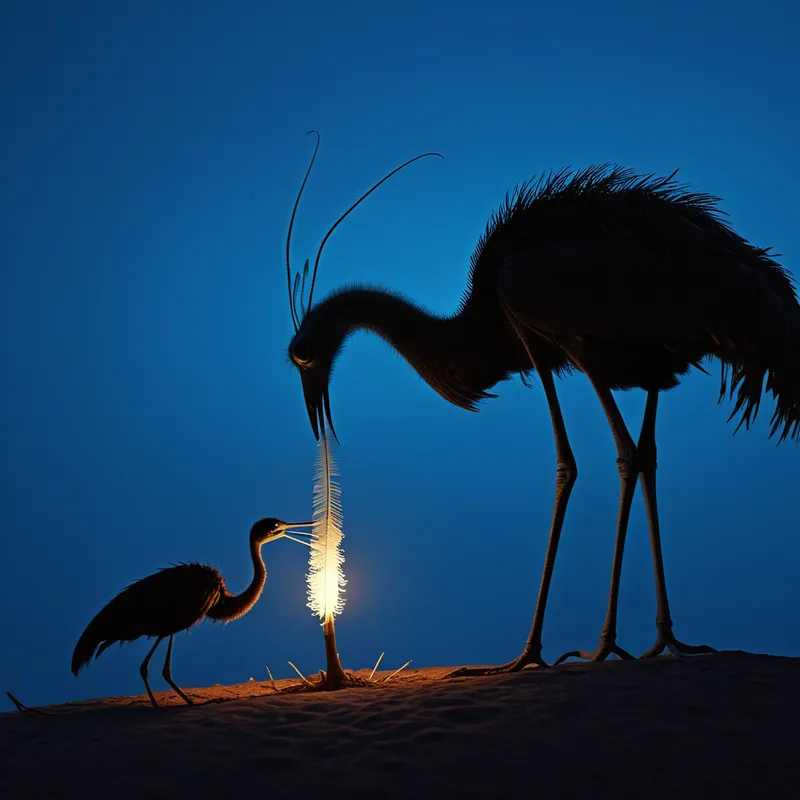
So Mantis, the insignificant, devised an insignificant plan. He found Ostrich, the great bird who thought herself the keeper of all beautiful things. With flattery sweeter than honeydew, he praised her magnificent feathers. “Oh, greatest of birds,” he chirped, “your feathers are like the black of the night sky and the white of the morning star! But they are dull. Let me adorn them, make them shine like the sun itself, so all will know you are queen.”
Vain Ostrich preened and agreed. Mantis, with infinite patience, took a single, hollow quill from her wing. Then, he journeyed to the place where the sun rested. He did not charge. He did not plead. He waited, a still, green leaf in the golden glare. And as Kaggen turned, a single, perfect ember, a seed of the sun, fell from its side. In a flash of movement too quick for any giant to see, Mantis caught the ember in the hollow quill and was gone, a whisper on the wind.
He returned to the first man and woman, figures he had shaped from the red earth. They were cold, silent, lifeless. Holding the glowing quill before them, Mantis blew gently. Sparks flew and landed in the dry grass, blooming into the first fire. The light danced in the eyes of the clay figures. The warmth entered their bodies. They shuddered, coughed, and drew their first breath. The People were alive.
And from that day, the giants feared the new creatures who carried the stolen sun in their hearths and in their eyes. Mantis, the trickster, the thief, had not conquered through strength, but through wit. He had stolen the divine spark and given it to the small, the vulnerable, the dreaming. Creation was not an act of solemn decree, but a brilliant, chaotic heist.
Cultural Origins & Context
This myth finds its deepest roots among the San peoples of the Kalahari, often considered some of the oldest continuous cultures on Earth. Here, the mantis, or Kaggen (a term that can refer to both the trickster and a supreme being), is a central figure in a vast oral tradition. These stories were not mere entertainment; they were the living encyclopaedia of the San, encoding survival knowledge, social codes, and cosmological understanding. Told around evening fires, the tales of Mantis were performed with mimicry, song, and click-language sounds that brought the arid landscape and its creatures to vivid life. The myth served to explain the paradoxical nature of existence: why humans are both clever and flawed, why fire is both a gift and a danger, and why creation often emerges from unlikely, even morally ambiguous, sources. It placed the small and observant at the center of the cosmic drama, a profound reflection of a hunter-gatherer society’s worldview where acute perception and adaptability were valued above brute force.
Symbolic Architecture
The Mantis embodies the ultimate paradox: the insignificant as the essential, the trickster as the creator. He is not a benevolent, omnipotent father-god, but a liminal being operating at the edges of the established order.
- The Trickster as Necessary Catalyst: Mantis does not create from nothingness; he rearranges through deception. He steals fire from the sun (the established, divine order) to give it to humanity (the new, emerging consciousness). This represents the psychological truth that new consciousness, innovation, and life itself often arise not from purity, but from a disruptive, even "criminal" recombination of existing elements. The ego’s orderly world must be tricked for the soul’s new fire to be born.
The sacred spark is never given; it is always stolen from the complacency of the gods by the cunning of the soul.
- The Weapon of Perception: Mantis’s power lies in his enormous, compound eyes—his capacity to see from multiple angles, to wait with perfect stillness, and to strike with precision. This symbolizes the focused attention of the unconscious itself, which observes the complexes and energies (the "giants") of the psyche and finds the precise, unexpected moment to intervene and redirect energy (the ember) for a new purpose.
- The Hollow Quill (Vessel of Transformation): The ostrich feather is a symbol of vanity and surface beauty, co-opted by Mantis. He hollows it out, making it a vessel for the divine fire. This represents the process of taking a superficial aspect of the personality (a vanity, a pride) and, through conscious insight, emptying it of its old content to make it a conduit for transformative energy.
The Dreamer's Resonance
When the archetype of Mantis stirs in the modern dreamscape, it signals a psyche engaged in a covert operation of self-creation. Dreaming of a mantis, especially one that is observant, still, or engaged in a seemingly illogical but precise action, points to a process where the dreamer’s deep Self is orchestrating a fundamental change.
Somatically, this might manifest as a feeling of being "small" or overlooked in waking life, coupled with a simmering, intelligent frustration with the "giants"—the overwhelming systems, internalized authorities, or monolithic life structures that seem cold and unyielding. The Mantis dream is a reassurance from the unconscious: the power for change does not lie in direct, forceful confrontation, but in patient observation, cunning, and the willingness to use the very tools of the system (the hollow quill of one’s circumstances) against itself to steal back one’s own vital energy (fire). It is the psyche preparing for a creative act that may feel, on the surface, like rebellion or theft.

Alchemical Translation
The myth of Mantis models the alchemical stage of Nigredo leading directly to Albedo. The old, solar order (the stagnant, inflated, or dominant conscious attitude) must have its central fire "stolen" to initiate the transformation.
For the individual, this translates to the often uncomfortable process of creative disillusionment. The "giants" are our inner rulers: the rigid persona, the crushing super-ego, the monolithic complexes that dictate "how life is." The "fire" is our latent libido, our authentic life force, currently bound up in serving these giants. Mantis-consciousness is that sly, observant part of the ego that allies with the Self to stage a heist.
Individuation begins not with a grand declaration, but with a quiet, internal theft—the stealing of attention back from the collective and giving it to the nascent, authentic self.
The process involves: 1) The Flattery (Observation): Studying the complex without triggering its defenses. 2) The Hollowing (Making Space): Finding a seemingly insignificant aspect of one’s life or personality that can be used as a vessel. 3) The Theft (Redirection of Energy): The moment of insight where energy is siphoned from a neurotic pattern into a creative endeavor. The result is not a purified, saintly self, but a fully human one—warm, flawed, inventive, and alive, born from the cunning marriage of chaos and purpose. We do not become sun-gods; we become fire-keepers, our humanity ignited by a stolen spark.
Associated Symbols
Explore related symbols from the CaleaDream lexicon: