
Manna in the Wilderness Myth Meaning & Symbolism
A mysterious substance appears each dawn to feed the Israelites in the desert, a gift of divine grace that tests their faith and dissolves their certainties.
The Tale of Manna in the Wilderness
The sun was a merciless eye. It had watched them for weeks, this ragged multitude, as they stumbled through a world of stone and dust. The memory of the Reed Sea’s closing waters, a victory shout still echoing in their ears, had curdled into the bitter taste of thirst. Freedom, they discovered, was a vast and hungry emptiness.
Their bellies growled a chorus of regret. In [the shadow](/myths/the-shadow “Myth from Jungian culture.”/) of the mountain, the people turned on [Moses](/myths/moses “Myth from Biblical culture.”/) and his brother Aaron. “Would that we had died by the hand of YHWH in the land of Egypt,” they cried, their voices cracking like [the earth](/myths/the-earth “Myth from Hindu culture.”/), “when we sat by the pots of meat and ate bread to the full! For you have brought us out into this wilderness to kill this whole assembly with hunger.”
Their lament rose like heat-shimmer, a palpable force of despair. Moses took their anguish to the silence, and the silence answered. The voice of the Lord spoke from [the cloud of unknowing](/myths/the-cloud-of-unknowing “Myth from Christian Mysticism culture.”/): “Behold, I will rain bread from heaven for you.”
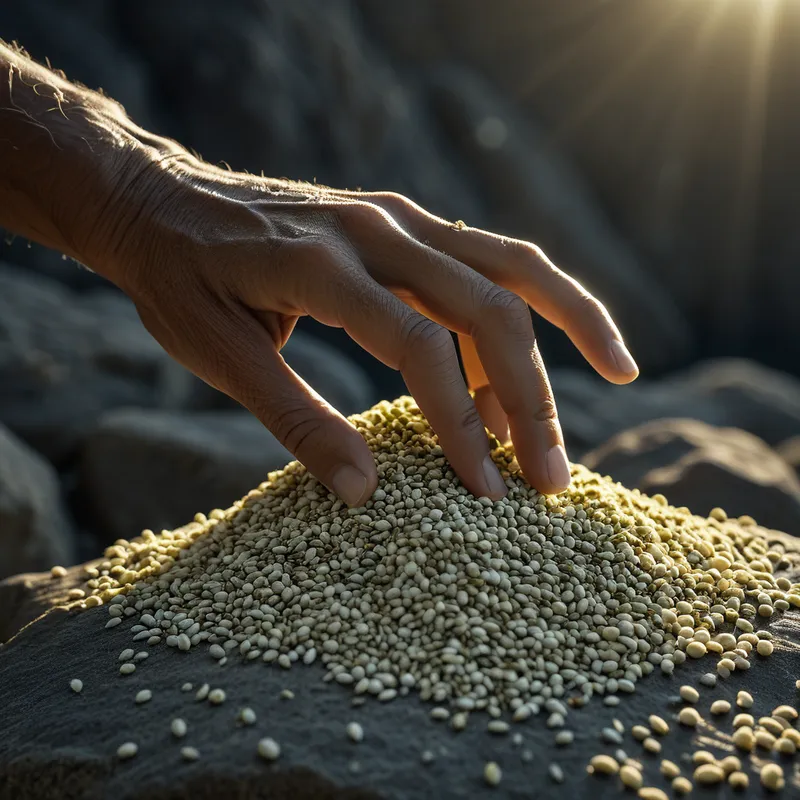
That night, a wind from the quarters of grace stirred [the desert](/myths/the-desert “Myth from Biblical culture.”/). And in the morning, when [the dew](/myths/the-dew “Myth from Alchemical culture.”/) lifted, there lay upon the face of [the wilderness](/myths/the-wilderness “Myth from Biblical culture.”/) a fine, flake-like [thing](/myths/thing “Myth from Norse culture.”/), fine as frost on the ground. The people saw it and said to one another, “Man hu?” For they did not know what it was.
It was white, like coriander seed, and the taste of it was like wafers made with honey. A daily miracle with strict instructions: gather only what you need for the day, an omer per person. On the sixth day, gather a double portion, for the seventh day is a solemn rest, a [Sabbath](/myths/sabbath “Myth from Judeo-Christian culture.”/) to the Lord. On that day, the ground would yield nothing, but the stored portion would remain sweet and whole.
Some did not listen. Driven by a fear deeper than faith, they hoarded, only to find their secret stash writhing with worms and stinking by morning. Others, distrusting the rhythm of grace, went out to gather on [the Sabbath](/myths/the-sabbath “Myth from Abrahamic culture.”/) and found the earth barren. Thus, they learned to receive, not to seize. [The manna](/myths/the-manna “Myth from Biblical culture.”/) became their daily rhythm, their tangible proof of a covenant written not on stone but in the meeting of their need and the morning dew. For forty years, until the borders of [the promised land](/myths/the-promised-land “Myth from Biblical culture.”/), it was their food, this bread of angels, this question from heaven made edible.
Cultural Origins & Context
This story is embedded in the foundational epic of the Israelites, [the Exodus](/myths/the-exodus “Myth from Abrahamic culture.”/) narrative. It functions as a central pillar in the wilderness tradition, a period of liminality between the slavery of Egypt and the settled life in Canaan. The myth was preserved and shaped within priestly and prophetic circles, likely during the monarchy or the Babylonian exile, times when the community itself felt spiritually and physically precarious. Its telling served multiple societal functions: it was an etiological myth explaining the origin of the Ark of the Covenant’s pot of [manna](/myths/manna “Myth from Biblical culture.”/); a legal narrative establishing the sanctity of the Sabbath; and, most profoundly, a foundational story of identity. It answered the perennial question of a people formed in dislocation: “How did we survive?” The answer was not military prowess or agricultural skill, but radical dependence on a divine provision that refused to be controlled.
Symbolic Architecture
The manna is the ultimate [symbol](/symbols/symbol “Symbol: A symbol can represent an idea, concept, or belief, serving as a powerful tool for communication and understanding.”/) of grace—a gift that is necessary, unearned, and inexplicable by the [logic](/symbols/logic “Symbol: The principle of reasoning and rational thought, often representing order, structure, and intellectual clarity in dreams.”/) of [the world](/myths/the-world “Myth from Tarot culture.”/). It arrives not as a permanent [solution](/symbols/solution “Symbol: A solution symbolizes resolution, clarity, and the overcoming of obstacles, often representing a sense of accomplishment.”/) but as a daily negotiation with trust.
The wilderness is not a place of punishment, but the necessary emptiness where the soul’s true hunger can be heard, and where the bread of meaning must descend from a realm beyond the ego’s control.
The substance itself, a [mystery](/symbols/mystery “Symbol: An enigmatic, unresolved element that invites curiosity and exploration, often representing the unknown or hidden aspects of existence.”/) encapsulated in the question “Man hu?” represents [knowledge](/symbols/knowledge “Symbol: Knowledge symbolizes learning, understanding, and wisdom, embodying the acquisition of information and enlightenment.”/) that cannot be categorized. It is divine wisdom made digestible, yet it remains enigmatic. Its rules—no hoarding, respect for the Sabbath—psychologically model the [dissolution](/symbols/dissolution “Symbol: The process of breaking down, dispersing, or losing form, often representing transformation, release, or the end of a state of being.”/) of the id’s impulsive greed and the establishment of a sacred [rhythm](/symbols/rhythm “Symbol: A fundamental pattern of movement or sound in time, representing life’s cycles, emotional flow, and universal order.”/) ([temenos](/myths/temenos “Myth from Greek culture.”/)) that protects the [psyche](/myths/psyche “Myth from Greek culture.”/) from [the tyranny](/symbols/the-tyranny “Symbol: A symbol of oppressive control, unjust authority, and systemic domination that suppresses individual freedom and collective well-being.”/) of endless production and consumption. [The Israelites](/myths/the-israelites “Myth from Abrahamic culture.”/)’ constant grumbling symbolizes [the ego](/myths/the-ego “Myth from Jungian culture.”/)’s [resistance](/symbols/resistance “Symbol: An object or tool representing opposition, struggle, or the act of pushing back against external forces or internal changes.”/) to this new, vulnerable state of being, perpetually nostalgic for the “pots of [meat](/symbols/meat “Symbol: Meat in dreams often symbolizes sustenance, vitality, and the primal aspects of one’s nature, as well as potential conflicts or desires.”/)” of Egypt—the familiar miseries of the old, confined self.
The Dreamer’s Resonance
When this myth stirs in the modern dreamer, it often manifests during life’s “wilderness” phases: after a great departure (a career change, the end of a relationship, a spiritual awakening), when the old structures have fallen away and the new land is not yet in sight. The dreamer may find themselves in a barren landscape, feeling a profound and anxious lack.
Dream images of inexplicable food appearing, of searching for sustenance in a desert, or of trying and failing to store a miraculous substance, point directly to this archetypal pattern. Somatically, this can correlate with feelings of emptiness in the gut, or anxiety about resources. Psychologically, the dream is orchestrating a crucial process: the breaking of the ego’s illusion of self-sufficiency. It is forcing a confrontation with dependency, asking the dreamer to attend not to grand plans, but to the “daily portion.” The worms in the hoarded manna are the dream’s perfect representation of the soul’s truth: psychic nourishment grasped by the greedy, controlling hand of the ego rots into anxiety and futility.

Alchemical Translation
The alchemical journey of the Massa Confusa—the chaotic, leaden state of the soul—into gold requires a [prima materia](/myths/prima-materia “Myth from Alchemical culture.”/), a fundamental substance. The manna myth provides the blueprint for this operation. The lead is the condition of the “orphan” archetype in the desert: lost, hungry, and complaining. [The first stage](/myths/the-first-stage “Myth from Alchemical culture.”/) ([nigredo](/myths/nigredo “Myth from Alchemical culture.”/)) is the deep despair and the bitter regret for the abandoned, albeit oppressive, “Egypt” of the unconscious personality.
The descent of the manna is the divine intervention of the lapis, the philosopher’s stone, not as a permanent trophy but as a process. The alchemical [solve et coagula](/myths/solve-et-coagula “Myth from Alchemical culture.”/) (dissolve and coagulate) is performed daily: the certainty of the old self is dissolved by the wilderness, and a new, provisional self is coagulated each morning with the acceptance of the gift.
Individuation is not about building a permanent fortress of the self, but about learning the sacred ritual of receiving your daily portion of meaning, and having the faith to let the remainder of the mystery remain ungrasped.
The strict Sabbath rhythm is the conjunctio, [the sacred marriage](/myths/the-sacred-marriage “Myth from Various culture.”/) of effort and rest, human need and divine law. By forbidding gathering on the seventh day, the myth insists that the psyche must have a chamber where it does not strive, where it lives on the nourishment already integrated. The ultimate transmutation is not arriving at a “[promised land](/myths/promised-land “Myth from Biblical culture.”/)” of perfect autonomy, but internalizing the wilderness itself as the sacred space where one dines, daily, on mystery. The ego is transformed from a desperate hoarder into a grateful, attentive receiver, and in that posture, the soul finds its true sustenance.
Associated Symbols
Explore related symbols from the CaleaDream lexicon: