Manna in the Desert Myth Meaning & Symbolism
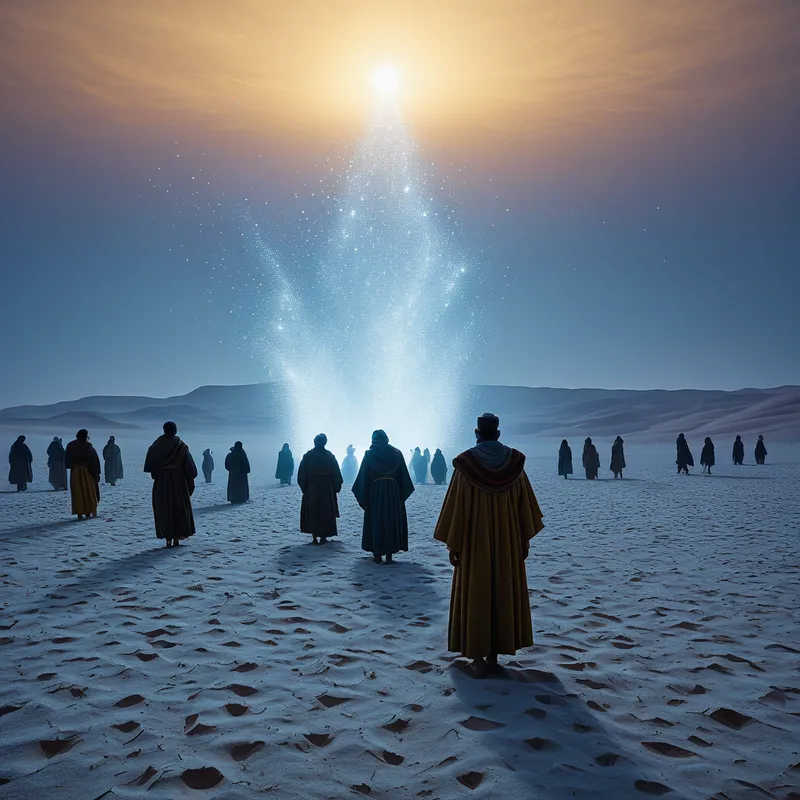
The Israelites, freed from slavery, face starvation in the wilderness. In response to their despair, a mysterious, life-sustaining bread descends from heaven each dawn.
The Tale of Manna in the Desert
Hear now the tale of a people caught between the memory of chains and the terror of freedom. The dust of Egypt still clung to their sandals, but the taste of its bitter herbs had faded, replaced by the dry, metallic thirst of the Desert of Sin. For a moon’s turn they had walked, a vast murmuring river of humanity led by the stern, cloud-wrapped presence of [Moses](/myths/moses “Myth from Biblical culture.”/). The Red Sea’s miracle was a memory growing thin, its roaring walls of [water](/myths/water “Myth from Chinese culture.”/) now a whisper against the present, grinding reality: empty bellies, wailing children, and the endless, baking expanse of stone and sand.
The grumbling began as a low hum, a vibration of fear in the camp at dusk. It swelled with the darkness. “Was it for lack of graves that you brought us to die here?” they cried to Moses and his brother Aaron. “In Egypt, we sat by pots of meat and ate bread to the full. You have brought us into this wilderness to kill this whole assembly with hunger!” Their freedom, so dearly won, felt like a cruel joke, a vast, empty room after the cramped certainty of servitude. [The wilderness](/myths/the-wilderness “Myth from Biblical culture.”/) was not a path to a [promised land](/myths/promised-land “Myth from Biblical culture.”/); it was a grinning maw.
And YHWH heard. The divine response was not thunder, but a promise whispered to Moses on [the wind](/myths/the-wind “Myth from Various culture.”/): “Behold, I will rain bread from heaven for you.” The people did not know what to watch for. That night, quail descended, a gift of flesh. But the true mystery came with the dawn.
As the first [pearl](/myths/pearl “Myth from Chinese culture.”/)-grey light touched the eastern hills, the camp awoke to a wonder. All across the face of the wilderness, surrounding their tents, was a fine, flaky substance, delicate as hoarfrost on the ground. It lay upon the face of [the desert](/myths/the-desert “Myth from Biblical culture.”/) like a veil of grace. They looked at one another, bewildered, and asked, “Man hu?” For they did not know what it was. Moses said to them, “It is the bread which YHWH has given you to eat.”
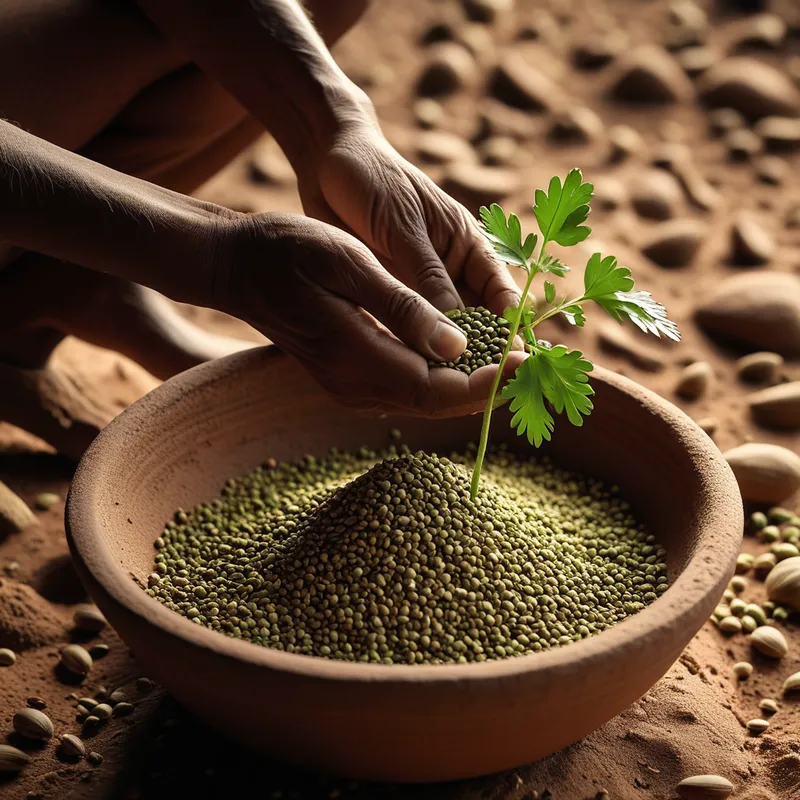
They gathered it, each according to their need, an omer per person. It was white like coriander seed, and its taste was like wafers made with honey. Some tried to hoard it, to save it against the terror of tomorrow, but by morning it bred worms and stank. Yet, each new day, the ground was covered again, a daily sacrament of trust. On the sixth day, a double portion fell, and this alone did not spoil, sustaining them through the sacred rest of the [Sabbath](/myths/sabbath “Myth from Judeo-Christian culture.”/). For forty years, as their sandals did not wear out and their feet did not swell, this bread from heaven was their sustenance, their daily lesson, their tangible proof that in the vast and terrifying emptiness, they were not forgotten, but fed.
Cultural Origins & Context
This narrative is embedded in the Book of Exodus, a foundational text of the Hebrew people. It functions as a core etiological story—explaining the origin of [the Sabbath](/myths/the-sabbath “Myth from Abrahamic culture.”/) observance and establishing a paradigm of divine providence. Passed down orally for generations before being codified, the tale was told at gatherings and taught to children, not merely as history, but as formative identity.
Its societal function was multifaceted. For a people often displaced, conquered, or in exile, it served as a potent reminder of their origins as a nation forged in a covenant of trust. It answered the existential anxiety of scarcity with a theological assertion: their God was a provider in the most literal sense. The strict rules around [the manna](/myths/the-manna “Myth from Biblical culture.”/)—no hoarding, a double portion before the Sabbath—reinforced communal ethics and sacred rhythm, teaching that survival and sanctity were intertwined. It was a story that transformed a collective memory of trauma (slavery) and terror (the desert) into a testament of sustained, miraculous care, solidifying a unique relationship between the people, their leader Moses, and their deity.
Symbolic Architecture
At its [heart](/symbols/heart “Symbol: The heart symbolizes love, emotion, and the core of one’s existence, representing deep connections with others and self.”/), the myth of [manna](/myths/manna “Myth from Biblical culture.”/) is an archetypal [drama](/symbols/drama “Symbol: Drama signifies narratives, emotional expression, and the exploration of human experiences.”/) of dependency and grace, set on the stark stage of the [human](/symbols/human “Symbol: The symbol of a human represents individuality, complexity of emotions, and social relationships.”/) [psyche](/myths/psyche “Myth from Greek culture.”/). The desert represents the liminal [space](/symbols/space “Symbol: Dreaming of ‘Space’ often symbolizes the vastness of potential, personal freedom, or feelings of isolation and exploration in one’s life.”/) of transformation—the fraught, empty middle ground between an old, familiar brokenness (Egypt/slavery) and a new, unformed wholeness ([the Promised Land](/myths/the-promised-land “Myth from Biblical culture.”/)/individuation). It is the psychological [wilderness](/symbols/wilderness “Symbol: Wilderness often symbolizes the untamed aspects of the self and the unconscious mind, representing a space for personal exploration and discovery.”/) we enter when we leave behind destructive patterns, relationships, or identities, before new structures have taken root.
The bread that falls from heaven is not earned, but given; it symbolizes grace that arrives precisely when our own resources—our cleverness, our strength, our stored provisions—are utterly exhausted.
The manna itself is the ultimate [symbol](/symbols/symbol “Symbol: A symbol can represent an idea, concept, or belief, serving as a powerful tool for communication and understanding.”/) of provision from the unknown. It is sustenance that comes not from cultivation (human [effort](/symbols/effort “Symbol: Effort signifies the physical, mental, and emotional energy invested toward achieving goals and personal growth.”/)) but from [revelation](/symbols/revelation “Symbol: A sudden, profound disclosure of truth or insight, often through artistic or musical means, that transforms understanding.”/) (divine [action](/symbols/action “Symbol: Action in dreams represents the drive for agency, motivation, and the ability to take control of situations in waking life.”/)). Its [ephemeral nature](/symbols/ephemeral-nature “Symbol: Ephemeral nature refers to the transient and fleeting quality of existence, emphasizing the impermanence of life and material things.”/)—spoiling if hoarded, renewing daily—is a profound psychological [truth](/symbols/truth “Symbol: Truth represents authenticity, honesty, and the quest for knowledge beyond mere appearances.”/). It represents the [insight](/symbols/insight “Symbol: A sudden, deep understanding of a complex situation or truth, often arriving unexpectedly and illuminating hidden connections.”/), inspiration, or emotional sustenance that nourishes us through a [crisis](/symbols/crisis “Symbol: A crisis symbolizes turmoil, urgent challenges, and the need for immediate resolution or change.”/) but cannot be stored or controlled. It must be gathered fresh each day, teaching a radical trust in the process of [life](/symbols/life “Symbol: The symbol of ‘Life’ represents a journey of growth, interconnectedness, and existential meaning, encompassing both the joys and challenges that define human experience.”/) and the unconscious. [The Israelites](/myths/the-israelites “Myth from Abrahamic culture.”/)’ confused question, “Man hu?” (What is it?), mirrors our own confrontation with gifts from the deep psyche that we cannot initially name or understand, yet which we must learn to receive and integrate.
The Dreamer’s Resonance
When this myth stirs in the modern dreamer, it often signals a profound somatic and psychological process of learning to receive. The dreamer may find themselves in a barren, anxious landscape—a featureless office, an empty house, a vast plain. There is a feeling of being stranded, of having left a situation (the “Egypt” of a job, relationship, or old self) but now facing a terrifying scarcity of purpose, energy, or hope.
The appearance of the manna in the dream takes many forms: unexpected money found, a stranger offering food, mysterious nourishment appearing in a cupboard, or simply a feeling of warmth and sustenance descending. The key is its unearned, surprising quality. Psychologically, this marks a critical shift. [The ego](/myths/the-ego “Myth from Jungian culture.”/), which believes it must control and procure everything, is in a state of failure and despair. The dream is an intervention from [the Self](/myths/the-self “Myth from Jungian culture.”/), the archetype of wholeness, offering a new paradigm: sustenance can come from beyond [the ego](/myths/the-ego “Myth from Jungian culture.”/)’s plans. The process involves the humiliation of the heroic, self-sufficient attitude and the slow, often reluctant, acceptance of support—from the unconscious, from others, or from life itself—in a form one did not anticipate and cannot fully explain.

Alchemical Translation
The alchemical journey mirrored here is the transmutation of anxiety into trust, and of scarcity consciousness into an awareness of psychic abundance. The “base metal” is the soul’s state of fear and clinging control, born from the trauma of “slavery” to external masters or internal complexes. The desert is the [nigredo](/myths/nigredo “Myth from Alchemical culture.”/), [the dark night of the soul](/myths/the-dark-night-of-the-soul “Myth from Christian Mysticism culture.”/), where all former identities and securities are dissolved.
The descent of manna is the beginning of the albedo, the whitening. It is the first evidence that the process itself is intelligent and nourishing. The discipline of gathering only what is needed for the day is the alchemical [separatio](/myths/separatio “Myth from Alchemical culture.”/)—learning to distinguish between genuine need and the greed of the anxious ego that seeks to hoard against future emptiness.
The miracle is not in the single dramatic rescue, but in the relentless, daily return of the nourishment, teaching the soul its deepest lesson: that the process of becoming whole is sustained by a grace that operates on a rhythm beyond human design.
For the modern individual, this models the path of individuation as a sustained reliance on the unconscious. We are to do our part—to “gather” the insights from our dreams, our creative impulses, our moments of synchronicity—but we cannot force their arrival or stockpile them against all future challenges. We must learn the Sabbath rhythm: to work with the nourishing material when it is given, and to trust in the sacred rest, the fallow period, when it seems absent, knowing the covenant of the process remains intact. Thus, the soul is led through its wilderness, not by a map it draws, but by a daily bread it receives.
Associated Symbols
Explore related symbols from the CaleaDream lexicon: