
Manna Myth Meaning & Symbolism
A mysterious substance, given daily by God, sustains the Israelites in the wilderness, teaching trust and the grace of impermanent provision.
The Tale of Manna
The sun was a hammer on an anvil of sand. For forty days, the breath of the wilderness of Sin had been a furnace, and the hope of a million souls had turned to ash. They were a people un-made, a river of former slaves cut off from the muddy banks of Egypt, adrift in a sea of desolation. Their bellies, once filled with the coarse bread of bondage, now echoed with a deeper hunger—a hunger for a future that seemed as barren as the stones beneath their feet.
Murmuring rose like heat haze. It began as a whisper against the rock, a sigh against the tent cloth, and swelled into a roar directed at Moses and his brother Aaron. “Would that we had died by the hand of Yahweh in the land of Egypt,” they cried, “when we sat by pots of meat and ate bread to the full! For you have brought us out into this wilderness to kill this whole assembly with hunger.”
Their words were arrows, and Moses felt each one pierce. He turned his face to the immense, silent sky, a question heavier than stone in his heart. And the silence answered. A voice, not in thunder but in the deep knowing of the spirit, spoke to Moses: “Behold, I will rain bread from heaven for you. And the people shall go out and gather a day’s portion every day.”
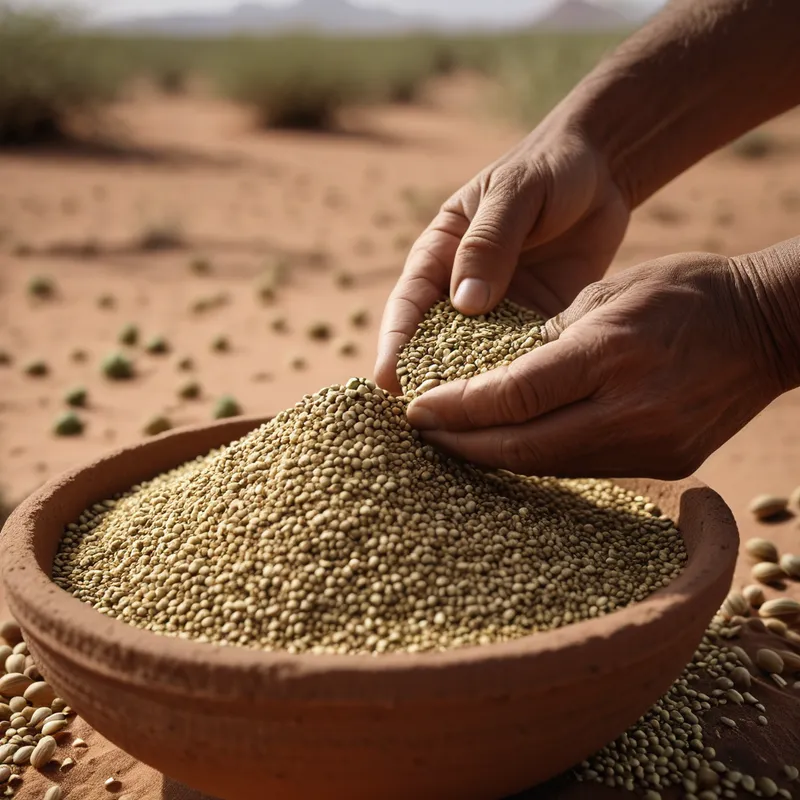
The next morning, a miracle lay upon the face of the wilderness. As the dew lifted, there remained on the ground a fine, flake-like thing, fine as frost. It was white, like coriander seed, and the taste of it was like wafers made with honey. The people saw it and said to one another, “Man hu?” For they did not know what it was. And Moses said to them, “It is the bread which Yahweh has given you to eat.”
A strict rhythm was established, a sacred cadence to their survival. They were to gather only what was needed for that day, an omer per person. Some, gripped by the old fear of scarcity, tried to save it for the morrow. But by morning, what they had hoarded was foul, writhing with worms, and stank. On the sixth day, a different instruction came: gather twice as much, for the seventh day was a Sabbath to Yahweh. And on that day, the gathered portion did not spoil; it remained pure and sweet. For forty years, until they reached the border of Canaan, this bread from heaven descended with the dew. It was their daily mystery, their edible grace.
Cultural Origins & Context
The myth of Manna is embedded in the foundational Book of Exodus, a text that crystallized the identity of the Israelite people. It functions as a core etiological narrative, explaining not just a historical event but the theological and social character of a nation forged in transition. Passed down orally for generations before being codified by priestly and Deuteronomistic writers, the story served multiple vital functions.
Societally, it established the paradigm of complete dependence on the divine. In the harsh, anarchic space of the desert—a place of both physical and spiritual testing—the regular, unearned gift of Manna countered the predictable but oppressive economy of Egyptian slavery. It taught a new rhythm of life, one centered on trust rather than control, on divine provision rather than human accumulation. The strict rules surrounding its gathering (no hoarding, observance of the Sabbath) were not arbitrary restrictions but formative disciplines meant to shape a communal ethic distinct from the empires they had left and were about to encounter. It was a myth told to remind a settled, agricultural people that their ultimate security was not in barns and storehouses, but in covenant.
Symbolic Architecture
At its heart, Manna symbolizes gratuitous grace—a sustenance that appears not as a reward for labor, but as a gift to the needy and complaining. It is the antithesis of the bread of affliction eaten in Egypt, which was earned through servitude. Manna is the nourishment of liberation, but a liberation that requires a profound vulnerability.
The gift that cannot be stored is the only gift that can teach the soul to live in the eternal present.
Psychologically, Manna represents the daily, often subtle, nourishment for the psyche’s journey through its own wilderness. The Israelites’ journey from slavery (a known misery) to the Promised Land (an unknown potential) mirrors the individual’s journey from a constrained, unconscious state toward wholeness, or individuation. This path is arid, disorienting, and fraught with regressive longing for the “fleshpots of Egypt”—the familiar comforts of our neuroses and complexes. Manna is the symbolic food for this journey: the unexpected insight, the moment of synchronicity, the dream image, or the sudden peace that arrives precisely when the ego’s resources are exhausted. It is not a permanent state of enlightenment, but a daily portion of what is needed to take the next step.
The command to gather only enough for one day is a profound psychological directive against the ego’s desire to stockpile certainty, to turn spiritual experience into dogma, or to cling to a past insight as a substitute for present engagement. The hoarded manna that breeds worms symbolizes the corruption of a living truth when it is possessed rather than received anew.

The Dreamer's Resonance
When the motif of Manna appears in modern dreams, it often signals a process of learning to receive. The dreamer may be in a life transition—a career change, the end of a relationship, a creative “dry spell”—that feels like an existential desert. They are being forced to rely on resources beyond their conscious planning and effort.
Dreams of finding mysterious, nourishing substances in barren places, of being fed by an unknown source, or conversely, of desperately searching for food and finding only inedible things, all resonate with the Manna archetype. Somaticly, this can correlate with a release of chronic tension—the “holding on” of the ego—and a shift toward a more receptive state. There may be anxiety around this receptivity, mirroring the Israelites’ complaints. The psyche is working through a foundational question: Can I trust that I will be supported if I relinquish my compulsive need to control my security? The dream Manna affirms that support exists, but in a form and on a schedule not of the ego’s making.
Alchemical Translation
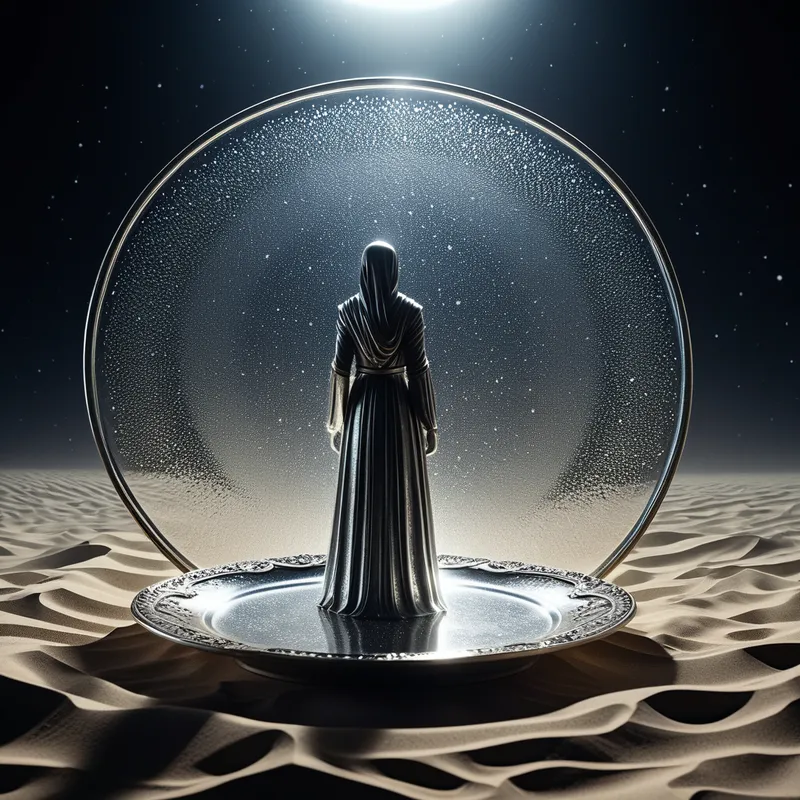
The alchemical process mirrored in the Manna myth is the solve et coagula—dissolve and coagulate—applied to the psyche’s attitude toward sustenance and security. The old, leaden identity of “slave” (dependent on the outer master for bread) must be dissolved in the fire of the desert. This is a painful, chaotic nigredo stage, filled with complaint and nostalgia for the known prison.
The wilderness is not a place of punishment, but the alembic where the soul is distilled from the collective and learns the taste of its own unique hunger.
The descent of Manna represents the beginning of the albedo, the whitening. A new, subtle substance—a spiritual principle of grace—begins to precipitate into conscious life. The daily gathering is the coagula, the careful, mindful integration of this grace into the fabric of daily existence. It is not a dramatic, once-and-for-all transformation, but a patient, repetitive practice of showing up empty-handed and receiving what is given.
For the modern individual, this translates to the practice of moving from a mindset of scarcity and control to one of trust and present-moment adequacy. It is the alchemy of transforming anxiety about the future into attention to the “daily portion”—the next right action, the immediate responsibility, the present moment’s gift of awareness or connection. The final stage is not the cessation of Manna, but the arrival at a new state of being (the Promised Land) where one can eat “the fruit of the land” (Joshua 5:12). This signifies the point where the internalized principle of grace becomes so natural that one’s own labors—the fruits of an integrated personality—become the sustainable nourishment. The external miracle is no longer needed because it has become the inner law.
Associated Symbols
Explore related symbols from the CaleaDream lexicon: