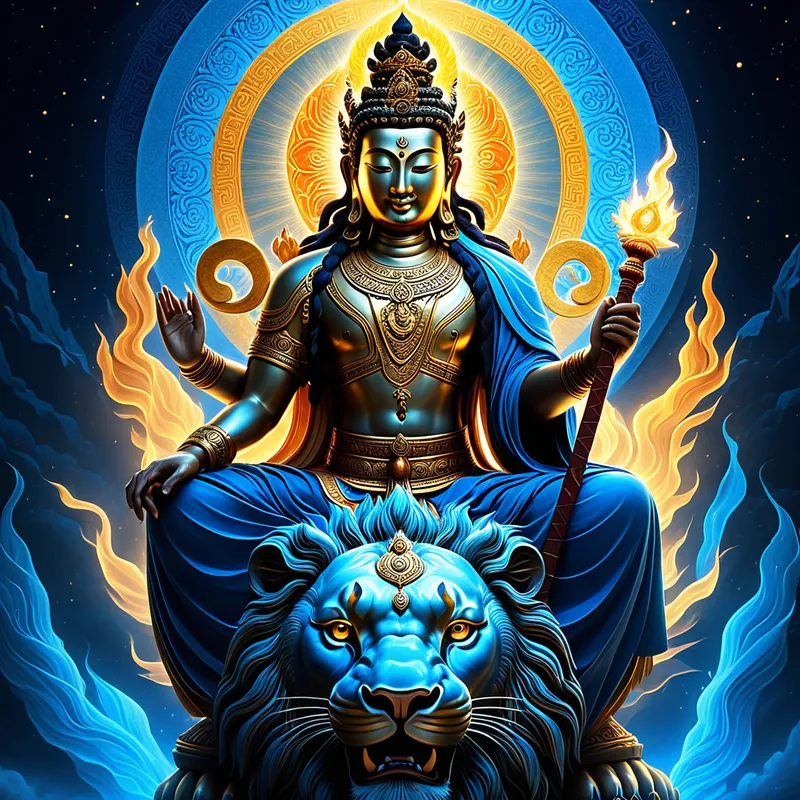
Manjushri Myth Meaning & Symbolism
The Bodhisattva of Wisdom cleaves a sacred valley with a flaming sword, draining a primordial lake to reveal the ground for a great civilization and temple.
The Tale of Manjushri
In the age when the world was still soft with myth, there lay in the high Himalayas a vast and serene expanse. It was not land, but water—a great, circular lake, profound and still, named Nagadaha. Its surface mirrored the snow-capped peaks that cradled it, a perfect, undisturbed sapphire holding the sky and mountains in a silent embrace. Beneath its placid waters, the nagas dwelled, guardians of profound depths and occult knowledge. The valley was a vessel of potential, beautiful yet dormant, waiting beneath the water’s glassy lid.
From the realm of transcendent wisdom, a presence turned its gaze toward this hidden basin. He was Manjushri, whose mind was a clear, boundless sky. He perceived not just the lake, but the future cradled within its depths—a future where a great center of learning and light, a stupa, would stand, and a civilization would flourish. But the land was submerged, the sacred earth asleep under the nagas’ domain. The time for awakening had come.
Manjushri descended, not with an army, but with a single, focused intention. In his hand, he did not carry a weapon of destruction, but an instrument of decisive clarity: the Prajna Khadga. Its blade was not of steel, but of incandescent wisdom, a blue-white flame that burned without consuming, light that cut through shadow. Standing at the lake’s southern rim, where the mountains formed a natural bowl, he raised this sword of luminous insight.
The air crackled with the intensity of concentrated thought. Then, with a gesture that was both gentle and irrevocable, he brought the flaming sword down. It did not strike the water, but the living rock of the mountain barrier. With a sound like the universe cracking open a seed, the blade sheared through the ridge at a place called Kotwal. Stone parted like mist before dawn. A deep chasm was rent open, and the waters of Nagadaha, stirred from their aeonic slumber, roared toward the breach.
A mighty river was born in that instant, draining the colossal lake in a torrent of liberation. The waters rushed out, carving their path, leaving behind not ruin, but revelation: a fertile, crescent-shaped valley, rich and ready. The nagas, their realm transformed, became protectors of the new land. And in the center of the revealed earth, the luminous Swayambhu shone forth, a self-arisen hill of light, the spiritual axis now accessible. Where there was once only reflective depth, Manjushri’s act of precise, compassionate incision created the ground for life, learning, and enlightenment to take root.

Cultural Origins & Context
The myth of Manjushri and the draining of the Kathmandu Valley is a foundational kshetra-purana (sacred geography story) for Newar Buddhism in Nepal. It is not a tale from the canonical sutras, but a living, local myth that historically explained the very topography of the Newar homeland. Passed down through chronicles like the Swayambhu Purana and woven into ritual, art, and pilgrimage, it served a crucial societal function: it sacralized the landscape.
The story provided a divine mandate for human settlement, transforming the physical valley into a buddha-kshetra. It explained why the Bagmati River flows through the Chobhar gorge and validated the supreme sanctity of the Swayambhunath stupa. Told by priests, depicted in intricate thangkas, and re-enacted in festivals, the myth established a covenant between the people, the land, and the protective, enlightening power of wisdom. It framed civilization itself not as an imposition on nature, but as the flowering of a potential revealed by transcendent insight.
Symbolic Architecture
At its heart, the myth is a profound allegory for the awakening of consciousness. The primordial lake represents the undifferentiated, unconscious mind—potentially infinite, reflective, but dormant and enclosed. It holds all possibilities (the nagas’ treasures) but lacks form and function. The water is the medium of emotion, intuition, and the psychic depths, which, without a channel, can lead to stagnation.
The sword of wisdom does not destroy the water; it provides the channel that allows its power to flow into the world, transforming potential into fertile ground.
Manjushri embodies the archetypal principle of prajna—not mere intellectual knowledge, but penetrating, intuitive insight that discerns reality from illusion. His flaming sword is the incisive power of this wisdom. The act of cutting the gorge is the moment of kensho or insight, where a single clear thought cuts through the dense rock of ingrained ignorance (avidya), allowing the pent-up energies of the psyche to be directed and utilized.
The revealed valley is the conscious, cultivated self—the “field” (kshetra) where the work of enlightenment can proceed. The self-arisen Swayambhu at its center symbolizes the innate, luminous Buddha-nature (tathagatagarbha), always present but previously inaccessible, now made the central focus of life.

The Dreamer's Resonance
When this myth stirs in the modern psyche, it often manifests in dreams of breakthrough and revelation. You may dream of being trapped in or beside a large, calm body of water—a lake, a flooded room, a still aquarium. The mood is not of terror, but of quiet impasse or beautiful stagnation. Then, an element of precise, luminous force appears: a laser beam, a shaft of lightning, a brilliant blade, or simply a sudden, undeniable knowing.
This force creates an opening, a drain, a door, or a crack in a wall. The water begins to flow out with a sense of immense relief and release, not chaos. What is revealed underneath is not emptiness, but fertile soil, ancient architecture, or a long-lost personal treasure. Somaticly, this can correlate with the release of a tension held for so long it was forgotten, a literal “clearing of the mind,” or the sudden solution to a problem that “drains away” anxiety. Psychologically, the dreamer is undergoing the process of discernment—separating confusing emotional complexes from the solid ground of authentic insight.

Alchemical Translation
The alchemical journey modeled by Manjushri’s myth is the transmutation of the prima materia of the unconscious into the lapis philosophorum of an integrated, purposeful self. The initial stage is the nigredo: the dark, watery, undifferentiated state of psychic confusion or potential without direction. We all have our “Nagadaha”—a deep pool of unprocessed emotions, talents, memories, or dreams that feels overwhelming and inaccessible.
Individuation requires not the evaporation of the unconscious, but the courageous, precise incision that gives it form and direction, turning the swamp into a navigable river and a cultivable field.
Manjushri’s descent represents the ego’s appeal to, or invocation of, a higher guiding principle—the Self. The flaming sword is the focused application of consciousness, the willingness to examine, discriminate, and make a decisive cut. This is the separatio of alchemy. It is the difficult, often painful act of setting boundaries, ending delusional narratives, or committing to a path that requires leaving a familiar, if limiting, psychic “lake.”
The draining water is the solutio—not a dissolution into chaos, but a guided flowing of psychic energy into new channels. This is the liberation of creative or emotional energy that was previously bound up in maintaining the stagnant status quo. Finally, the revealed land and the shining stupa represent the albedo and rubedo: the clarified, conscious personality grounded in its own truth (the fertile valley), oriented around its central, authentic purpose (the self-arisen stupa). The civilization that grows there is the mature, creative, and compassionate life built upon that unshakable foundation of wisdom.
Associated Symbols
Explore related symbols from the CaleaDream lexicon: