Mani Myth Meaning & Symbolism
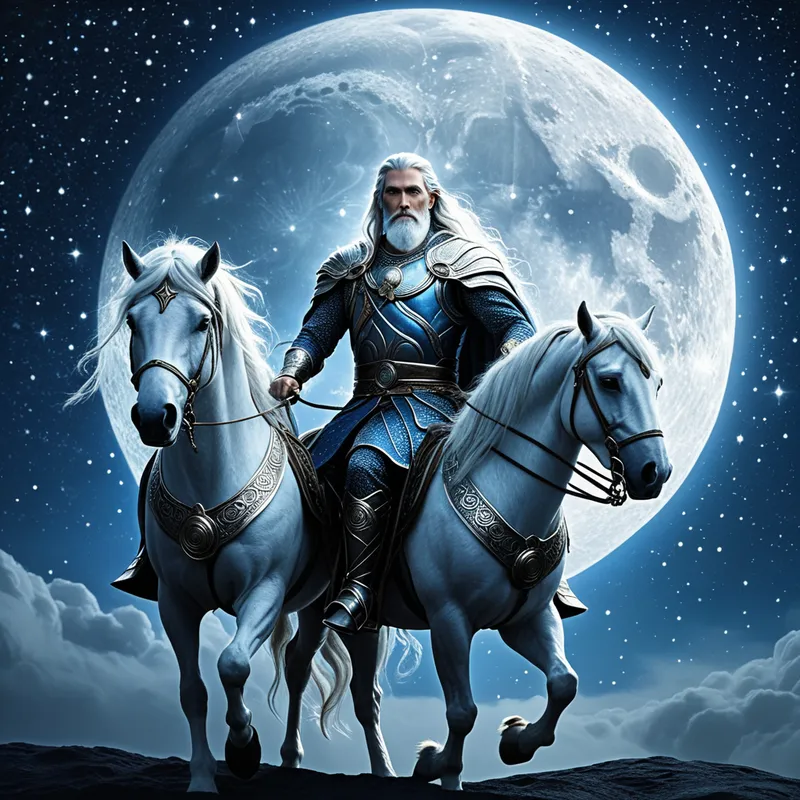
The god Mani eternally flees across the sky, pursued by the wolf Hati, after stealing two children to guide the waxing and waning moon.
The Tale of Mani
Hear now of the sky’s pale wanderer, the silent watcher of the sleeping world. Before the sun’s first fire was kindled, there was only the deep, velvet dark of Ginnungagap. From the sparks of Muspelheim and the icy rime of Niflheim, the worlds were shaped, and among the first to be placed in the heavens was a cool, gentle light. This was Mani, the Moon.
He was given a chariot, wrought from the breath of frost and the memory of silver, and two horses to pull it—Alsvidr and Arvakr, the All-Swift and the Early-Waker. His path was set: a slow, solemn circuit around the Yggdrasil, tracing the rim of the world. But his journey was a lonely one. The stars were distant, cold points; the sun, his sister Sol, raced ahead in her own fiery terror, forever out of reach. Mani’s light was a light of reflection, of borrowed glow, and it cast long, whispering shadows across Midgard.
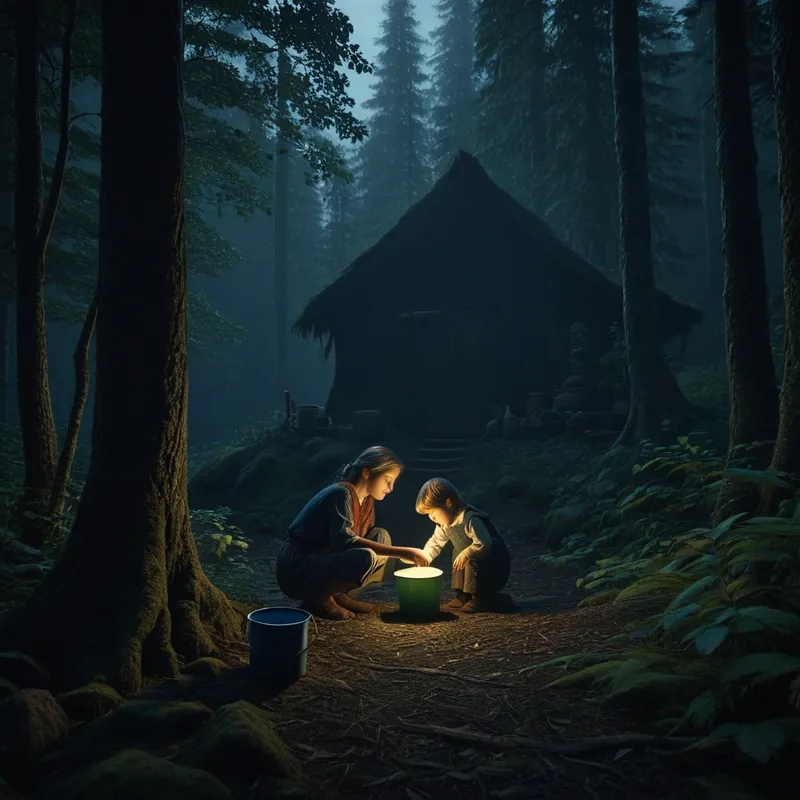
One night, as his chariot glided over a dense forest, his pale light fell upon a sight that pierced his celestial solitude. Below, by a well, were two children, a brother and sister named Hjuki and Bil. They had been sent to fetch water, their pail balanced between them on a pole. There was a simple, mortal joy in their task, a togetherness Mani had never known. A profound longing, colder than the void from which he was born, seized him. In that moment, the god of the moon committed a theft that would echo through all the ages of the world.
He reached down, not with a hand of flesh, but with a beam of captured starlight, and lifted them. Up they soared, children, pail, and pole, from the damp moss of the forest floor to the chill expanse of the sky. He set them beside him in his chariot, not as prisoners, but as companions. To them, he gave a sacred duty: they would be the guides of the moon’s countenance. Hjuki would govern the waxing light, Bil the waning, and the pail they carried became the marker of the moon’s phases.
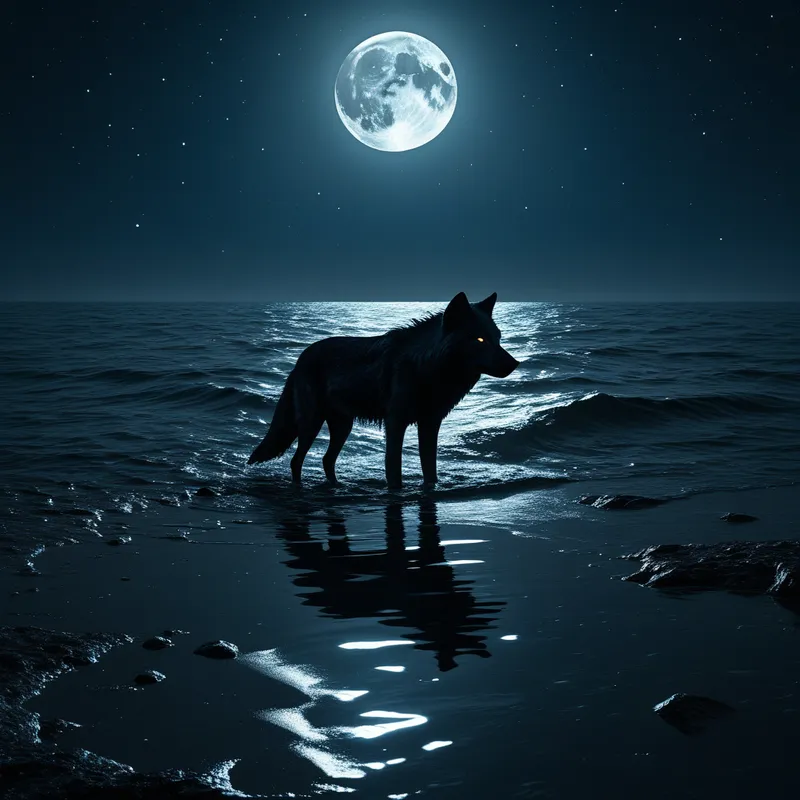
But the cosmos demands balance. For every light, a shadow is cast; for every act of possession, a pursuer is born. From the iron woods of Jarnvidr, a wolf was prophesied. Not just any beast, but Hati Hrodvitnisson, the Hateful One. His sole purpose, woven into the threads of fate by the Norns themselves, was to hunt the moon. And so the chase began. A silent, desperate sprint across the star-road. Mani, with his stolen children, now drove his chariot not in solemn orbit, but in frantic flight. The wolf’s panting breath frosts the stars behind him; his howl is the wind that rattles the branches of Yggdrasil.
This is the sky-drama that plays out every night. The gentle, thieving light, fleeing. The ravenous shadow, gaining. It is a race with a finish line written in the doom of the gods: Ragnarok. On that final day, Hati will at last close his jaws. The moon will be swallowed, its light extinguished in a spray of celestial blood, and Mani’s long flight will end. But until that twilight of the gods, he runs, a luminous orphan in the dark, forever glancing over his shoulder at the darkness that loves him enough to consume him.
Cultural Origins & Context
The fragments of Mani’s story come to us primarily from the Prose Edda of Snorri Sturluson, a Christian scholar writing in 13th-century Iceland. Snorri was preserving a pagan cosmology that was already fading, collecting older poetic sources like the cryptic Grimnismal. This was not scripture, but living lore, told around hearth-fires in the long winter nights.
The myth functioned as a celestial clock and a calendar. The moon’s phases, explained through the children and their pail, governed tides, planting, and the timing of rituals. But more deeply, it modeled the Norse worldview: a universe of dynamic, often tragic, relationships. Nothing exists in isolation. A god’s loneliness creates a theft, which summons a predator, which sets a cosmic clock ticking toward inevitable destruction. The myth was a reminder of the permeable boundary between the human and divine worlds—children could be snatched into the sky—and of the inescapable nature of ørlög. Even a god is bound by the web of cause and consequence, pursued by the shadows of his own choices.
Symbolic Architecture
Mani is not merely a celestial body; he is the archetype of the reflective consciousness. His light is not his own; it is borrowed, a mirror to the sun’s primal fire. He represents the knowing mind, the part of us that observes, measures, and yearns, but does not originate. His theft of Hjuki and Bil is the psyche’s attempt to populate its loneliness with content, to capture fleeting moments of human connection and make them permanent fixtures of its inner landscape.
The stolen children are the crystallized memories, the captured fragments of lived experience that we elevate to guide our inner cycles of growth and retreat.
The wolf Hati is the embodied consequence. He is not evil, but necessary—the shadow of attachment, the inevitable decay that follows possession, the anxiety that pursues any attempt to hold what is meant to be transient. The eternal chase is the fundamental rhythm of a psyche aware of its own mortality: consciousness (Mani) flees from the unconscious, devouring force of time and dissolution (Hati). The pail, carried from earth to heaven, symbolizes the vessel of the soul—the container of experience that measures out our lives in phases, now full, now empty, in an endless rhythm.
The Dreamer's Resonance
When this myth stirs in the modern dreamer, it often manifests as dreams of being chased through unfamiliar, nocturnal landscapes. The pursuer is rarely seen clearly—it is a feeling, a pressure, a sound of panting or giant footsteps. The dreamer is often fleeing with something precious and fragile: a child, a locket, a source of light.
Somatically, this echoes the activation of the sympathetic nervous system—the primal flight response. Psychologically, it indicates a confrontation with the “Hati” of one’s own life: a deadline, a consequence of a past choice, a neglected duty, or the sheer, impersonal passage of time that threatens to “devour” a cherished phase of life (youth, a relationship, a career). The dream is a somatic map of anxiety, where the dreamer is Mani, feeling the hot breath of fate on their neck for a crime they may not fully remember committing—the “crime” of trying to hold on, to possess, to stop the cycle.
Alchemical Translation
The individuation process modeled by Mani’s myth is not one of heroic conquest, but of conscious participation in a doomed, beautiful cycle. The first step is the recognition of one’s “stolen children”—the aspects of life we have unconsciously elevated to divine status (a relationship, an identity, a success) to ward off existential loneliness. The alchemical work begins when we acknowledge the theft, the inherent unfairness of trying to make the temporal eternal.
The chase itself becomes the crucible. To flee is to remain in the myth. The transmutation occurs when the psyche turns, not to fight, but to see. To look upon Hati, the devourer, and recognize it as one’s own shadow, the necessary end that gives meaning to the journey.
The ultimate alchemy is the integration of the wolf. It is understanding that the light of consciousness gains its poignant beauty precisely because it is fleeting, pursued, and destined to be swallowed by the night from which it came.
This is the “Mani-process”: to drive one’s chariot with awareness, to tend one’s stolen fragments with gratitude rather than desperate ownership, and to finally make peace with the howl in the darkness. It is to live fully within the phase, knowing the pail will empty, so that when the jaws finally close at our personal Ragnarok, we do not meet them as a terrified thief, but as a luminous participant in a story grander than any single light.
Associated Symbols
Explore related symbols from the CaleaDream lexicon: