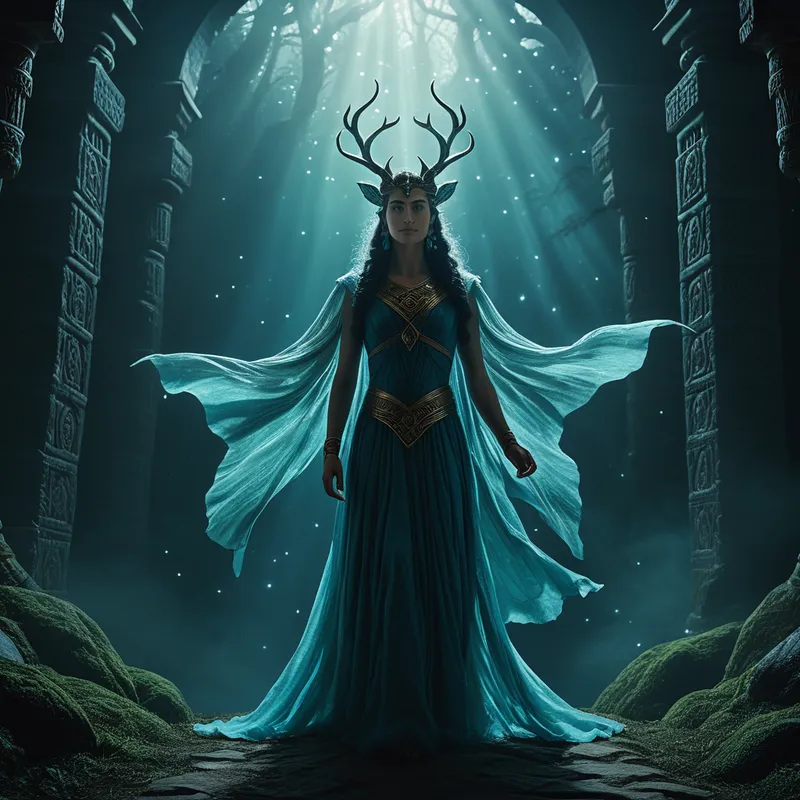
Mangas Demon Monsters
Malevolent spirits and demonic entities from Mongolian folklore, haunting the vast steppes with their terrifying powers and ancient origins.
The Tale of Mangas Demon Monsters
The wind that scours the endless steppe carries more than dust and the scent of wormwood. It carries whispers of a hunger that is not of this world, a hunger given form in the tales of the Mangas. These are not mere beasts of claw and fang, but demon monsters born from the deepest fractures in the cosmic order. Their tale is not one of a single battle, but a chilling presence woven into the fabric of the land itself.
In the beginning, according to the ancient shamanic cosmology, the world was in balance between the luminous, life-giving spirits of the Tengri and the nurturing forces of the Earth Mother. But from the chaotic, formless void of the underworld, entities of pure negation began to seep through. The Mangas are born of this seepage, of places where the fabric between worlds grew thin—a lightning-shattered tree, a deep, forgotten cave, a site of a terrible betrayal where blood soaked the earth. They are the manifestations of broken taboos, of forgotten offerings, of promises sworn on the wind and then abandoned.
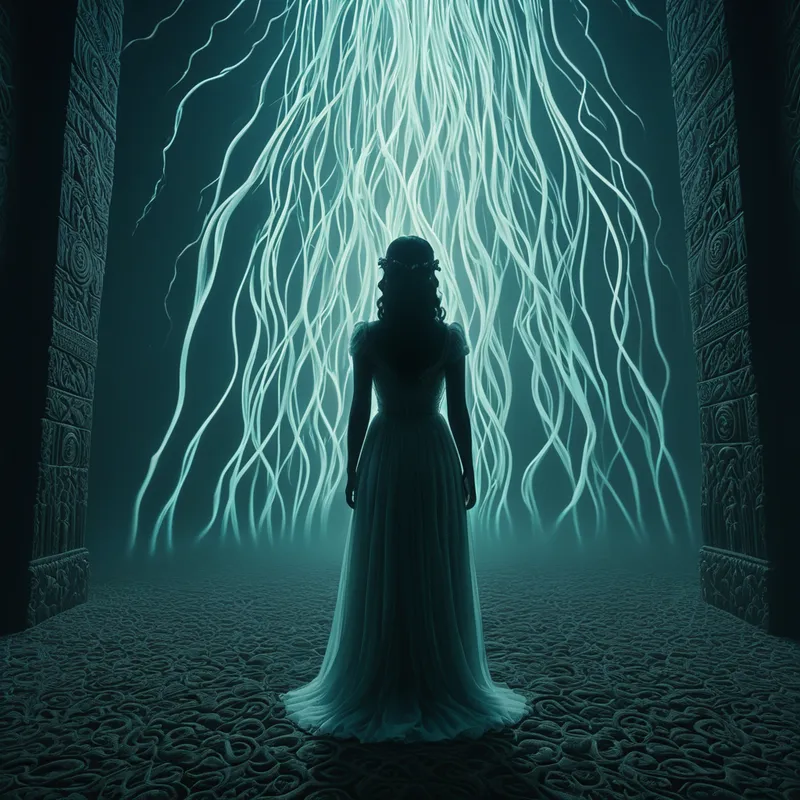
One tale tells of a hunter, arrogant and skilled, who pursued a sacred white deer across seven mountain passes. Ignoring the warnings in the rustling grass and the troubled flight of birds, he cornered the creature at a spring said to be a mirror to the sky. As he drew his bow, the spring’s water turned black and viscous. From it emerged a Mangas, its form shifting like a heat haze—sometimes a monstrous, multi-limbed bear, sometimes a mass of writhing, root-like tendrils, its eyes like cold voids where stars go to die. It did not merely attack the hunter; it unmade his courage, turning his pride to ash and his skill to trembling fear before it consumed his essence, leaving behind only a hollow, frost-bitten shell. The Mangas then retreated to its liminal place, sated for a time, but forever hungry.
Another story whispers of a Mangas that takes the form of a beautiful, sorrowful woman by a lonely river, singing a melody that pulls the soul from the body. Those who approach, lured by pity or desire, find her face dissolving into a gaping maw, the river itself rising as a cage of icy water. They are demons of the in-between: between day and night, between the steppe and the mountain, between sanity and madness. They haunt the thresholds, the places one is not meant to linger, waiting to devour the unwary, the prideful, or the spiritually weak.
Cultural Origins & Context
The Mangas are not arbitrary inventions of fear; they are the psychological and ecological guardians of a harsh, magnificent world. For the nomadic peoples of Mongolia, survival on the vast, open steppe depended on a sacred covenant with nature, governed by the principles of Törü and maintained through ritual respect for the local spirits, the gazriin ezed (masters of the place). The Mangas arise as the direct consequence of violating this covenant.
They are the incarnate punishment for ecological transgression—polluting a spring, hunting a pregnant animal, cutting a sacred tree. They are the manifestation of social rupture—the breaking of an oath, the curse of a powerful shaman (böö), or the unavenged blood of a murdered kinsman. In a landscape where the horizon is infinite and the individual is small, the Mangas embody the terror of being spiritually exposed, of being cut off from the protective web of community and cosmic order. They are the dark counterpart to the protective spirit-ancestors, the ongon. If an ongon is a spiritual ally, a Mangas is a spiritual predator, born from the neglect or corruption of that very relationship.
Symbolic Architecture
The Mangas are a profound symbolic expression of the psyche’s encounter with the formless, devouring aspects of the unconscious. They represent not just external monsters, but the internal "demons" that arise when the conscious ego becomes inflated, isolated, or violates its own deeper moral and instinctual laws.
The Mangas is the embodied consequence of the un-lived life, the unpaid debt, the ignored warning. It is the psychic toxin that coagulates in the spaces we refuse to consciously acknowledge.
Their shapeshifting nature reveals their core identity: they are not fixed entities but processes of corruption and consumption. They take forms that specifically mirror and invert the virtues of the steppe. Where the Mongolian horseman represents swift, directed movement and connection, the Mangas is often a lumbering, chaotic, or eerily static presence that entraps. Where the sky (Tengri) is clarity and order, the Mangas brings a confusing fog or a blinding, unnatural darkness. It is the anti-archetype of the baatar (hero); it is the ultimate consumer, where the hero is the ultimate integrator.
The Dreamer's Resonance
To encounter the Mangas in the inner landscape of a dream or a psychological complex is to confront a force of pure, undifferentiated appetite. It might appear as a suffocating depression that drains all vitality, a compulsive addiction that consumes identity, or a gnawing, irrational guilt that isolates one from the community of the self. It is the shadow of the Magician archetype—not the wise healer or the skillful shape-shifter, but the manipulative sorcerer who uses knowledge for consumption and control, ultimately consuming himself.
The Mangas does not fight fair; it attacks through resonance, finding the hidden wound, the secret pride, the unhealed grief, and amplifies it until it becomes a doorway through which it can enter. Its terror lies in its specificity to the victim. It is a personalized demon, reflecting back the individual’s weakest point in monstrous form. To face it is to face the part of oneself that has been orphaned from the whole, the part that, in its hunger, would consume the rest of the psyche.
Alchemical Translation
The alchemical journey here is not to slay the Mangas in a final battle, for it is born from the fundamental ground of existence—the chaotic potential of the underworld. The work is one of re-binding and re-consecration. The shamanic practice of dealing with such entities involves identification, confrontation, and ultimately, transformation through negotiation or forceful redirection back to its proper sphere.
The psychological parallel is in the re-contextualization of the complex. One does not eradicate a deep-seated rage or shame; one must, like a shaman, journey to its origin (the Cave, the Wound), acknowledge its power, and through conscious integration, strip it of its autonomous, demonic authority. The devouring energy of the Mangas, when faced and contained, can be transformed into a fierce protective instinct or a relentless drive for psychological truth.
This is the nigredo of the Mongolian soul—the blackening, the confrontation with the uttermost shadow. The Mangas is the keeper of this black ore. To integrate its lesson is to perform a sacred act of healing for the personal and the ancestral landscape, restoring Törü within the self. The monster, when its message is heard, becomes a severe but necessary teacher about boundaries, respect, and the cost of spiritual arrogance.
Associated Symbols
Explore related symbols from the CaleaDream lexicon:
- Demon — The archetypal embodiment of a conscious, malevolent force that opposes cosmic order and preys upon the human soul.
- Shadow — The hidden, rejected, and unconscious aspects of the self which, when ignored, can take on autonomous and destructive power.
- Cave — A primal entrance to the underworld of the unconscious, a place of initiation, confrontation with darkness, and potential emergence.
- Wound — A site of psychic or spiritual injury that, if left unhealed, can become a gateway for negative influences or a source of corrupted power.
- Hunger — A devouring, insatiable emptiness that seeks to consume rather than nourish, representing unmet needs turned destructive.
- Threshold — The liminal space between worlds where normal laws are suspended, a place of danger, opportunity, and encounter with the other.
- Chaos — The primordial, formless state from which order emerges, but which also contains the potential for annihilation and terror.
- Ritual — The prescribed act of ceremony and respect that maintains the boundaries between worlds and keeps chaotic forces at bay.
- Fear — The primal emotional response to the unknown and the predatory, a necessary signal of danger that can also paralyze or attract what is feared.
- Spirit — The essential, non-corporeal force of being, which in its corrupted or antagonistic form can manifest as a possessing or draining entity.
- Monster — A composite creature born of boundary violation, representing the fear of the other and the distorted reflection of the self.