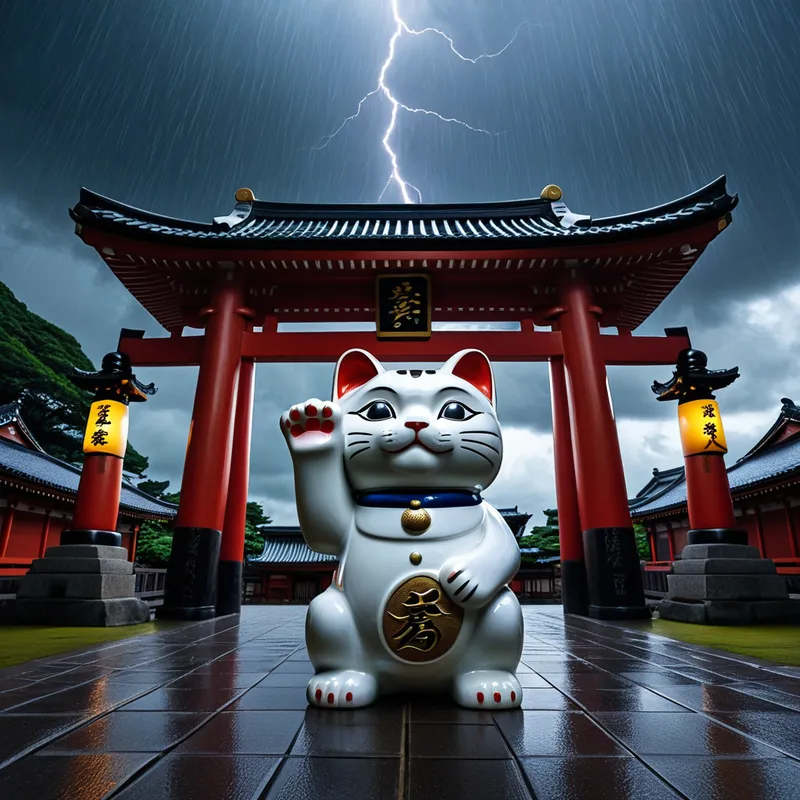
Maneki-neko Myth Meaning & Symbolism
A cat's beckoning paw, born from a storm and a monk's compassion, becomes a timeless symbol of fortune, protection, and the call to a destined encounter.
The Tale of Maneki-neko
Listen. The rain does not fall; it is a solid wall of silver needles, driven sideways by a howling wind that speaks with the voice of the mountain. The world is reduced to grey water and black mud. In this drowned realm, a lone figure moves—a humble monk from the Gōtoku-ji temple. His robes are a second skin of cold, heavy with the storm. His sandals sink with each step, the path to his sanctuary lost in the deluge.
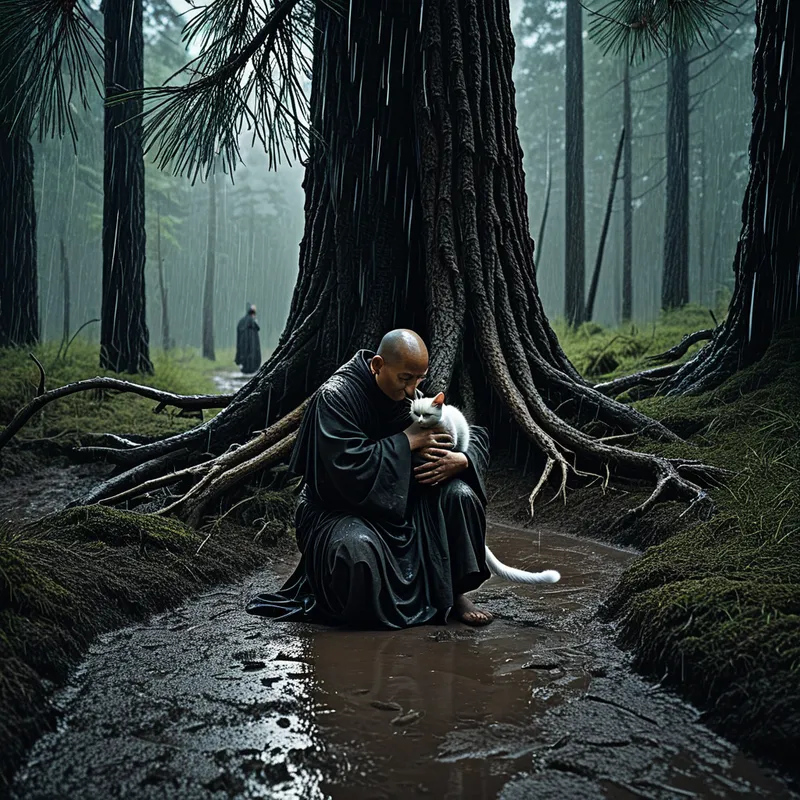
He seeks shelter under the gnarled arms of a great pine. It is there, in the mud and the roaring dark, that he hears it—not the storm, but a sound beneath it. A pitiful, desperate cry. Peering through the veil of rain, he sees a small, bedraggled form: a cat, its fur plastered flat, one paw raised not in greeting, but in a feeble attempt to shield itself. Its eyes hold the same drowning terror as the sky.
Without a thought for his own chilled bones, the monk kneels. The mud accepts him. He gathers the shivering creature into the rough, dry fold of his robe, against his chest where a sliver of warmth remains. He speaks soft, forgotten words, not of scripture, but of simple comfort. The cat’s trembling slows. Its raised paw, now cleansed by the monk’s sleeve, seems to rest against his heart.
And then, a crack that splits the world—a bolt of white-fire from the heavens aimed at the very pine that was to be his shelter. The tree explodes into a spear of flame, instantly quenched by the torrent, leaving only a smoldering, shattered skeleton.
The monk stands frozen, the cat a still, warm weight in his arms. The raised paw of the creature, he now sees, was not a shield. It was a beckoning. It had called him away from the lightning’s embrace. As the thunder’s roar fades to a grumble, a new sound emerges—the jingle of harness and the squelch of hooves. From the grey curtain emerges a samurai lord and his retinue, lost and seeking guidance. They had seen, from a distance, the strange sight: a monk under a tree, and the cat that seemed to wave them near.
The samurai dismounts. He sees the saved monk, the saved cat, the blasted tree. He understands a language deeper than words. In gratitude for this divine warning, and for the guidance to this holy man, the samurai becomes the temple’s patron. His wealth transforms Gōtoku-ji from a struggling hermitage into a place of splendor and peace. And the cat? It lived out its days in honor. And when it passed, its form was immortalized—not as a fierce guardian, but as a serene figure with one paw forever raised, eternally beckoning fortune, protection, and connection from the storm.
Cultural Origins & Context
The myth of the Maneki-neko is a mukashibanashi, a "tale of long ago," with its most famous variant originating from the Edo period (17th-19th centuries) associated with Tokyo’s Gōtoku-ji temple. Unlike state-sponsored Kojiki tales, this is a folk story, passed orally among merchants, farmers, and townsfolk. Its primary societal function was not to explain cosmic origins, but to model a practical, accessible cosmology of luck and ethical cause-and-effect.
The story flourished in the burgeoning merchant culture of the Edo period. For the shopkeeper, luck was not an abstract concept but the vital difference between prosperity and ruin. The Maneki-neko myth provided a narrative framework: fortune (kōun) follows not from greed, but from compassion (the monk’s act) and attentive recognition (the samurai’s perception). The cat became a tangible intermediary, a charm that condensed this folk wisdom into a single, silent gesture. It was a story told to children, displayed in businesses, and offered at temples—a democratization of auspiciousness, making the favor of fortune something attainable through kindness and awareness.
Symbolic Architecture
At its core, the Maneki-neko is an archetypal symbol of the guiding intermediary. It stands at the threshold between chaos and order, danger and safety, scarcity and abundance. The cat itself is a rich symbol: a creature of the liminal world, domestic yet independent, seeing in the dark, moving between the human realm and the unseen.
The beckoning paw is not a demand, but an invitation. It does not seize fortune; it signals a path that the individual must choose to walk.
The storm represents the unpredictable, often destructive, forces of fate—the external chaos of the world and the internal chaos of crisis. The monk embodies the principle of selfless compassion, an action taken without expectation of reward. His salvation is not his goal, but the direct consequence of his ethical orientation. The samurai represents the receptive mind, the one who can interpret the subtle sign (the beckoning) and align his actions with the flow of opportunity it reveals. The cat is the synchronicitous link between them—the meaningful coincidence made manifest. Psychologically, it represents the intuitive function, that inner knowing which raises a "paw" in our awareness, guiding us away from psychic lightning strikes and toward destined encounters.
The Dreamer's Resonance
When the image of the Maneki-neko appears in a modern dream, it rarely manifests as a cheap figurine. It is often immense, luminous, or strangely alive. It appears in transitional spaces: at the end of a dark hallway, in the corner of a sterile office, at a fork in a misty road. The dreamer typically feels a mixture of curiosity and anxiety.
Somatically, this dream points to a process of attunement. The dreamer is in a "storm"—a period of life stress, career uncertainty, or emotional turbulence. The beckoning is a call from the unconscious to pay attention to a subtle guiding principle. The anxiety reflects the ego's resistance to leaving a known, if painful, pattern (the shelter of the doomed tree). The dream is an somatic enactment of a choice: to heed the intuitive call toward a new patronage (a new job, relationship, or inner state) or to ignore it and remain in the path of the coming lightning. The cat’s silent gesture asks the dreamer to become both the compassionate monk (by tending to their own neglected, "bedraggled" instincts) and the perceptive samurai (by recognizing the opportunity in the strange signal).

Alchemical Translation
The myth models a precise alchemy of individuation—the process of becoming whole. The base metal of the psyche is the isolated, storm-battered ego (the monk, cold and lost). The first transformation is the act of compassionate containment. The ego must turn its attention inward, to rescue and integrate the wounded, instinctual self (the cat). This is not an act of grandiose heroism, but of humble, muddy-kneed care.
The lightning that destroys the old shelter is not a tragedy, but the necessary dissolution of an outworn psychic structure—a belief, an identity, a safe harbor that had become a prison.
The second transformation is interpretive alignment. The saved instinct, now integrated, becomes the guiding function (the raised paw). The ego must now learn to read its signals—those feelings of "rightness," hunches, and synchronicities that beckon toward a new alignment. The arriving samurai represents the emergent Self, the patron of the new, more prosperous and authentic psychic life. The final gold is not mere material wealth, but the fortune of wholeness: a psyche where consciousness (monk), intuition (cat), and the power of purposeful action (samurai) are in harmonious, reciprocal relationship. The eternal Maneki-neko thus symbolizes the ongoing process itself—the perpetual, gentle beckoning of the Self, inviting us away from the storms of fragmentation and toward the temple of our own completion.
Associated Symbols
Explore related symbols from the CaleaDream lexicon: