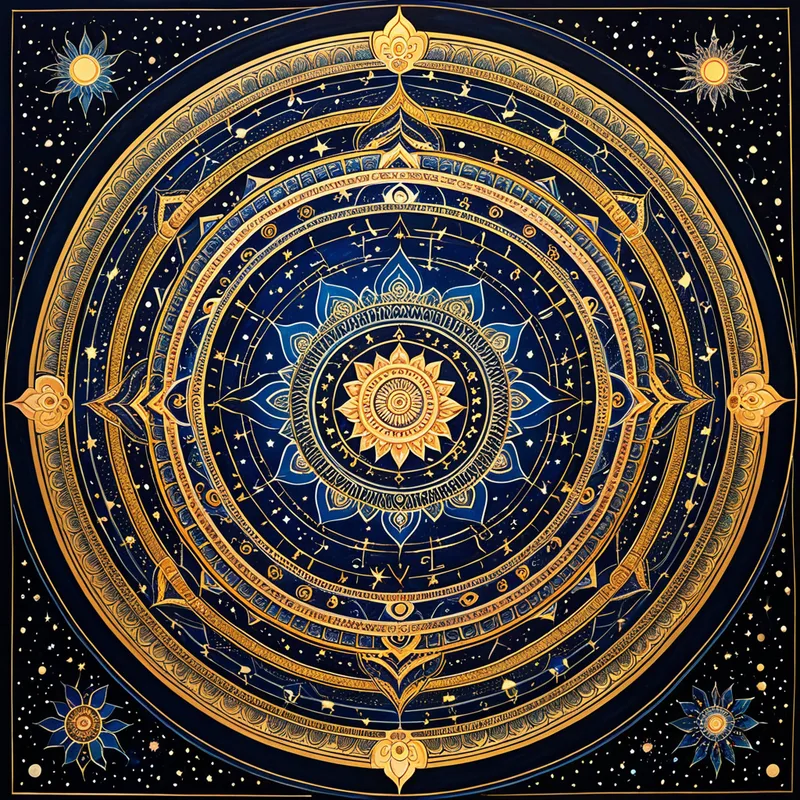
Mandala of Sound Myth Meaning & Symbolism
A mythic tale of a primordial sound that weaves the cosmos into being, revealing the sacred geometry of reality through vibration and silence.
The Tale of Mandala of Sound
In the beginning, before time had a name, there was only the Great Silence. It was not an empty silence, but a pregnant, potent fullness—a boundless ocean of potential where all things slept, unformed and dreaming. There was no light, no dark, no here, no there. Only the profound, listening stillness of the Dharmakaya.
And then, from the very heart of that silence, a vibration stirred. It was not a sound that ears could hear, but the first intention of being, a subtle tremor in the womb of the absolute. This was the seed syllable, the Bija. Some say it was the syllable A, the source of all letters, the open throat of creation itself.
It hummed, a single, pure tone that was both a question and its own answer. And as it hummed, it began to spin. From its axis, light spilled forth—not as a blinding sun, but as intricate, geometric lattices of luminosity. The vibration differentiated, giving birth to a second tone, then a third, until a celestial chord resonated through the void. These were the foundational frequencies, the Five Dhyani Buddhas, each a perfect note representing a wisdom, a color, a direction in the emerging cosmos.
The tones wove themselves into patterns, concentric circles of resonant energy that expanded outward like ripples on a pond of pure consciousness. This was the Mandala of Sound taking form—a living, singing architecture. At its outermost rings, the vibrations coalesced into the myriad phenomena of the world: the roar of mountains rising, the whisper of winds, the crash of oceans, the chorus of living beings. Celestial musicians, the Gandharvas, manifested from the harmonics, their very bodies composed of melody, plucking vinas that strung galaxies together.
Yet, at the very center of this roaring, glorious symphony, the original Silence remained. Unmoved. Untouched. The source and the destination. The myth tells us that to hear the full Mandala is to perceive the entire spectrum from the cacophony of samsara at its edges to the profound quiet at its heart. It is the cosmic breath: the exhalation that creates the universe of form and the inhalation that draws it all back into silent, luminous unity.

Cultural Origins & Context
The concept of the Mandala of Sound is not a single, codified myth from one scripture, but a profound metaphysical idea woven through various strands of Buddhist thought, particularly within <abbr title=“The “Diamond Vehicle,” a major branch of Buddhism emphasizing esoteric practices and rituals”>Vajrayana and Tibetan traditions. It finds its roots in the ancient Indian philosophical concept of Shabda-Brahman, which Buddhism adapted and transformed.
It was passed down through two primary channels: the esoteric tantric texts and the oral instructions of masters to disciples. In the hidden tantras, the universe is described as arising from seed syllables (bijas) and mantras. Furthermore, the practice of nada yoga (the yoga of inner sound) within Buddhism guides an adept to listen for the inner celestial sounds that lead the mind back to its source.
Its societal function was deeply initiatory and transformative. For the monastic and yogic communities, it was not merely a story but a map of reality and a guide for meditation. By chanting mantras, visualizing seed syllables, or engaging in deep auditory meditation, practitioners sought to attune themselves to the fundamental vibrations of enlightenment, to trace the music of phenomena back to the silence of the Dharmakaya, thereby recognizing the illusory yet sacred nature of all experienced reality.
Symbolic Architecture
The Mandala of Sound is a master symbol of the interdependent nature of reality and the path of awakening. Its architecture is a multi-layered revelation.
The Central Silence represents the unconditioned ground of being, the Dharmakaya, pure awareness itself. It is the source and the substratum of all that arises.
The first note did not break the silence; it was the silence choosing to sing.
The Seed Syllable (Bija) symbolizes the first movement of consciousness, the point where potential becomes manifestation. It is the archetypal idea, the primal intention that sets the creative process in motion.
The Expanding Harmonic Rings symbolize the process of emanation and differentiation. From unity comes diversity; from the pure tone comes the complex chord of existence. Each ring represents a layer of reality: the subtle mental formations, the energetic patterns, and finally the dense physical world. This is the realm of samsara, experienced as separate from the source.
The Complete Mandala, therefore, is a map of the psyche and the cosmos. The periphery is our ordinary, fragmented perception—the noise of our thoughts, desires, and the external world. The journey inward, through the layers of vibration, is the path of meditation: calming the mental chatter to hear subtler frequencies, ultimately arriving at the silent, vibrant center where perceiver and perceived are one.
The Dreamer’s Resonance
When the Mandala of Sound resonates in the modern dreamscape, it often signals a profound process of psychic reorganization. The dreamer may hear overwhelming, beautiful, or terrifying symphonies; see vibrating geometric patterns; or experience a deep, somatic hum in their dream body.
This is the psyche’s way of portraying the restructuring of its fundamental “vibrational signature.” The cacophony at the dream’s edge represents the chaos of unintegrated complexes, unresolved emotions, and the static of daily life. The movement toward a central, coherent tone mirrors the ego’s difficult but necessary journey toward the Self—the organizing center of the total psyche.
Somatically, this can feel like a tuning. The dreamer may awaken with a sense of physical resonance or dissonance, as if their very cells are being recalibrated. Psychologically, it indicates a confrontation with the raw, formative energies of one’s own being. The dream is an auditory mandala, inviting the dreamer to listen deeply—not to the content of their thoughts, but to the foundational frequency from which they arise.

Alchemical Translation
The myth models the entire alchemical opus of individuation—the process of becoming whole. The modern individual begins in a state of “noise”: identified with the peripheral clamor of persona, societal expectations, and unconscious compulsions. This is the prima materia, the confused starting material.
The first alchemical stage (Calcinatio/Nigredo) is the recognition of this dissonance—the suffering that comes from being out of tune with one’s own center. It is the painful but necessary burning away of false notes.
The work is not to create the music, but to remove the obstructions to hearing the symphony that is already playing.
The second stage (Sublimatio) is the journey inward. Through introspection, therapy, art, or meditation (the modern mantras), one begins to discern patterns in the chaos. Complexes are seen as recurring motifs; life themes emerge as melodies. The ego learns to listen, becoming a conductor rather than a lone, frantic instrument.
The final stage (Coniunctio/Rubedo) is the integration symbolized by reaching the silent center. Here, the individual does not become silent in a dead way. Instead, they become the silence that contains and gives birth to the music. The conscious ego aligns with the Self. One acts not from the noise of insecurity or desire, but from the centered, creative vibration of one’s authentic nature. The individual becomes a localized expression of the cosmic Mandala—unique in form, yet perfectly resonant with the fundamental tone of being. They have translated the myth from a story of cosmic creation into the lived reality of a Self-created life.
Associated Symbols
Explore related symbols from the CaleaDream lexicon: