
Manananggal Myth Meaning & Symbolism
A terrifying Filipino vampire myth of a woman who severs her own body to hunt, embodying the deep psychological split between monstrous hunger and human longing.
The Tale of Manananggal
Listen, and let the night wind carry the tale. It begins not with a monster, but with a woman. A woman who walks in the twilight between the village and the wild, whose laughter sometimes catches in her throat like a sob. When the moon swells to its fullest, a hunger awakens in her—a thirst that no well water can quench, a void that no human company can fill.
In the deep indigo of midnight, she retreats to a place of solitude. There, she anoints her body with a sacred, stolen oil, and she begins to chant words older than the rice terraces. Her form shudders. A terrible, wet cracking sound echoes, not of bone breaking, but of spirit sundering. With a final, wrenching gasp, her upper torso—wings of leather and membrane bursting from her back—detaches from her lower half. The severed lower body stands where she left it, a silent, waiting sentinel of flesh.
Freed, the winged half takes to the humid air. She is a silhouette against the moon, seeking the homes of the vulnerable: pregnant women, the sick, those in deep sleep. She descends with the silence of a shadow, extending a long, proboscis-like tongue to pierce through the thatched roof and siphon the life from the unborn or the slumbering. The act is one of profound violation, a theft of essence in the deepest dark.
But her power is her peril. She must return to her lower half before the first true rays of the sun spear the horizon. If dawn finds her separated, she will be consumed by the light, cursed to wander as a wretched, incomplete thing forever. The hunt is thus a race against the coming day, a frantic flight back to the self she abandoned. To reunite is to become whole again, to walk once more in the world of women, the monstrous hunger temporarily sated, the human form reassumed… until the next full moon calls the hunger forth again.

Cultural Origins & Context
The myth of the Manananggal is rooted in the pre-colonial animist beliefs of the Philippine archipelago, where the world is alive with unseen spirits (anito). It belongs to the rich category of aswang, shape-shifting monsters that reflect deep-seated societal fears and taboos. These stories were not mere entertainment; they were oral textbooks on community safety, morality, and the natural world.
Traditionally told by elders (lola or lolo) around the hearth or under the stars, the tale served multiple functions. It enforced social cohesion, warning people—especially pregnant women—to secure their homes at night and stay within the protective circle of family and community. It explained infant mortality and miscarriage in a time before modern medicine. Furthermore, it acted as a social sanction, often used to ostracize or control individuals, particularly women, who were seen as outsiders, overly independent, or possessing unconventional desires. The Manananggal is thus a cultural container for anxieties about the "other," the untamed feminine, and the terrifying things that happen in the vulnerable dark.
Symbolic Architecture
At its core, the Manananggal is a devastating symbol of self-fragmentation. She is not attacked by an external monster; she becomes the monster through an act of self-severance. This represents the ultimate psychic split, where a part of the self is so ravenous, so unacceptable, that it must be violently excised to function in the daylight world.
The most terrifying hunger is the one we disown, for it returns not as a guest, but as a predator wearing our own face.
Her flight represents the dissociated part of the psyche—the shadow—operating autonomously, driven by insatiable, often destructive, needs. The feeding on the unborn or the vulnerable symbolizes how our unintegrated traumas and hungers can "feed on" our own potential for new life (creativity, relationships, growth) or prey on our most defenseless inner states. The lower half, left standing and waiting, is the abandoned body of lived experience, the grounded self left behind in the pursuit of some ghostly sustenance. The entire myth is a parable of addiction, trauma, and the profound loneliness of a self at war with itself.

The Dreamer's Resonance
To dream of the Manananggal is to dream of a profound inner crisis of integrity. The dreamer is likely experiencing a somatic and psychological process of severe disconnection. This could manifest as feeling "split in two"—perhaps one part of you performing a role in the world (the standing lower half) while another, hidden part engages in secret, consuming behaviors or thoughts (the flying hunter).
Somatically, this might feel like chronic dissociation, a numbness in the lower body, or a sense of being "ungrounded." Psychologically, it speaks to a hunger so deep and primal it feels monstrous—a need for love, recognition, or power that seems to require the sacrifice of one's own wholeness or the violation of personal boundaries to satisfy. The dream is a stark portrait of the cost of such self-betrayal: the frantic, dawn-chased terror of never being able to become whole again.
Alchemical Translation
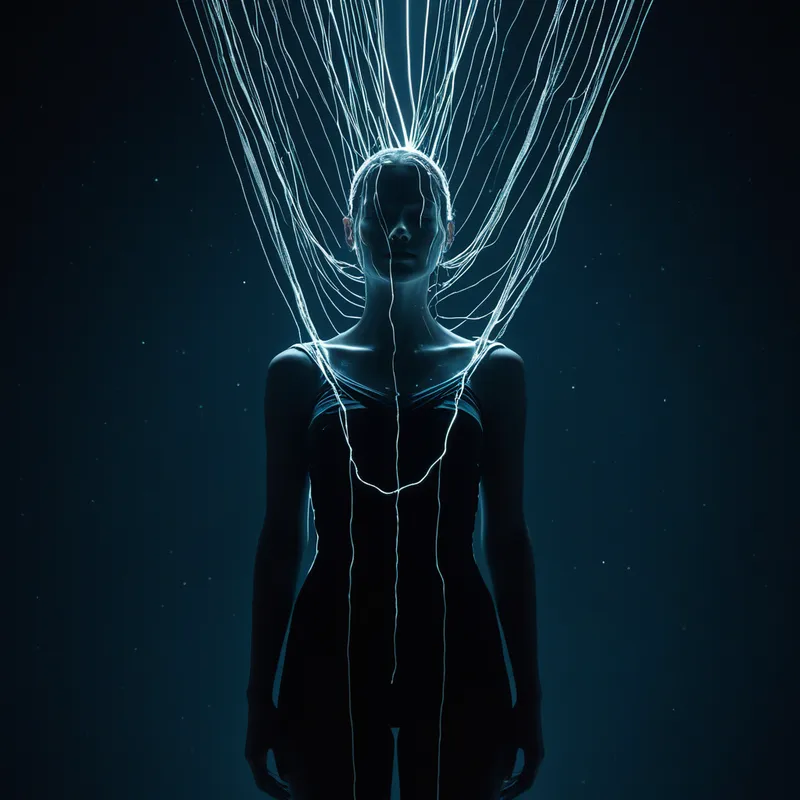
The individuation process modeled here is not one of slaying the monster, but of reclaiming it. The Manananggal cannot be killed by an external hero; her cycle only ends when the split is healed from within. The alchemical work is to turn toward the terrifying hunger, not in flight, but in curious, compassionate inquiry.
The path to wholeness begins not by condemning the part that flies away, but by asking the part left behind what it needs.
This means consciously retrieving the dissociated shadow—the ravenous, "monstrous" feelings of rage, need, or grief—and reintegrating them into the self. It involves listening to the body (the lower half) that has been abandoned. The "oil" she uses to separate becomes the salve for reunion; the secret knowledge of division must be transformed into the wisdom of integration. The goal is to end the cyclical flight, to feel the hunger within the whole body, and to find humane ways to address it, so one can stand in the dawn not as two terrified halves, but as one complex, complete being, capable of holding both human longing and primal need.
Associated Symbols
Explore related symbols from the CaleaDream lexicon:
- Blood — Represents the vital life force that is stolen, symbolizing the draining of psychic energy, vitality, and potential by unintegrated aspects of the self.
- Moon — Governs the cycle of the Manananggal's transformation, representing the pull of the unconscious, cyclical compulsions, and the illumination of hidden, nocturnal aspects of the psyche.
- Shadow — The Manananggal is the literalized Shadow archetype, a severed part of the self that operates autonomously in darkness, embodying all that is repressed and deemed monstrous.
- Separation — The core action of the myth; a violent self-partitioning that creates a state of profound existential loneliness and psychic peril.
- Hunger — The driving force of the monster, symbolizing an insatiable, primal need—for love, power, or sustenance—that has become dissociated and destructive.
- Dawn — Represents the moment of reckoning and the imperative for reintegration; the threat of being caught in a state of fragmentation by the light of consciousness.
- Heart — The organ of the unborn that is targeted, symbolizing the vulnerability of new life, potential, and tender feeling to internal predatory forces.
- Flight — The autonomous journey of the severed self, representing dissociation, escape from grounded reality, and the pursuit of nourishment in impossible places.
- Wound — The permanent site of severance, the psychic injury that enables the fragmentation and must be addressed for healing to occur.
- Ritual — The act of anointing and chanting that enables the separation, symbolizing the unconscious or conscious rituals we perform to enact our own self-harm and fragmentation.