Mammoth as World Pillar Myth Meaning & Symbolism
An ancient Siberian myth where a primordial mammoth holds the world upon its back, embodying the foundational pillar of reality and the psyche.
The Tale of Mammoth as World Pillar
Listen, and hear the breath of the First Time, when the world was soft and the sky was close enough to touch. In the great dark before the sun learned its path, the earth was a formless bog, a trembling skin of mud and mist. There was no up, no down, only a churning, watery chaos. The spirits of the air grew dizzy, and the spirits of the deep grew restless, for nothing had a place to rest.
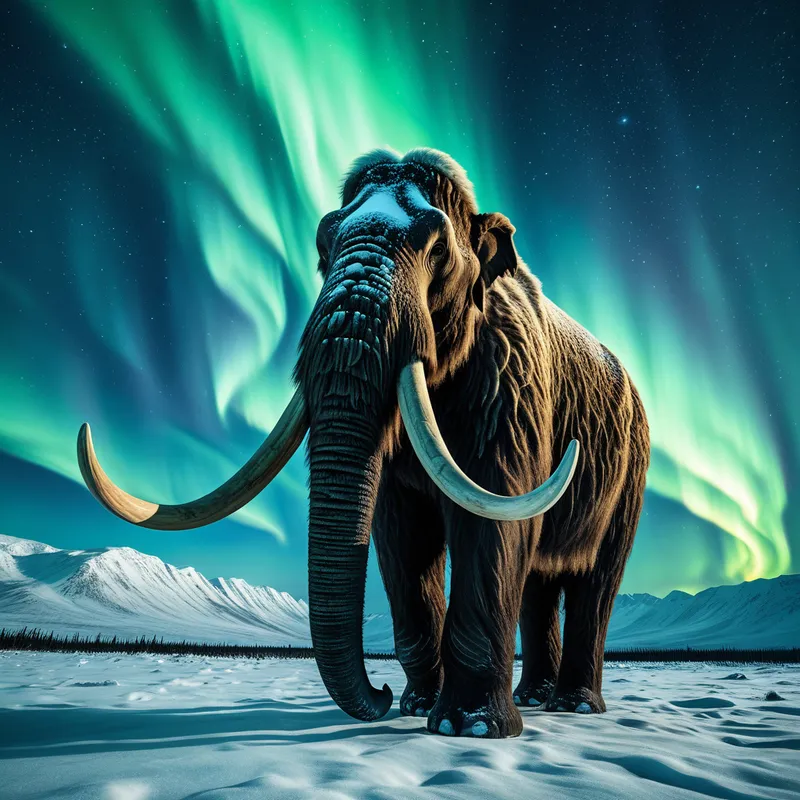
From the uttermost north, where the cold is born, came a sound—a deep, resonant rumble that was not thunder, but a heartbeat. It was the heartbeat of Khargi, the First and Mightiest, the Mammoth of the World’s Beginning. He was vaster than mountains, his fur the color of storm clouds and starless midnight, his tusks great curves of ancient ice that caught the first, faint light. He moved through the primordial sludge, and where his feet fell, the earth firmed. Where his breath blew, the mists parted.
But the world still slid and shifted. The newborn lands quaked, threatening to sink back into the endless, swallowing water. The Great Spirit, the Tengri of the highest blue, saw this instability and spoke in the language of wind and lightning. “Mighty Khargi,” whispered the sky, “you who have shaped the mud into land, you must now become its bone. You must become the pillar that holds the separating heavens from the hungry depths. You must take the weight of All That Is upon your back.”
There was no refusal, for this was the order of things. Khargi, with a sigh that became the first north wind, knelt in the very center of the world. He planted his four legs like the corners of the earth. He lowered his great head, and his sweeping tusks became the arches of the northern and southern skies. His broad, immense back grew still—so still it became stone and soil, forest and tundra. The world settled upon him. The chaos was ordered. The heavens vaulted upward from his tusks, and the waters receded, held at bay by the solidity of his form.
He did not sleep, for a sleeper may turn. He entered a watchful, eternal vigil. His slow, deep breaths became the tides of the land itself, the gentle rising and falling of hills over millennia. His heartbeat, that first sound, became the deep, magnetic pulse at the world’s core. And there he remains, the silent, steadfast Dalan Khubun, the Mammoth-Pillar, holding the middle world steady between the upper and lower realms, so that life may walk upon his back, unaware of the immense, patient strength beneath their feet.
Cultural Origins & Context
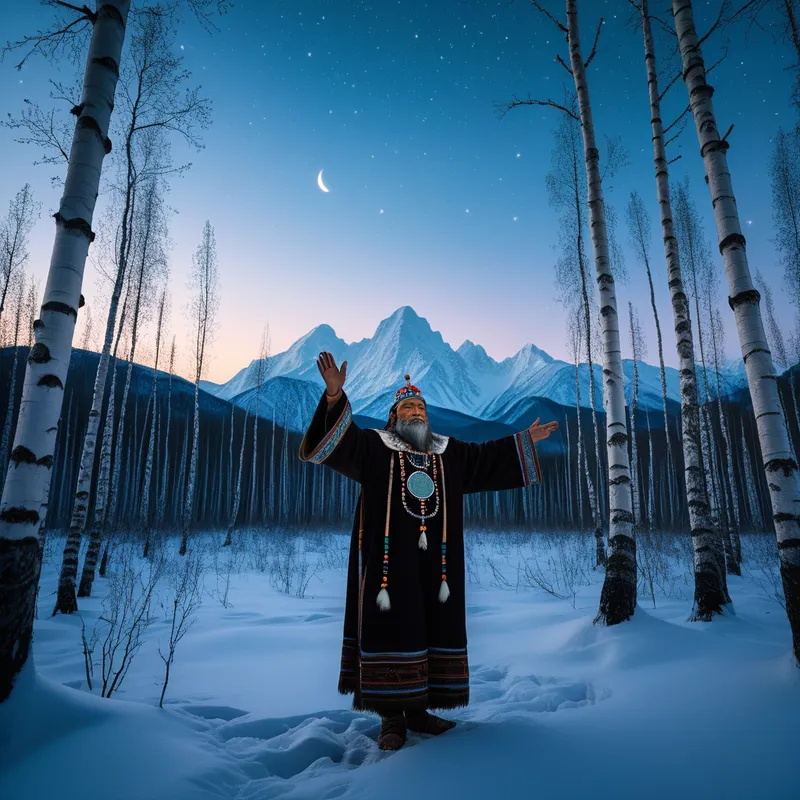
This myth belongs to the complex shamanic cosmology of various Indigenous Siberian peoples, including the Evenki, the Sakha (Yakut), and others across the taiga and tundra. It is not a single, standardized story but a profound cosmological concept passed down through oral tradition, woven into epic tales, shamanic invocations, and explanations of the natural world. The storytellers were the shamans, who, in their ecstatic journeys, would travel the axis of the world and commune with its foundational spirits.
The myth served multiple vital functions. Primarily, it was an etiological narrative, explaining the very structure and stability of reality—why the earth is solid, why it sometimes shakes (the mammoth stirring), and what lies beneath. It provided a cosmic map for shamans, for whom the World Pillar was the central pathway for ascending to the sky gods or descending to the underworld. Societally, it reinforced a worldview of deep reciprocity and reverence. The land one lived on was not inert dirt; it was the sacred body of a primordial being, demanding respect and careful stewardship. To hunt a regular mammoth (before their extinction) was thus a deeply ritual act, acknowledging this ancient, foundational kinship.
Symbolic Architecture
The Mammoth as World Pillar is a master symbol of the psychic foundation. It represents the non-egoic, instinctual ground of being upon which the conscious personality is built.
The pillar is not what we aspire to, but what we unconsciously rest upon. It is the given, the ancient, the utterly reliable substrate of the Self.
The mammoth itself is a perfect vessel for this symbolism. It is a creature of immense physicality and antiquity, a literal relic of a bygone age that now exists only in memory and myth. Psychologically, it symbolizes the deepest strata of the personal and collective unconscious—the archaic, instinctual patterns that predate our individual lives and form the bedrock of our psychic structure. Its transformation from a moving creature to a stationary pillar signifies the process by which dynamic, primal energy becomes structured, giving form and stability to the chaos of nascent consciousness.
The act of bearing the world is the ultimate image of silent, enduring sacrifice. The mammoth surrenders its freedom and its animal nature for the sake of cosmic order. This symbolizes the necessary sacrifice of pure, undifferentiated instinctual energy to create a stable psyche capable of harboring complex life—our thoughts, relationships, and cultures. The stability it provides is not passive, but alive; its breath and heartbeat remind us that the foundation is a living process, not dead stone.
The Dreamer's Resonance
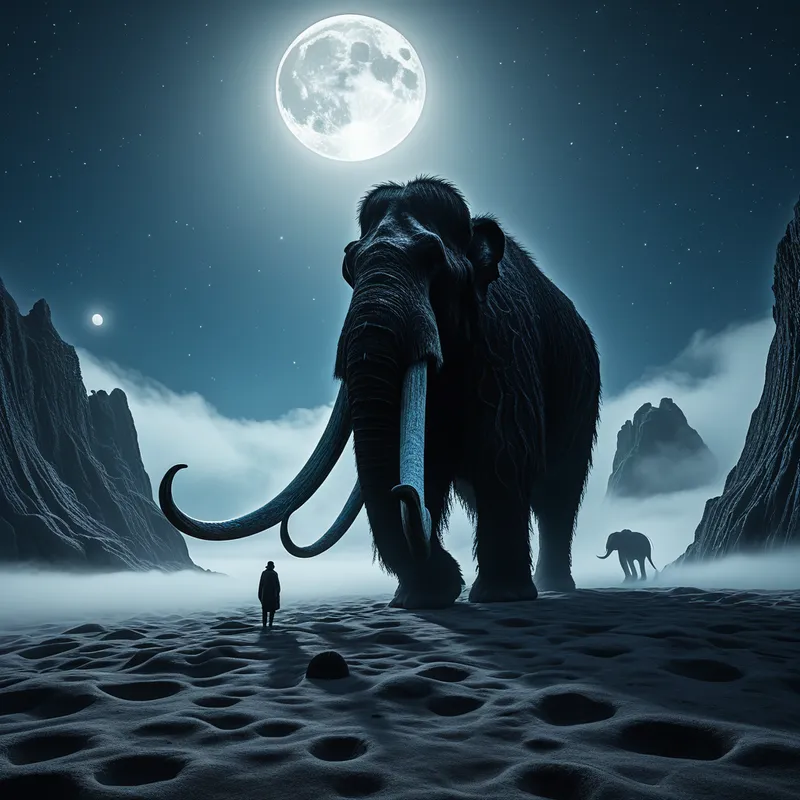
When this mythic pattern stirs in the modern dreamer, it often signals a profound encounter with the foundations of the Self. Dreams of immense, silent animals (elephants, whales, bulls) supporting vast weights, or dreams of discovering a hidden, colossal structure beneath one’s house or familiar landscape, are its echoes.
Somatically, this can coincide with feelings of grounding or, conversely, of foundational anxiety—a sense that the very floor of one’s being is unstable. Psychologically, the process is one of confronting the psychic substrate. The dreamer may be undergoing a life transition so fundamental that it calls into question their core assumptions, values, or identity. The mammoth in the dream is the deep, instinctual intelligence rising to meet this crisis, offering not answers, but sheer, unwavering presence. It is the psyche’s way of asserting, “Beneath this turmoil, there is something ancient and unshakable that holds you.” The work for the dreamer is not to analyze the pillar, but to learn to trust its support, to feel the solidity of the ground beneath their feet when everything in their conscious world seems in flux.
Alchemical Translation
The myth models the alchemical stage of coagulatio—the making solid. In the process of individuation, we must move from the prima materia of chaotic potential and unconscious identification to a structured, resilient, and grounded personality. The mammoth’s journey from primordial wanderer to world pillar is this very process.
Individuation requires the animal soul to become the architectural soul, to willingly take on the weight of consciousness and transform it into a habitable world.
For the modern individual, the “chaotic waters” are the flood of possibilities, anxieties, identities, and influences that characterize contemporary life. The “mammoth” is the core of one’s innate nature, one’s deepest instincts and values. The alchemical work is to call upon this inner mammoth—not to rage or flee, but to kneel. To make the conscious, difficult sacrifice of limitless potential for the sake of embodied, responsible form. This means committing to a path, solidifying a value, grounding a relationship, or embodying a truth. It is the act of saying, “Here I stand. This I will bear.”
The resulting “world” built upon this inner pillar is the integrated personality. It is stable, yet alive; structured, yet breathing. It allows the individual to navigate between the “heavens” of spirit, aspiration, and transcendence and the “depths” of the unconscious, shadow, and instinct without losing their center. The myth ultimately teaches that true strength and the capacity to hold a meaningful life come not from towering above, but from grounding so deeply within that one becomes the axis of one’s own universe.
Associated Symbols
Explore related symbols from the CaleaDream lexicon: