Mami Wata Myth Meaning & Symbolism
A powerful water spirit offers immense fortune and forbidden beauty, demanding a total sacrifice of the known world in return.
The Tale of Mami Wata
Listen. The story does not begin on the shore, but in the deep, where the light fails and the pressure holds secrets like a fist. It begins with a man, a fisherman perhaps, or a trader, whose life is a line of known horizons. One evening, as the sun bleeds into the water and the world holds its breath, the sea changes. It becomes not water, but glass—dark, perfect, and unnaturally still.
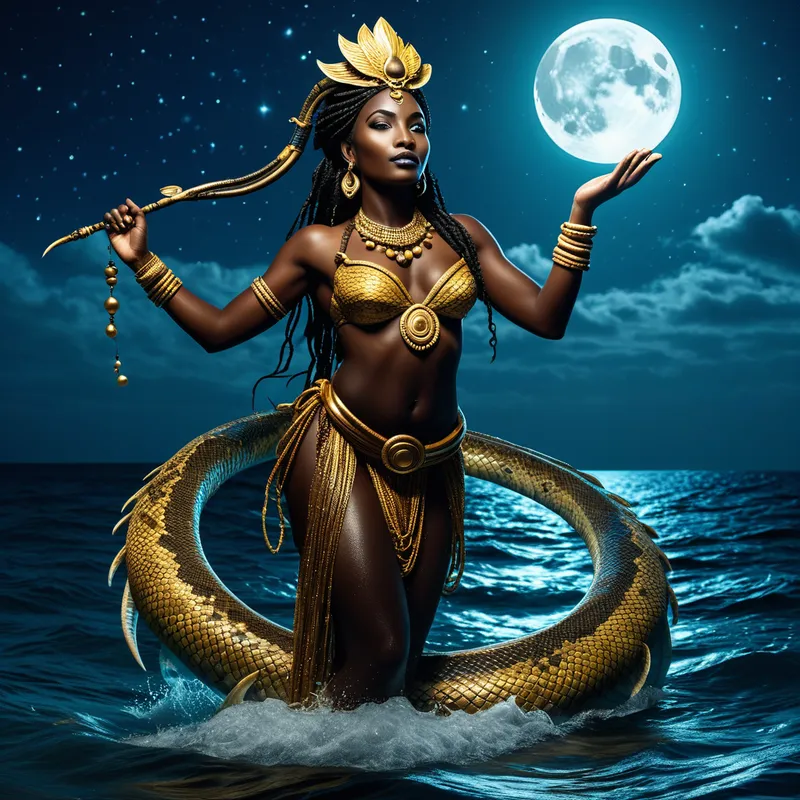
From this mirror, she rises. Not with a crash, but a sigh. Mami Wata is her name, though to speak it is to feel the taste of salt and honey on your tongue. Her skin is the color of polished obsidian, catching the last light of the drowned sun. Her hair is a living river, sometimes braided with coral, sometimes writhing with the sinuous forms of pythons. Her eyes are twin abysses, promising everything you have ever lacked. Around her neck, on her wrists, dripping from her ears: gold. Not the gold of kings, but the gold of the deep, cold and ancient, whispering of empires lost beneath the waves.
She speaks without moving her lips. Her voice is the sound of waves in a conch shell, the murmur of a distant waterfall. She offers a vision: wealth beyond counting, beauty that turns heads and breaks hearts, power that hums in the blood. She shows him his village transformed, his hut a palace, his name a legend. But her gaze holds a warning, a chill that cuts deeper than the ocean’s heart.
The pact is simple, and absolute. All this, for him. Not just his labor, but his past. His ties to the shore, to his family, to the rhythm of sun and soil. He must come with her. He must belong to her. The world he knows will become a dream, a faint echo from a life once lived. The man stands on the knife-edge of longing and terror. To reach for her hand is to let go of every other hand that ever held his. The sea, once a source of life, now yawns as a doorway to a different existence. Does he step from the canoe? Does he let the dark, jeweled water close over his head, following the glint of her tail—half woman, half fish, or sometimes serpent—into the silent, glittering kingdom below? The story holds its breath. His choice is the hinge upon which two worlds swing.

Cultural Origins & Context
The spirit we call Mami Wata is not a single, fixed deity from one ancient text, but a vibrant, evolving constellation of beliefs that flowed with the people. Her roots are deep in the indigenous water spirit veneration of West and Central Africa, where rivers, lakes, and the ocean were seen as realms of immense spiritual power, fertility, and danger. With the transatlantic encounter, her image was catalyzed by European depictions of mermaids and snake charmers on trade goods, which were absorbed and powerfully reinterpreted through a African spiritual lens.
She is a quintessential figure of the crossroads, both geographically and spiritually. Her stories were carried across the ocean during the diaspora, transforming into Lasirèn in Haiti, Yemaya and Oxum in the Afro-Caribbean traditions, and maintaining her potent presence in modern West African cities. Traditionally, her priests and priestesses (Mami Wata devotees) were often healers, diviners, and artists—those who navigated the margins of the community and the mysteries of the unseen. Societally, her myth functioned as a profound commentary on desire, foreignness, and the cost of extraordinary success. She explained sudden, unexplained wealth or ruin, mental illness (seen as her possessive call), and the powerful allure and peril of the unknown, whether across the seas or within the human psyche.
Symbolic Architecture
Mami Wata is the archetypal embodiment of the unconscious itself—vast, beguiling, amoral, and unimaginably rich. She is not evil, but she is utterly other, governed by laws that defy terrestrial logic.
The unconscious does not bargain; it demands a life.
Her water is the primordial soup of the psyche, teeming with latent potentials, forgotten memories, and instinctual forces. The treasures she offers—wealth, beauty, charisma—symbolize the latent gifts and powers that lie dormant within an individual, inaccessible to the conscious, ego-bound mind. The pythons coiled around her are ancient symbols of transformation (shedding skin), wisdom, and the chthonic, earth-bound energy that balances her aquatic nature. They remind us that this deep psyche is also visceral and somatic.
The cruel heart of the myth is the pact: to gain the riches of the deep Self, one must sacrifice the familiar identity of the ego. The shore represents the conscious world—ordered, social, known. Mami Wata’s kingdom is the realm of the personal and collective unconscious. You cannot have the gold and remain a simple fisherman. The transformation she offers is total, and it always carries the scent of isolation and melancholy, for the old self must "drown."
The Dreamer's Resonance
When Mami Wata swims into modern dreams, she heralds a profound summons from the depths of the dreamer’s own being. She appears not to entertain, but to initiate.
Common dream motifs include: finding inexplicable treasure in water; being irresistibly drawn to a beautiful yet frightening figure near a pool, ocean, or even a bath; making a Faustian bargain for talent or success; or experiencing a sense of eerie, luxurious isolation after a life change. Somatically, the dream may be accompanied by sensations of pressure, floating, or a chilling awe. Psychologically, this signals a critical encounter with what Jung called the soul-image (the Anima for a man, the Animus for a woman)—the inner representative of the unconscious that holds the key to one’s deepest creativity, eros, and spiritual connection.
The dreamer is at a psychic crossroads. The conscious attitude has become sterile or confined. Mami Wata’s appearance is the psyche’s dramatic, numinous attempt to break the dam, to flood the dry land of ego with the fertilizing, dangerous waters of a larger potential. The terror in the dream is the ego’s rightful fear of dissolution. The longing is the soul’s call to wholeness.

Alchemical Translation
The myth of Mami Wata is a precise map for the alchemical process of individuation, where the base metal of the limited personality is transmuted into the gold of the Self. Her realm is the solutio—the dissolution, where rigid structures are softened and broken down by the psychic waters.
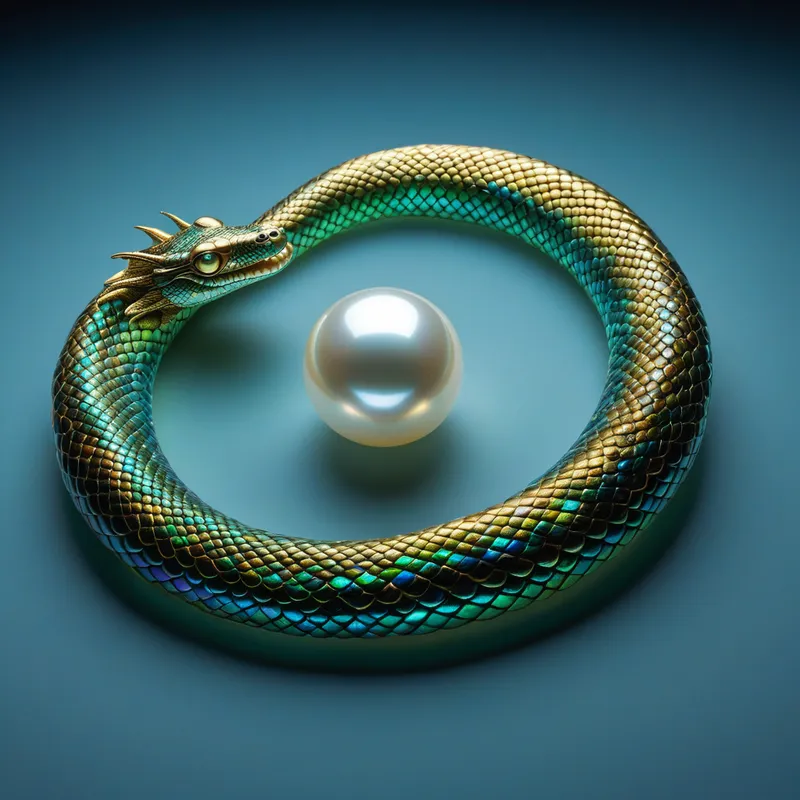
To find the pearl, one must consent to the long descent into the shell of the deep.
The fisherman’s initial life represents the status quo, the persona. The encounter is the shocking, often disruptive eruption of the unconscious (the nigredo, or darkening). The painful sacrifice of his old world is the necessary mortificatio—the death of the ego’s absolute rule. This is not a literal abandonment of responsibility, but a profound inner death: the letting go of outdated self-concepts, familial expectations, and safe but soul-killing identities.
If he has the courage to undergo this dissolution—to be taken into the deep—the treasures manifest. This is the albedo (whitening) and citrinitas (yellowing), where the insights and energies retrieved from the unconscious begin to illuminate and enrich conscious life. The final stage, the rubedo (reddening), is not guaranteed in the myth, which wisely focuses on the critical moment of choice. It would be the conscious integration of those depths, where the individual no longer belongs solely to the shore or the deep, but becomes a living bridge between the two—a person who can navigate both worlds, whose wealth is not just material but spiritual, embodied, and real. The myth tells us the gold is real, but the price is everything you once believed you were. The transformation is total, perilous, and the only path to a life that is truly, deeply one’s own.
Associated Symbols
Explore related symbols from the CaleaDream lexicon: