
Malin Kundang Myth Meaning & Symbolism
A poor boy becomes a wealthy sea captain, but upon returning home, he denies his humble mother and is turned to stone by her curse.
The Tale of Malin Kundang
Listen, and hear the tale whispered by the salt-wind through the pinang trees of the Minangkabau shore. It speaks of a boy named Malin Kundang, born to a mother whose love was as deep and patient as the Samudera Hindia itself. His father was a ghost, taken by those same waves, leaving them in a poverty so thin you could see the sky through the walls of their hut. Yet, in his mother’s eyes, Malin was not poor. He was her hope, her small, fierce fire against the dark.
But a boy’s heart is a restless vessel. The horizon called, a siren song of fortune carried on the trade winds. “I will return a king, Mother,” he vowed, his young face turned to the sea. With a heart heavy as a monsoon cloud yet full of resolve, she let him go, her blessing a fragile shell placed in his pocket. For years, the sea was his tutor and his tyrant. He learned its brutal grammar, its mercurial moods. Through cunning and courage, he rose from deckhand to merchant, his perahu growing into a fleet, his rags transforming into the fine silks and gold-threaded jackets of a kapitan. He married a woman of noble beauty, and the memory of the shore, of the humble woman who waited, was buried under layers of wealth and new identity, like sand over a forgotten anchor.
Fate, however, charts its own course. A storm—or perhaps a deeper current—drove his magnificent ship back to the very beach of his birth. The villagers gathered, a tapestry of awe. And among them, she came. Time had bent her frame and etched her face with the script of longing, but her eyes knew her son. She pushed through the crowd, her calloused hands reaching for the splendid stranger. “Malin! My son, you have returned!”
On the deck of his ship, surrounded by his crew and his elegant wife, Malin Kundang looked down. He saw not his mother, but a specter of the shame he had sailed so far to escape—a reminder of the hunger, the helplessness, the earth-floor poverty. To acknowledge her was to shatter the glittering palace of self he had built. Pride, cold and hard as coral, sealed his heart. “You are mistaken, old woman,” he declared, his voice cutting the air like a blade. “I am a wealthy kapitan. My mother is not a beggar from the shore.” He ordered his crew to cast her away.
The world held its breath. The woman staggered back as if struck. The love in her eyes, a flame kept alive for decades, did not extinguish—it transformed. It became a fire of a different kind. She turned her face to the sky, to the sea, to the very earth that had borne him. Her voice, once soft with lullabies, rose in a raw incantation of ultimate grief and righteous power. “Oh, deities of the sea and sky! If he is truly not my son, let him go in peace. But if he is my flesh, my blood, my Malin Kundang who denies me… let your justice be stone!”
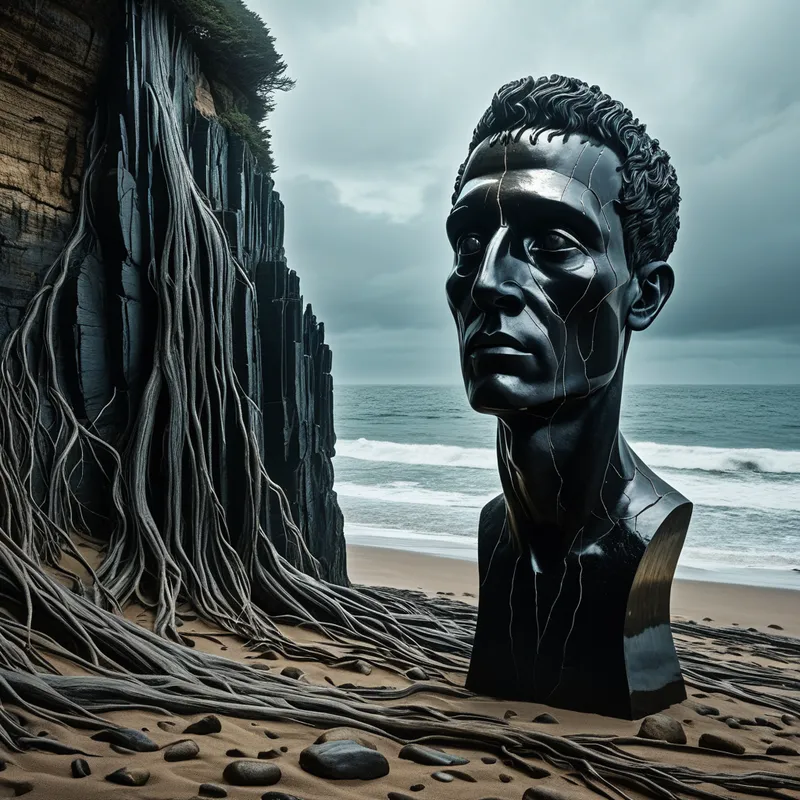
The curse hung in the air, a final, terrible thread. The sky darkened. The sea, a moment ago calm, began to churn with unnatural fury. A wave, like a giant’s hand, slammed into the ship. Malin Kundang was thrown onto the black volcanic sand. As he tried to rise, a profound numbness seized his feet. He looked down in horror to see his fine leather boots darkening, hardening, cracking into grey, unfeeling stone. The petrification crawled up his legs, his torso, his arms raised in futile defense. His cries turned to gravel, his defiant gaze to blank, sightless rock. Where a proud man stood, a new stone outcrop remained on the beach—a permanent, silent testament for the waves to lament and the wind to scour. His mother, her justice delivered, walked into the sea, becoming one with the element that had given and taken everything.

Cultural Origins & Context
The myth of Malin Kundang is rooted deeply in the Minangkabau culture of West Sumatra. It is an oral tradition, a cerita rakyat, passed down through generations not merely as entertainment, but as a foundational moral edict. In a society famously matrilineal, where lineage and property pass through the mother’s line, the figure of the mother holds immense social and spiritual authority. The story functions as a powerful societal sanction, reinforcing the sacred, inviolable bond between child and mother, and by extension, between the individual and their origins, their kampung halaman (hometown).
Told by elders, woven into the teachings of adat (customary law), the tale serves as a stark warning against the perils of sombong (arrogance) and ingkar (denial). It speaks to a culture that, while encouraging merantau (the journey away from home to seek knowledge and fortune), demands that one never sever the ethical and emotional umbilical cord. The mother’s curse is not portrayed as wicked witchcraft, but as the natural, cosmic consequence of a fundamental rupture in the moral order. Her appeal to the higher powers is a ritual act of last resort, aligning personal grief with universal law. The petrification of Malin Kundang is the ultimate social punishment: to be rendered immobile, silent, and eternally present as a cautionary monument, forever exiled from the flow of human connection and community.
Symbolic Architecture
At its core, Malin Kundang is a myth of failed individuation. The hero’s journey outward is successful in the worldly sense—he gains wealth, status, a new identity. But the crucial return, the integration of his past with his present, is catastrophically aborted. He attempts to create a Self in total denial of its Source.
The stone is not just a punishment; it is the embodied state of a soul that has chosen the illusion of perfection over the messy truth of its own becoming.
The Mother here symbolizes the unconscious foundation, the humble, often embarrassing soil from which the ego-consciousness grows. Malin’s rejection is an act of psychic matricide. He tries to kill off the part of himself that feels vulnerable, poor, and dependent. His wealth and ship are a Mask of such grandeur that he believes it can replace his essence. The Ocean represents both the realm of possibility (his success) and the repository of truth—it literally brings him back to face what he has cast away.
The transformation to Stone is profoundly alchemical. It represents the ultimate failure of the psychic process: instead of the lapis philosophorum (the philosopher’s stone of integrated wholeness), he becomes mere rock—inert, isolated, and incapable of further growth or feeling. His fate is a state of existential paralysis, the ego frozen in its own defensive pride.

The Dreamer's Resonance
When this myth stirs in the modern Dream, it often manifests as dreams of profound shame exposure or irreversible hardening. You may dream of returning to a childhood home that is now ruinous and being recognized by a parent you desperately wish to disown. You may feel your limbs turning heavy and numb as you deliver a speech of denial. Or you may be on a magnificent ship that is suddenly revealed to be made of brittle, painted paper, crumbling as an old, sorrowful figure points at you from the shore.
Somatically, this echoes the process of dissociation—a psychic “turning to stone” to avoid the overwhelming flood of shame, grief, or vulnerability associated with one’s origins or past actions. The dream is signaling a critical impasse. The conscious personality has built a successful life, but at the cost of severing connection to its emotional and historical roots. The body in the dream hardens because the psyche is enacting the very defense mechanism that is killing it: emotional petrification. The dream is a plea from the soul to feel again, even if that feeling is the searing pain of acknowledged shame, before the transformation becomes permanent.
Alchemical Translation
The alchemical journey modeled here—and its tragic reversal—offers a stark map for psychic transmutation. The process begins with the nigredo, the blackening: Malin’s poverty and longing. The albedo, the whitening, is his ascension and purification into a man of status. But the work fails at the rubedo, the reddening or final stage of integration, which requires the conjunctio, the sacred marriage of opposites: the wealthy captain with the pauper’s son, the present self with the past shadow.
Individuation demands not the denial of the humble mother within, but her sacred reconciliation. To become whole, one must bow to the source of one’s life, not as an act of submission, but as an act of completion.
The successful alchemical translation would have seen Malin Kundang disembark and embrace his mother. This would not diminish his wealth; it would have humanized it. The gold would have been tempered by the earth, the silk woven with the threads of humility. The mother’s curse, in its positive, unrealized form, is the blessing she initially wished to give: the stability of stone as foundation, not as prison. To integrate the Shadow of one’s origin is to gain its substance, its grounding power. The alternative is to become a statue—admired perhaps from a distance for one’s form, but utterly devoid of the beating Heart that makes one truly alive. The myth instructs us that the greatest Journey is not the one away from home, but the courageous voyage back to the shores of the self we left behind, to offer it the honor it is due.
Associated Symbols
Explore related symbols from the CaleaDream lexicon:
- Mother — The absolute archetype of origin, the unconscious ground of being, and the moral authority whose denial leads to existential annihilation.
- Ocean — The vast unconscious, the realm of memory and potential that both carries the hero to fortune and returns him to face his repressed truth.
- Stone — The state of psychic petrification, representing hardened pride, emotional death, and the eternal monument to a failed transformation.
- Mask — The constructed persona of wealth and status that Malin Kundang wears, which he mistakenly believes can replace his authentic, rooted identity.
- Shame — The core emotional wound that Malin flees, which festered into the pride that caused him to deny his source and led to his ruin.
- Journey — The physical and psychological voyage of merantau, which is only complete when it includes the return and integration of the self’s origins.
- Ship — The vehicle of ambition and the conscious ego, which becomes the very stage for the tragic denial and subsequent divine judgment.
- Shadow — The disowned, impoverished, and vulnerable part of Malin’s self that he projects onto his mother and tries to cast away, with catastrophic consequences.
- Heart — The center of feeling and connection that Malin Kundang sealed with pride, leading to his transformation into unfeeling, stony matter.
- Pride — The tragic flaw that acts as the catalyst for the rupture, the defensive arrogance that prevents humility and seals his fate.
- Grief — The mother’s overwhelming emotion, which alchemically transforms from loving longing into the righteous, world-shaping power of her curse.
- Root — The connection to origin, family, and cultural soil that Malin severed, leaving his magnificent new identity without sustenance or stability.