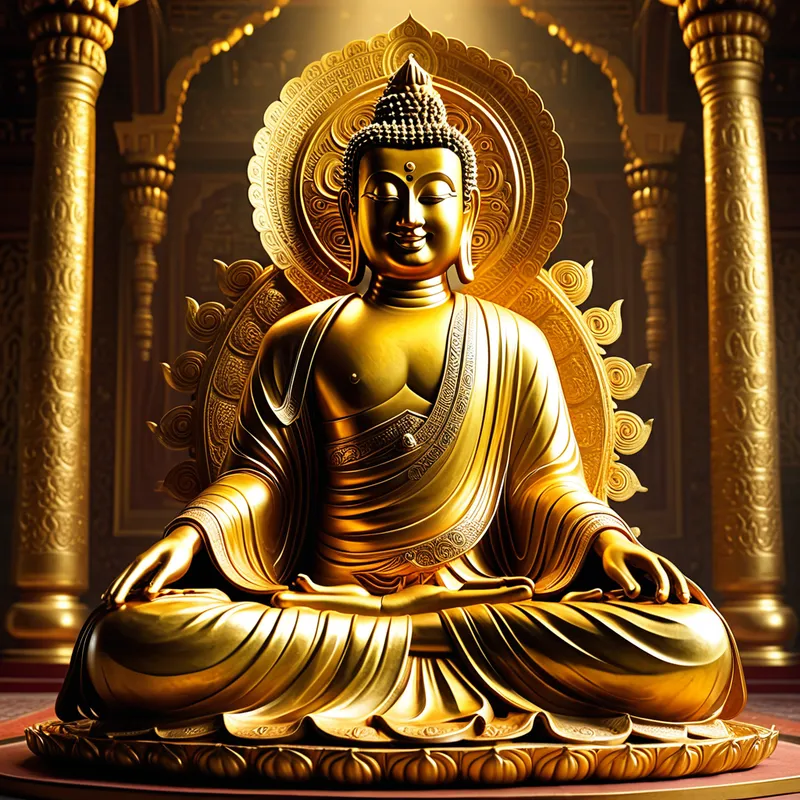
Maitreya Myth Meaning & Symbolism
The myth of Maitreya, the Buddha yet to come, is a profound archetype of hope, the promise of future enlightenment, and the patient cultivation of the heart.
The Tale of Maitreya
In the long twilight of the world, when the teachings of the Shakyamuni have faded to a whisper and the wheel of samsara turns with a heavy groan, there is a promise. It is not a promise of immediate rescue, but of a future dawn. It resides in the Tushita Heaven, a realm of sublime peace and radiant light. Here, amidst palaces of wisdom and gardens of contemplation, waits a bodhisattva.
His name is Maitreya. He is not a god of wrath or a warrior king, but a being of boundless, patient compassion. He sits in the posture of royal ease, a posture that speaks of readiness, not rest. His countenance holds a smile that understands the weight of all suffering and the certainty of its end. In his hair rests a small stupa, a treasure-house of the Dharma he will one day unlock.
The world below forgets. The noble truths become obscured. Compassion cools into indifference, and wisdom is traded for trivial gain. The earth itself feels this forgetfulness; the soil yields less, life-spans shorten, and hearts grow hard. This is the age of decline, the long waiting.
But in Tushita, Maitreya does not sleep. He teaches the gods. He cultivates the perfections of a bodhisattva to their ultimate flowering. He watches the human realm with eyes that see across eons, feeling the collective longing for relief as a gentle tug on his heart. His time is not yet. The world must ripen in its yearning. The people must, in their deepest despair, begin to turn their minds toward kindness, toward a morality born of genuine need. They must prepare the ground, not for a conqueror, but for a friend.
Then, when the moment is woven into the fabric of time itself—when a human lifespan stretches to 84,000 years and a king named Sankha will offer him the leadership of the world—Maitreya will descend. He will not come on a chariot of fire, but will take birth as a human, in the ancient lineage of the Shakyas. He will walk to the same tree, the Bodhi tree, now grown tall once more. There, on the very seat now held empty in memory, he will attain perfect, complete enlightenment. With a voice that is the sound of a river meeting the ocean, he will set the wheel of Dharma turning for a new age. He will open the gates of wisdom to multitudes, and under his guidance, countless beings will taste liberation. The long winter of the spirit will end in a spring that lasts for millennia. The promise, held in patient compassion through the ages, will be fulfilled.
Cultural Origins & Context
The figure of Maitreya emerges from the <abbr title="The "Great Vehicle" branch of Buddhism, emphasizing the bodhisattva path">Mahayana Buddhist tradition, a development that expanded the Buddhist path from a personal quest for liberation to a universal mission of compassion. While the historical Buddha, Shakyamuni, described a future Buddha in some of the earliest texts, it was in the Mahayana sutras—such as the Maitreyavyakarana (The Prophecy of Maitreya)—that his story was fully elaborated. This myth served a critical sociological and psychological function in a growing religious community facing the inevitable passing of its founder.
Told by monks and depicted in art from Gandhara to China, the myth of Maitreya addressed the anxiety of decline. It provided a narrative arc for history itself, assuring devotees that the Dharma was not a fleeting event but an eternal truth that would re-manifest. It transformed passive waiting into active preparation. Culturally, it inspired not only devotion but also social ideals—the hope for a just ruler (Sankha) and a harmonious society was intertwined with Maitreya's coming. In East Asia, particularly, Maitreya devotion sometimes took on millenarian characteristics, with figures claiming his embodiment to inspire social reform or rebellion, demonstrating the myth's powerful resonance as a symbol of future justice and renewal.
Symbolic Architecture
At its core, Maitreya is not merely a future person but an archetypal force. He represents the potential for enlightenment that exists within the continuum of time and consciousness. He is the answer to the despair that asks, "What if I am born in a dark age? What if I miss the teaching?"
Maitreya symbolizes the future-perfected aspect of our own mind, the Buddha-nature that is always present but not yet fully actualized.
His residence in Tushita Heaven is profoundly symbolic. This is not an escape from the world, but a realm of preparation. It represents a state of consciousness where the qualities of compassion (metta, from which his name derives) and wisdom are nurtured to maturity. The empty seat beneath the Bodhi tree is one of the most potent symbols in all of Buddhism—it is the seat of potential, a sacred space held open for the awakening that is always to come. It teaches that the structure for enlightenment is eternally present; it awaits the qualified occupant.
Maitreya’s promised descent models the incarnation of compassion into the messiness of time and history. Enlightenment is not forever removed to a heavenly abode; it will, must, and does enter the human realm to address its suffering directly.
The Dreamer's Resonance
When the archetype of Maitreya stirs in the modern psyche, it often manifests in dreams of awaiting, preparation, and future promise. One might dream of an empty chair of great importance in a familiar room, a vacant podium before an audience, or a vehicle being meticulously prepared for a long journey whose departure date is unknown. There is a mood of pregnant pause, of something immense being gathered that cannot yet be seen.
Somatically, this can feel like a deep, quiet humming in the chest—a sense of potential energy with no immediate outlet. Psychologically, the dreamer may be in a life phase of incubation. This is not stagnation, but a necessary period of inner cultivation. The conflict felt is between the ego's desire for immediate resolution and the soul's understanding of divine timing. To dream of Maitreya is to confront the virtue of patience as an active, creative force. It may indicate that the dreamer is developing the inner qualities—compassion, ethical integrity, wisdom—required for a future life transition or creative birth that the conscious mind cannot yet envision.

Alchemical Translation
The alchemical process modeled by the Maitreya myth is the transmutation of hope into embodied readiness. In the vessel of the psyche, the base metal of wishful thinking ("I hope things get better") must be subjected to the long, patient fire of practice to become the gold of confident expectation ("I am preparing the ground for the better that is to come").
The first stage is ascension to Tushita—withdrawing psychic energy from the frantic, decaying patterns of the outer world (the "age of decline") and investing it in inner development. This is the sadhana of the soul, building the internal palace of wisdom.
The wait for Maitreya is not passive; it is the active cultivation of the heart so that when the future arrives, we are not its surprised recipients, but its recognizing hosts.
The empty Bodhi seat is the central symbol of this work. It is the sacred space we clear within ourselves—through meditation, reflection, and ethical living—where the future, enlightened self can take its place. We do not build the self that will sit there; we build the seat, the supportive structure of character and consciousness. The final stage, the descent and awakening, occurs when the cultivated inner potential finally meets the ripe outer circumstance. The promised future becomes the embodied present. The individual realizes that the Maitreya they awaited was, in a profound sense, the totality of their own journey toward completeness, the sage archetype made whole within them. The myth thus guides us to live not for an idealized past or an impatiently demanded future, but in a present that is consciously dedicated to preparing for the awakening that is our ultimate destiny.
Associated Symbols
Explore related symbols from the CaleaDream lexicon: