Maia Myth Meaning & Symbolism
A story of silent growth and hidden power, where a goddess of the earth nurtures the swift messenger of the gods in the shadows of a sacred cave.
The Tale of Maia
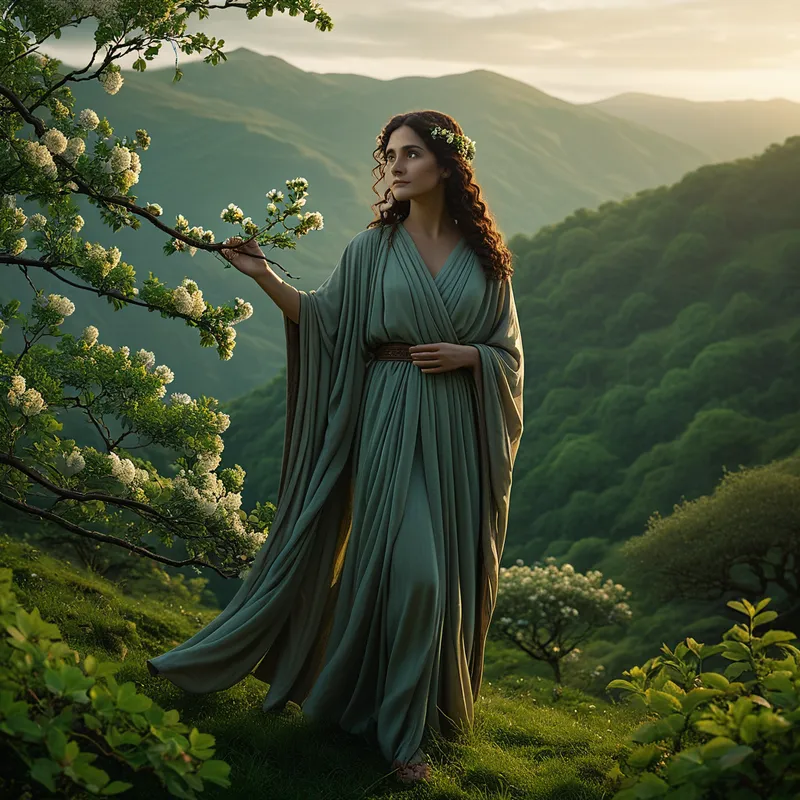
Listen, and hear the story not of thunder, but of the quiet that comes before the dawn. In the time when the world was younger and the gods walked closer to the earth, there was a sisterhood of stars. Seven they were, the Pleiades, born of the Titan Atlas, who bore the weight of the sky, and the ocean nymph Pleione. Among these celestial sisters, one shone with a different light—not the sharp glitter of the distant firmament, but the warm, fecund glow of the living earth. Her name was Maia.
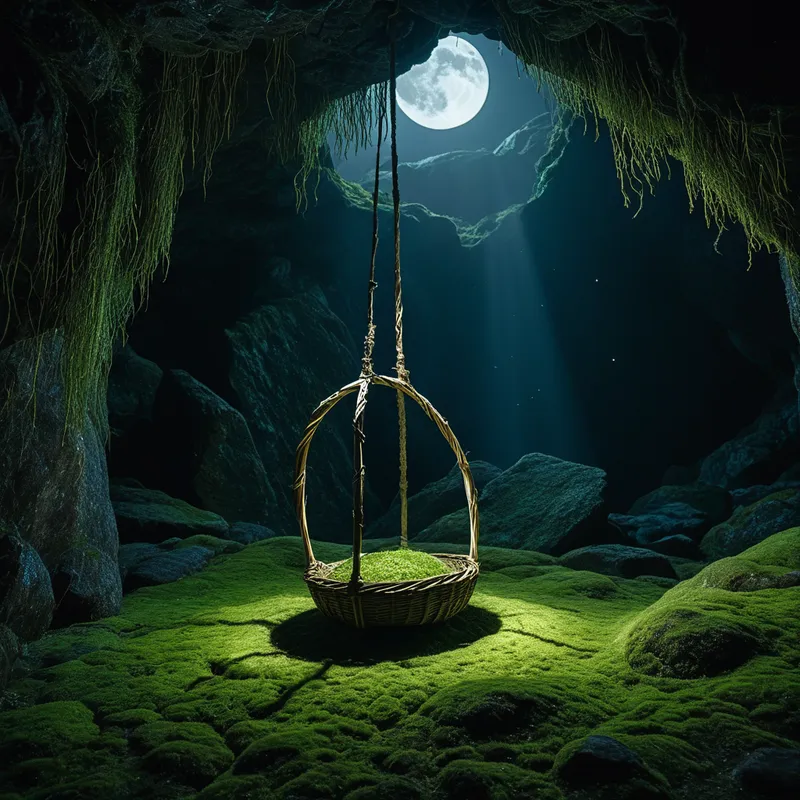
While her sisters danced in the vault of night, Maia sought the deep, secret places. She dwelled not in the glittering halls of Jupiter, but in a shadowy, moss-lined cave on the wooded slopes of Mount Cyllene. Here, the air was cool and smelled of damp stone and rich soil. Here, the only sounds were the drip of water and the whisper of the wind through the pines. She was a goddess of the increasing earth, of the silent, swelling power of spring, of that which grows unseen.
Into this sanctuary of quiet came the great god Jupiter, not with a bolt of lightning, but cloaked in the deep blue of twilight. Drawn by her hidden power and her reclusive grace, he sought her out. Their union was not a celestial battle, but a merging of the sky’s expansive potential with the earth’s receptive, nurturing depth. It happened in the secret dark, witnessed only by the stones and the roots.
From this union, in that very cave, a child was born. But this was no ordinary babe. He was precocious, a spark of mischief and motion incarnate. While still in his cradle of woven willow, his eyes held the glint of a thousand paths. This was Mercury, the future messenger of the gods, the guide of souls, the god of commerce and cunning. And it was Maia, alone in her hidden grotto, who nurtured him. She swaddled him not in gold-threaded cloth, but in the softest moss. She fed him not ambrosia, but the knowledge of growing things—the patience of the seed, the resilience of the vine, the silent strength of the mountain that housed them.
She taught him the language of the rustling leaves and the hidden streams, the first alphabets of the natural world. In the profound stillness of her cave, she cultivated the speed of his mind. His first cries did not echo in grand palaces, but were absorbed by the living earth, a secret between mother and son, between the nurturing dark and the nascent light destined to race across the heavens.
Cultural Origins & Context
The figure of Maia is a fascinating tapestry woven from both Roman and earlier Italian threads. Her name itself is believed to derive from the Latin root ma-, related to magnus (great), suggesting an ancient, foundational concept of growth and increase. To the Romans, she was primarily Maia Maiestas, "Maia the Majestic," a goddess of fertility and the burgeoning month of May (Maius), which was named in her honor. Her festival, the Sacra Maia, involved offerings made by the priest of Vulcan, connecting her earthy, generative power to the transformative fire of the hearth and craft.
Her mythological role as the mother of Mercury, however, is a later Greek import, a syncretism where the Roman Maia was identified with the Greek nymph of the same name. This fusion enriched her character, layering the indigenous Italian goddess of physical abundance with the poignant, psychological narrative of the hidden mother who nurtures a revolutionary force. Her story was not the stuff of grand public epics but of more intimate tellings, passed down by poets like Ovid and embedded in the calendar of agricultural life. She represented the essential, often overlooked, foundation—the fertile ground from which all dynamic action (Mercury) must spring.
Symbolic Architecture
Maia’s myth is an ode to the power of hiddenness and latent potential. She is the archetype of the fertile void, the dark, rich soil necessary for any seed to germinate. Her cave is not a prison, but a sacred temenos—a protected enclosure where the raw materials of creation are gathered and incubated away from the blinding light of collective consciousness.
The greatest potentials are not announced with fanfare; they are conceived in silence and nurtured in shadows.
Mercury, the god of communication, commerce, and swift travel, is paradoxically born from the goddess of silence and stillness. This symbolizes a profound psychological truth: all conscious expression, all agile thought and social exchange, has its roots in a period of unconscious gestation. Maia represents the somatic, pre-verbal intelligence of the body and the earth. She is the incubation period of an idea, the quiet gathering of resources before a venture, the unspoken bond that nourishes a talent before it is presented to the world. She embodies the "holding environment," the necessary containment where something fragile and nascent can integrate and gain strength before facing the winds of exposure.
The Dreamer's Resonance
When the pattern of Maia stirs in the modern psyche, it often manifests in dreams of secluded, womblike spaces: hidden rooms in familiar houses, deep forests where sunlight filters softly, caves with glowing interiors, or simply a powerful feeling of being protectively enclosed. One might dream of tending to a small, luminous object or a vulnerable animal in such a place. There is a somatic quality of fullness, quiet, and patient waiting.
These dreams signal a phase of psychic incubation. The dreamer is in a "Maia phase," where a new aspect of the self, a new skill, a new relationship, or a creative project is in its earliest, most vulnerable stage of development. The psyche is wisely insisting on protection and privacy. The conflict here is often between this inner need for hidden nurturing and the external (or internal) pressure to "produce," to be visible, to articulate what is still only a feeling. The dream is a reassurance: this silence is not stagnation, but the most active kind of growth, happening below the surface.
Alchemical Translation
The alchemical journey modeled by Maia’s myth is the stage of nigredo—the blackening, the descent into the prima materia, the fertile dark. In the process of individuation, this is the often uncomfortable but crucial phase of turning inward, of acknowledging the unconscious, unformed potentials within us. It is a retreat from the persona, the social mask, to attend to what is germinating in the shadows of the soul.
To become a messenger of one's own truth, one must first be mothered by one's own depths.
The modern individual engaged in this alchemy is learning the virtue of containment. Before expressing an insight, they must let it be fully formed in the cave of their intuition. Before launching a venture, they must nurture its roots in the soil of thorough preparation and inner conviction. Maia’s process teaches that the swift, mercurial genius—the ability to think, communicate, and adapt—is not a spontaneous bolt from the blue, but the child of prolonged, respectful engagement with the silent, earthy parts of ourselves. The triumph is not in the eventual emergence of Mercury into the world, but in the complete and unhurried sanctity of the nurturing cave. It is the transmutation of raw, unconscious potential into a nurtured soul-force, ready to engage the world with agility, because it was first given a foundation of profound, unshakeable depth.
Associated Symbols
Explore related symbols from the CaleaDream lexicon: