Magpie Bridge Myth Meaning & Symbolism
A celestial weaver and a cowherd, separated by the Milky Way, are allowed one annual reunion across a bridge formed by the compassion of magpies.
The Tale of Magpie Bridge
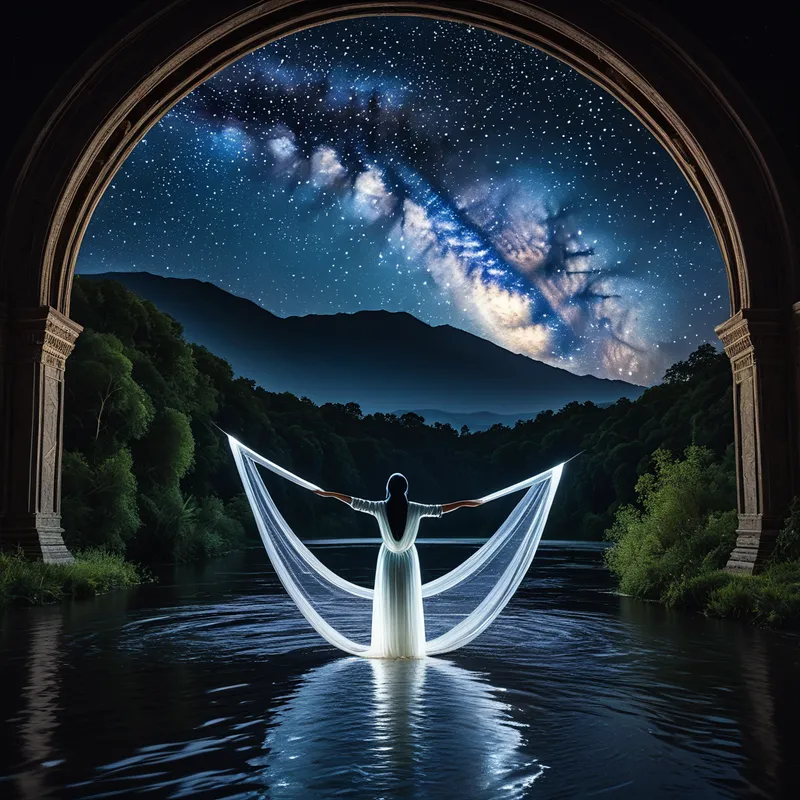
Hear now the sigh of the heavens, the story written in star-dust and longing. Before time was measured in dynasties, the sky was a different kingdom. There, upon the eastern bank of the Tianhe, lived Zhinü, daughter of the Jade Emperor. Her fingers were lightning, her thread was moonlight, and on her loom of clouds she wove the robes of the gods and the very tapestries of sunset and dawn. Her life was one of sublime, lonely perfection.
On the western bank of that starry river lived Niulang, a humble herdsman of celestial cattle. His world was the smell of dew on star-grass and the low, comforting songs of his beasts. He was content in his solitude, until the day his oldest ox spoke with a voice like grinding stones. "Master," it said, "cross the river at the ford of twilight. You will find a happiness beyond your ken."
Guided by this bovine sage, Niulang crossed. There he saw Zhinü, and in that seeing, the ordered cosmos shuddered. She looked upon him, and the perfect, endless pattern of her weaving snapped. They spoke not of divinity or duty, but of the heart's simple, terrifying truth. They fell in love, were wed, and for a time, heaven and earth knew a joy so profound it blurred the boundaries between them. Zhinü set aside her loom; Niulang left his herd. They built a hearth in the meadow between the stars.
But the cosmos cannot abide such imbalance. The Jade Emperor, enraged by his daughter's abandonment of her sacred duty and the ensuing disorder in the celestial cloth, descended in a tempest of righteous fury. With a stroke of his hand, he carved the Tianhe deeper and wider, a torrent of liquid stars now impassable. On one shore stood Zhinü, on the other, Niulang, their cries lost in the river's silent roar. Their punishment was eternity: to see, to know, but never to touch.
Yet even the stern heart of heaven can be moved. Perhaps it was the ox’s pleading, or the sheer, unwavering intensity of the lovers’ grief, which shone brighter than any star. The Jade Emperor relented—but only so far. Once a year, on the seventh day of the seventh lunar month, they may meet. But how to cross a river of stars?
This is where the compassion of the earth intercedes. Learning of the decree, every magpie in the world, feeling the pull of this celestial sorrow, takes wing on that night. They fly, a great, chattering river of black, white, and iridescent blue, ascending to the heavens. There, over the glittering void, they link wing to wing, body to body, to form a living, breathing bridge—the Que Qiao. And across this bridge of feathered hope, Zhinü and Niulang run. For one night, the universe holds its breath. For one night, the separated halves become whole. At dawn, the magpies scatter, the bridge dissolves, and the lovers part once more, their hearts fortified by the memory of touch, until the next year’s stars align.
Cultural Origins & Context
This myth, one of China’s Four Great Folktales, finds its earliest roots in the Shang Dynasty star lore, where the stars Vega and Altair were first noted. It crystallized into its familiar narrative during the Han Dynasty and has been passed down through poetry, opera, and village storytelling for over two millennia. The festival associated with it, Qixi, transformed from a ritual observance where young women prayed for Zhinü’s skill in weaving and needlework into a broader celebration of love and devotion.
Its societal function was multifaceted. For young women, it was a tale that validated skill and dedication (Zhinü as the archetypal skilled weaver). For all, it was a profound lesson in cosmic order, filial piety (and its limits), and the bittersweet nature of destiny. The myth was not merely entertainment; it was a celestial map for human emotions, explaining the very real, annual meteorological fact that magpies seem to vanish around Qixi—they have, the story explains, flown to heaven to perform their sacred duty. It rooted the rhythms of the natural world (bird migration, the seasonal position of the stars) deeply within the emotional landscape of the human heart.
Symbolic Architecture
At its core, the Magpie Bridge is a masterful allegory of the fundamental human experience of separation and the yearning for connection. The Tianhe is not just a river in the sky; it is the archetypal chasm—between duty and desire, the divine and the mortal, the conscious ego and the unconscious soul, or even between two aspects of the self that feel irrevocably split.
The bridge is not a given; it is an act of collective compassion built across a decree of separation.
Zhinü represents the anima, the soul-force, often confined to a celestial, patterned, but lonely existence (the conscious mind's ordered reality). Niulang represents the grounding animus, the earthly, instinctual life connected to nature and animal wisdom (the embodied, instinctual self). Their union is the fleeting, ecstatic, and destabilizing experience of wholeness. The Jade Emperor is the ruling principle of consciousness, the "kingly" ego that demands order and differentiation, who sees union as chaos. The ox is the deep, instinctual wisdom of the psyche itself, which guides the ego toward the necessary, transformative encounter.
The magpies are the critical, active agents of reconciliation. They symbolize joy, auspiciousness, and resourcefulness in many East Asian cultures. Psychologically, they represent those fleeting thoughts, memories, synchronicities, and acts of empathy—the "magpie moments"—that, when gathered together, can temporarily bridge our deepest internal divides. The bridge itself is ephemeral; it is not a permanent solution but a sacred, periodic ritual of reconnection.
The Dreamer's Resonance
When this myth patterns a modern dream, the dreamer is almost invariably in a state of profound inner or outer separation. They may dream of a loved one across an uncrossable gap, of a lost part of themselves on a distant shore, or of a river of light or data that divides their world.
The somatic feeling is one of acute longing, a heartache that is both beautiful and painful. The psychological process is one of yearning-mediated integration. The dream is not presenting a solution, but actively mapping the territory of the split. The appearance of birds—especially black and white ones, or birds working together—in such a dream points to the nascent, instinctual movement toward building a bridge. The dreamer may feel the frustration of the bridge dissolving at dawn (the return to conscious reality), but the mythic template assures that the capacity for reconnection is innate, even if its manifestation is cyclical and temporary. The dream asks: What in your life feels like the starry river? And what are your magpies?
Alchemical Translation
For the modern individual navigating the path of individuation—becoming whole, conscious, and authentic—the Magpie Bridge myth models the alchemy of the conjunctio, the sacred marriage. This is not a one-time achievement, but a lifelong, rhythmic process.
The first stage is the separatio: the necessary, often painful, differentiation enforced by the "Jade Emperor" of our own psyche (our upbringing, societal norms, traumatic wounds). We are split from our instinctual nature (Niulang), or from our creative, soulful essence (Zhinü). We see what we need across a chasm of our own making or inheritance.
The ox’s advice is the call from the deep Self to acknowledge this split and to seek the other shore. The annual decree is the acceptance of the rhythm of this work. We cannot live permanently in a state of ecstatic union; consciousness requires periods of separation and individual work.
The alchemical gold is forged not in permanent union, but in the faithful return to the bridge-building ritual itself.
The active, alchemical work is the gathering of the "magpies." This is the conscious effort in therapy, creative practice, relationship work, or meditation—the small, seemingly insignificant acts of self-compassion, honest communication, and symbolic expression. Each is a feather in the bridge. Qixi is the appointed time we create for this inner ritual, the sacred space in our calendar for deep reconnection.
The crossing is the experience of integration, however brief—the moment of insight, the heartfelt reconciliation, the creative flow, the sense of being whole. It fortifies us for the return to the separated state. The myth teaches that wholeness is not a destination, but a faithful, cyclical pilgrimage across a bridge built from the gathered fragments of our own compassionate attention.
Associated Symbols
Explore related symbols from the CaleaDream lexicon: