Magician's Wand Myth Meaning & Symbolism
A tale of a mortal who, through ordeal and sacrifice, forges a conduit of pure will, learning that true power flows from alignment, not command.
The Tale of the Magician's Wand
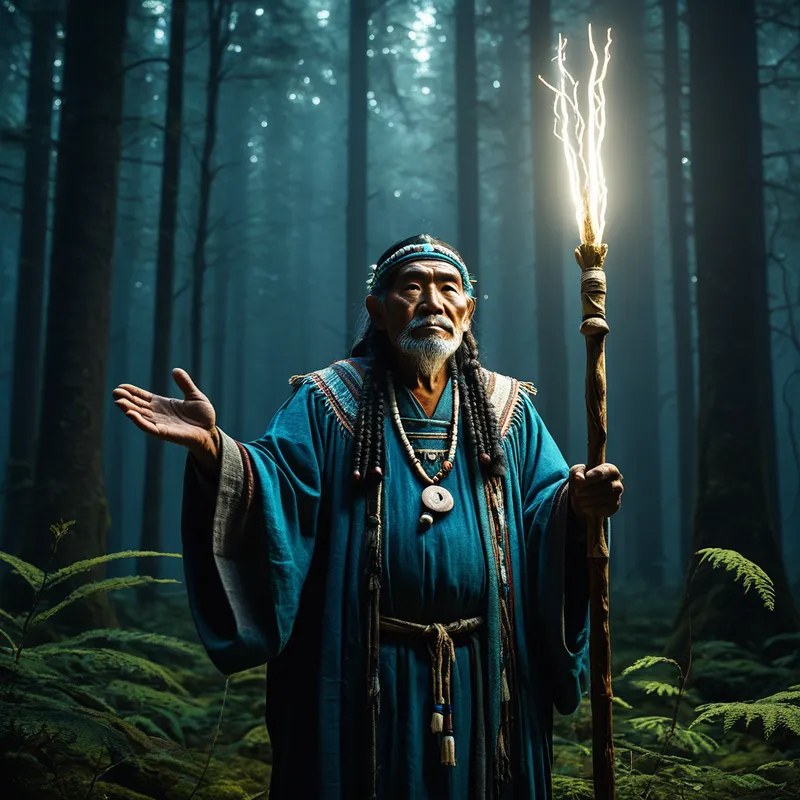
Listen, and let the embers of the fire carry this truth to you. It was not in a time you can mark on any stone, nor in a land you can find on any map. It was in the time when the world was still whispering its first secrets, and in the heart of the great, murmuring forest where the oldest trees remember the taste of starlight.
There lived a seeker, known to us only as the Listener. They were not born a king or a warrior, but with a hollow in their soul, a space that echoed with the wind’s song and the river’s chant. They heard the language of roots delving deep and the silent prayers of stones. Yet, this hearing was a torment, for the world’s voice was a cacophony of unmet need—the thirst of the cracked earth, the longing of the unspoken dream, the cry of the trapped spirit. The Listener’s own will was a scattered thing, blown like leaves in the storm of this perception.
Driven by a desperate need to answer, to focus this overwhelming chorus into a single, clear note, they embarked on an ordeal. They sought the Heartwood Tree, said to grow where the fabric between the worlds was thin as a spider’s silk. The journey stripped them of all they carried—their name, their past, their certainty. They arrived at the silvery trunk not as a conqueror, but as a bare soul.
The tree did not offer a branch. It offered a test. “To focus the world’s song, you must first hold its silence,” the wind seemed to sigh through its leaves. For three nights and days, the Listener sat, not listening, but being listened to by the forest. They felt the weight of the owl’s gaze, the curiosity of the fox, the patient judgment of the moss. It was an unbearable vulnerability.
On the dawn of the fourth day, a single, perfect branch, struck by lightning yet still vibrant with life, fell at their feet. This was the first ingredient. The second was their own vow, spoken not as a command, but as a sacred contract whispered into the wood as they carved it under the moon: “Let my will be a channel, not a cage. Let my power be a bridge, not a wall.”
The final ingredient was sacrifice. The wand, once shaped, was inert. The old tales spoke of a spark from the World-Forge. To gain it, the Listener had to offer a piece of their own chaotic, unfocused life-force—the very desperation that had driven them. They thrust the wand into their own chest, not to pierce the heart, but to touch the swirling storm of their raw intention. They drew it out, and where there was once chaos, there was now a resonant emptiness. And within the wand’s core, a tiny, steady star was now captive, humming with potential.
The wand was no weapon. When pointed at the drought-stricken field, it did not command rain; it hummed until the Listener’s own being resonated with the memory of water deep underground, guiding it upward. It did not heal the sick; it focused the healer’s compassion into a beam that encouraged the body’s own song to remember harmony. The power was always a dialogue, a marriage of the Listener’s purified intent and the world’s latent willingness. The wand was the wedding ring.
Cultural Origins & Context
The myth of the Magician’s Wand is a polygenetic narrative, appearing in fragments and echoes across shamanic traditions, early alchemical texts, and the folklore of tool-making peoples. It is not the story of a single culture’s patron deity, but a “various” myth—a universal story about the human encounter with instrumental power. It was told by firelight by tribal elders to initiates learning the sacred use of the drum or the rattle. It was encoded in the manuals of early smiths and carpenters, for whom the tool was an extension of sacred skill. Its societal function was deeply ethical: to frame the use of powerful objects (and by extension, powerful knowledge) within a cosmology of relationship and responsibility. It served as a warning against the hubris of mere technical mastery, insisting that true efficacy arises from alignment with the larger order of things.
Symbolic Architecture
The wand is the ultimate symbol of focused human will. It represents the transition from passive suffering of circumstance to active engagement with reality. Yet, its symbolism dismantles the modern illusion of power as domination.
The wand is not a remote control for the universe; it is a tuning fork for the soul.
The Heartwood Tree symbolizes the source of raw, undifferentiated power—the unconscious itself, wild and full of potential. The fallen branch is the “call” from the unconscious, offering the raw material for consciousness to shape. The lightning that struck it represents a moment of divine or psychic intervention, a catalyzing shock that makes transformation possible.
The Listener’s ordeal of silence is the crucial step of receptivity. Before the will can be directed outward, the ego must be quieted to hear the deeper Self. The carving is the process of individuation—shaping the chaotic stuff of the psyche into a functional instrument of the personality. The vow is the ethical framework, the conscious agreement that binds the ego to the service of the whole Self.
Most critically, the act of plunging the wand into the chest is the sacrifice of egoic will. The Listener does not take power; they exchange their scattered, self-centered desperation for a focused, connected potency. The wand becomes a container for this transmuted life-energy.
The Dreamer's Resonance
When this myth pattern activates in the modern dreamer, it often manifests as dreams of finding or being given a potent tool—a key, a remote, a stylus, a unique weapon. The dreamer feels a surge of possibility, but also anxiety. The somatic sensation is often one of a current of energy moving up the arm, a buzzing in the palm, or a pressure in the chest.
Psychologically, this dream signals a moment where the ego is being presented with a new capacity for agency. Perhaps the dreamer is on the cusp of mastering a skill, stepping into a leadership role, or accessing a buried creative talent. The conflict in the dream mirrors the myth’s conflict: will the dreamer use this new “wand” to control and dominate their environment (leading to dreams of the tool backfiring or becoming uncontrollable), or will they seek to understand it, to forge a relationship with it? The dream is an invitation from the unconscious to consciously accept the responsibility that comes with increased personal power.

Alchemical Translation
The myth of the Magician’s Wand is a perfect allegory for the alchemical process of individuation. The prima materia—the base, leaden state—is the Listener’s initial condition: sensitive but overwhelmed, full of potential but ineffective. The journey to the Heartwood Tree is the nigredo, the descent into the darkness of the unconscious, the confrontation with one’s own chaotic inner world.
The ordeal of silence is the albedo, the whitening. It is the purification of the ego, the washing away of old, noisy identities and agendas. The carving of the wand is the citrinitas, the yellowing, where conscious understanding begins to shape the insights gained from the unconscious into a usable form—a nascent philosophy, a new skill, a clarified goal.
The final, crucial transmutation is not of the wand, but of the wielder. The power does not change the world until it first changes the one who holds it.
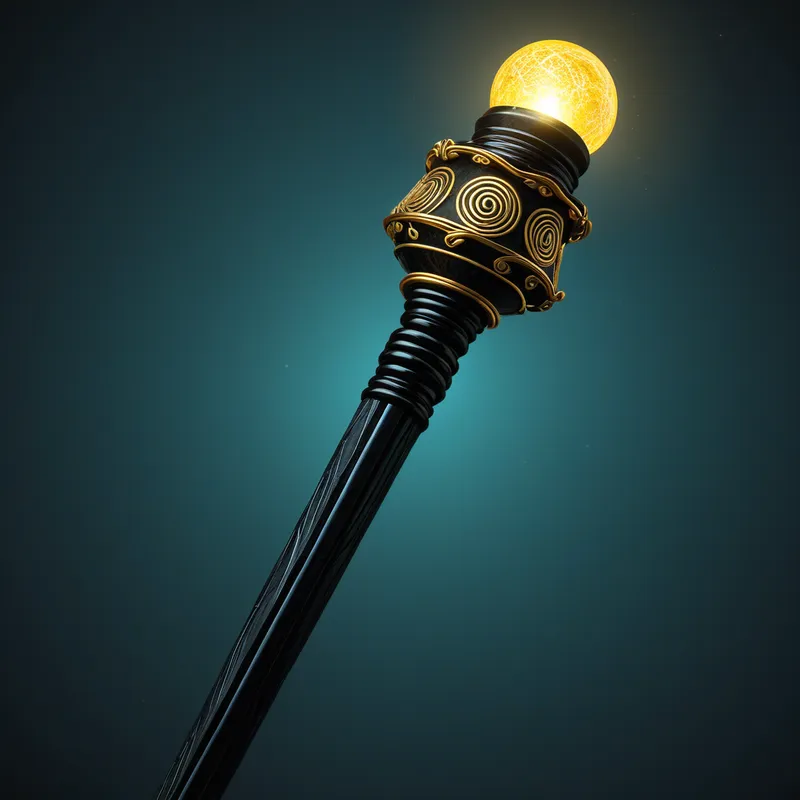
The sacrifice—the plunging into the chest—is the rubedo, the reddening. This is the integration. The ego’s desire for power (the scattered life-force) is sacrificed and transformed into a serviceable will (the captured star), now aligned with the purposes of the Self. The wand, now glowing, symbolizes the fully realized function—the ability of the conscious personality to act as a clear, effective, and ethical agent of the deeper, total psyche. For the modern individual, this translates to the hard-won ability to focus one’s life energy with integrity, to turn intention into effective action not through force, but through a resonant alignment with one’s deepest values and the reality of the world one seeks to affect. The wand is the symbol of the integrated Self in action.
Associated Symbols
Explore related symbols from the CaleaDream lexicon: