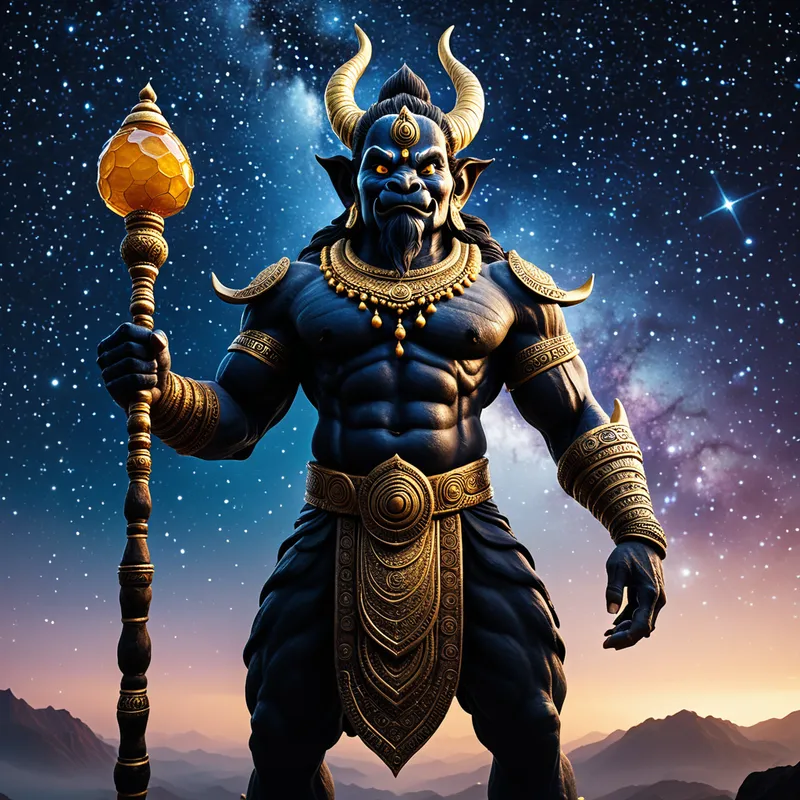
Madhu Myth Meaning & Symbolism
The myth of the demon Madhu, slain by Vishnu, symbolizes the sweet, binding illusion of the separate self that must be surrendered for true consciousness.
The Tale of Madhu
In the time before time, when the worlds were still soft from the breath of creation, there existed a sweetness so profound it became a demon. His name was Madhu. He was not born of fire or fury, but of a longing so deep it curdled the very ether. He and his brother, Kaitabha, emerged from the wax of Vishnu's ear as he lay in the cosmic slumber upon the endless coils of the serpent Ananta Shesha, adrift on the causal ocean.
They saw the sleeping Vishnu, the source of all that is and will be, vulnerable in his yogic trance. A terrible ambition, sweet and sticky, filled them. They would steal the seed of creation itself, the divine knowledge known as the Pranava, which rested in Vishnu's heart. They moved through the star-flecked darkness of that prenatal void, their forms shifting like shadows cast by a guttering candle. The air grew thick with the scent of lotus and something else—the cloying, intoxicating perfume of rotting nectar.
They found what they sought: the luminous, humming core of the sleeping god. As Madhu reached out, his fingers dripping with a golden, hypnotic light meant to ensnare the divine essence, the cosmos held its breath. But from the navel of the sleeping Vishnu, a radiant lotus stem grew, and upon it blossomed the four-faced Brahma. Seeing the peril, Brahma sang a hymn of such pure devotion and wakeful urgency that it pierced the depths of Vishnu's slumber.
The eyes of the Preserver opened. They were not the eyes of anger, but of infinite, calm awareness. He rose from his serpent-bed, and the ocean of causality churned. For five thousand celestial years, a battle raged in that formless place. Madhu and Kaitabha were masters of Maya, weaving realities of honeyed delusion and wine-dark confusion. They offered Vishnu boons, trying to trap him in the net of their own cleverness. But Vishnu, the unchanging reality, could not be bound by illusion.
With a grace that was both terrible and beautiful, he expanded his form to encompass all directions. Then, with a final, decisive act of sovereignty, he took their lives upon his mighty thighs. The demons, granted a boon to choose their place of death, asked to die on a spot untouched by the primordial waters. Vishnu laid them upon his own thighs, which were beyond the creation they sought to corrupt, and there, their forms dissolved. Their essence, the sweetness and the intoxication, was reabsorbed, not destroyed, but transmuted. The void was silent once more, save for the gentle exhalation of the sleeping god, and creation could begin.

Cultural Origins & Context
The myth of Madhu finds its roots in the Brahmanas and is later elaborated in the great epics and Puranas, such as the Mahabharata and the Bhagavata Purana. It is a foundational narrative, a story told not at the dawn of a particular age, but at the dawn of cyclical time itself. It was recited by priests and sages to explain the very precondition for cosmic order (Dharma).
Its societal function was profound. It was not merely a story of a battle, but an ontological parable. It explained why the world, though often filled with the "sweet" temptations of ego and "intoxicating" confusions of separate existence, is ultimately grounded in a conscious, preserving principle. The myth served as a reminder that before any act of creation or preservation can occur, the latent, chaotic potentials of unintegrated consciousness—symbolized by the demons born from the body of the god himself—must be recognized and mastered. It framed the human struggle with attachment and delusion as a microcosm of this primordial, divine process.
Symbolic Architecture
Madhu is not an external monster to be feared, but an internal principle to be understood. His name, meaning "honey," is the key. He represents the seductive, adhesive quality of the individual ego—the "I"-sense that is sweet to possess but ultimately isolates us from the whole. He is the pleasure of separation, the identity forged in distinction, the delicious narrative of a self apart. His brother Kaitabha, "intoxication," is the confusion and arrogance that accompanies this separate state.
The ego is the honey that traps the soul in the beautiful, solitary cell of the self.
Their birth from Vishnu's earwax is a masterful symbol. They emerge from a bodily impurity of the god, signifying that these forces are not alien invaders, but inherent potentials within consciousness itself—the "wax" that can cloud perception. Their target, the Pranava in Vishnu's heart, is the vibrational root of reality. The ego seeks to claim ultimate reality for itself, to make the universal personal property.
Vishnu's awakening and victory symbolize the dawn of objective consciousness. The battle's immense duration (5,000 years) signifies the protracted, arduous inner struggle required to overcome these deep-seated tendencies. His final act—having them die on his thighs, a part of himself beyond their realm—reveals the ultimate truth: the ego is not annihilated, but reintegrated. Its energy is reclaimed by the larger Self. The sweetness is not destroyed; it is liberated from its sticky, binding form.
The Dreamer's Resonance
When this myth stirs in the modern psyche, it often manifests in dreams of sticky substances, golden traps, or beautiful yet suffocating environments. One might dream of being caught in amber, of a voice that is hypnotically compelling but leads to a dead end, or of a mirror that reflects a perfected, but frozen, version of the self.
Somatically, this can correlate with a feeling of being "sweetly stuck"—in a job, a relationship, or a self-image that is comfortable but growth-stifling. There is a cloying quality to the stagnation. The psychological process is the confrontation with the legitimate seduction of the current identity. It is not a battle against a hated shadow, but a reluctant parting from a beloved, familiar self. The dreamer is navigating the painful, necessary dissolution of an ego-structure that has served them, that has been their "sweetness," but now prevents further awakening. The terror in the dream is the terror of dissolution, of losing the known "I," even if that "I" is the very thing that confines them.

Alchemical Translation
The individuation process modeled by the Madhu myth is not one of violent conquest, but of conscious reclamation. The first alchemical stage is Recognito: the awakening to the fact that one's most cherished identity—the successful professional, the devoted caregiver, the unique artist—may itself be a form of Madhu, a sweet, self-made demon claiming the throne of the true Self.
The work is not to kill the demon, but to withdraw the projection of Selfhood from it.
The second stage is Contemplatio, the lengthy inner "battle." This is the sustained self-observation where one sees how the ego, like Madhu, offers clever bargains and justifications for its continued reign. The final, crucial stage is Transmutatio. This is Vishnu placing the demons on his thighs. It is the realization that the energy of the ego—its drive, its desire for significance, its capacity for enjoyment—is not evil. It is divine energy (Shakti) in distorted form. The alchemical goal is to lift this energy from the mud of petty self-interest and place it in service to the totality of the psyche.
For the modern individual, this translates to a practice of compassionate dis-identification. One learns to say, "This desire, this fear, this story of who I am, is like honey. It is part of me, born from me, but it is not my core." By ceasing to fight it as an enemy and instead recognizing it as a lost fragment of one's own being, it loses its binding power. The sweetness remains, but now as a flavor of life, not a prison. The individual no longer is the honey; they contain it, and in that container, it becomes an offering, not an trap. This is the victory of Vishnu: the re-establishment of the Self as the sovereign space where all parts, even the most beguiling demons of identity, are held, integrated, and transcended.
Associated Symbols
Explore related symbols from the CaleaDream lexicon: