Mad Hatter's Tea Party Myth Meaning & Symbolism
A young dreamer enters a timeless, chaotic tea party where logic is inverted, presided over by a mad host who has broken the clock.
The Tale of Mad Hatter's Tea Party
Listen, and you shall hear of a realm that exists in the hinge-moment between waking and dream, in the eternal, sun-struck hour of a never-ending afternoon. It is a place found not on any map, but in the wandering mind of a child, a girl named Alice. Weary of the sensible, ordered world of lessons and lawns, she followed a creature of haste and anxiety—a white rabbit muttering of lateness—and tumbled down, down into a land where the roots of reality are exposed.
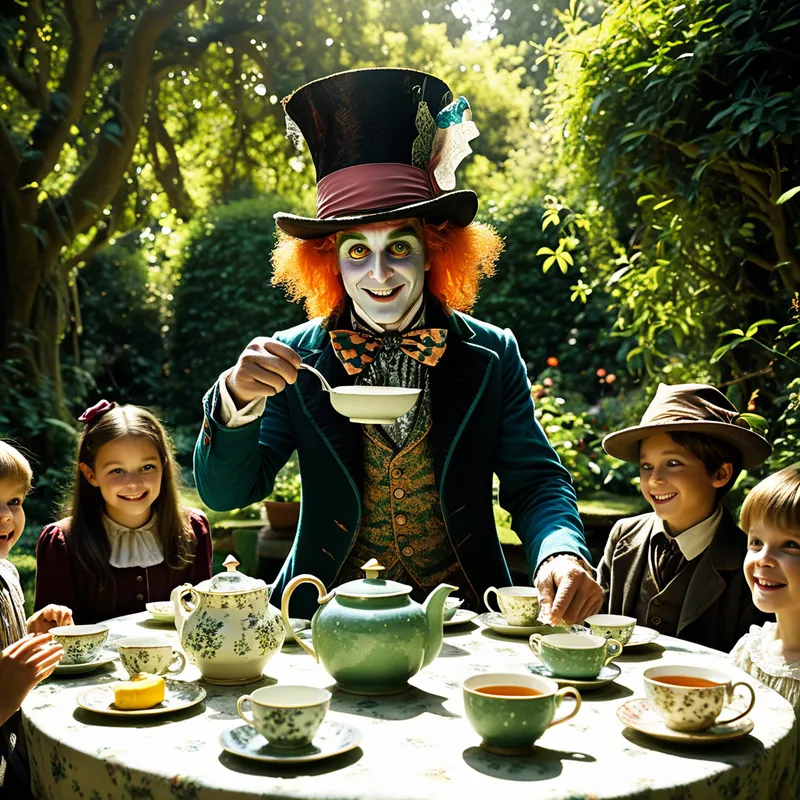
There, in a clearing that smelled of damp earth and burnt toast, she found the Table. It was a long, meandering thing, set under a tree with leaves that whispered nonsense. And at this table was a Party that was no celebration, but a ritual stuck in a single, repeating moment. The host was the Mad Hatter</abtitle="The lord of fractured time and inverted ceremony">atter, a figure crowned not with gold, but with a towering, battered top hat bearing the cryptic sigil "10/6". His eyes were wide pools of manic glee and profound exhaustion, for he was a being who had committed the ultimate transgression: he had "murdered the time". He had sung to it, and it, offended, had stopped forever at six o'clock—tea-time.
With him were his eternal companions: the Dormouse, forever being stuffed into teapots or slumbering in the butter, and the March Hare, whose hospitality was a kind of violence. Their ritual was precise in its madness. They moved ceaselessly around the table, shifting seats as the china grew dirty, never cleaning, only migrating. They offered wine where there was none, asked unanswerable riddles, and engaged in conversations that began in the middle and spiraled into absurdity.
Alice, the stranger from the world of sequence and sense, sat among them. She was offered tea by a host who declared he had none, then scolded her for wanting what she hadn't been given. She was asked a riddle with no answer: "Why is a raven like a writing-desk?" The air grew thick with the clatter of misplaced saucers and the weight of the unsolved. The conflict was not of swords, but of frameworks. Her linear mind, seeking order and polite convention, shattered against the Hatter's circular, paradoxical reality. The rising action was a crescendo of frustration, a feeling of being gaslit by the very fabric of the world. The ritual reached its peak when the Hatter, in a moment of bleak clarity, proclaimed his party was stuck because he had nowhere else to go. The resolution was not a victory, but an exit. The table, the party, the clearing—they all became "rude" to Alice. With her rejection of the foundational nonsense, the spell broke just enough for her to walk away, leaving the eternal trio to their perpetual, pointless rotation, forever trapped in the teacup of a broken moment.
Cultural Origins & Context
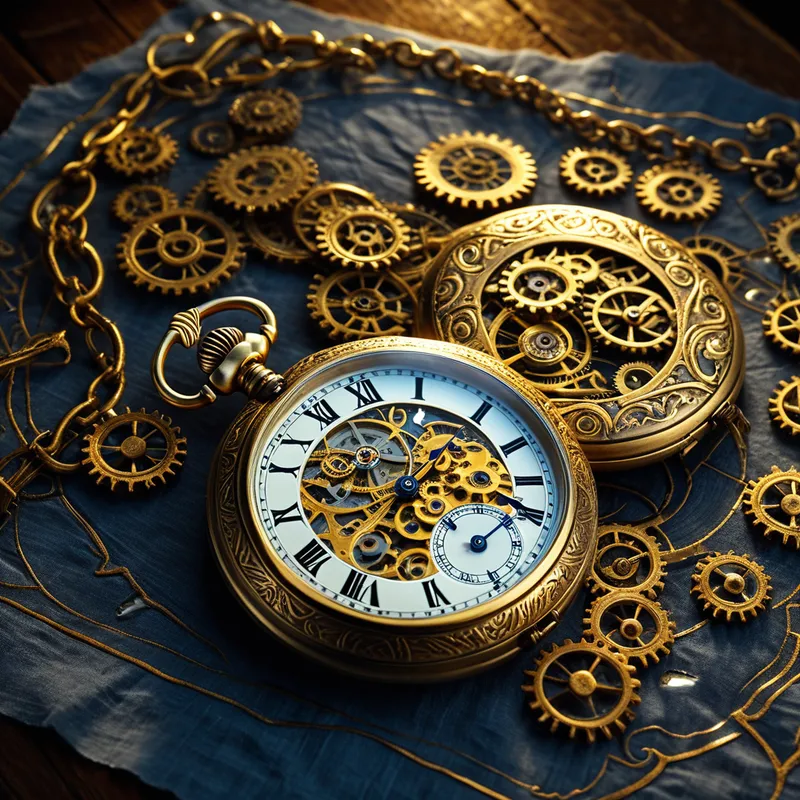
This myth springs not from ancient oral tradition, but from the fertile, anxiety-ridden soil of Victorian England, penned by the mathematician and logician Charles Lutwidge Dodgson under his dreaming name, Lewis Carroll. It was a time of immense social rigidity, imperial confidence, and burgeoning scientific rationalism, yet also one shadowed by a deep, subconscious dread of chaos and meaninglessness. The myth was passed down not around campfires, but through the illustrated pages of Alice's Adventures in Wonderland, read in the nurseries and parlors of the very society it subtly skewered.
Its societal function was complex. For children, it was a delightful inversion of adult authority and etiquette. For the adult reader, however, it served as a profound, satirical mirror. It mocked the absurd, rigid rituals of high tea and social convention by presenting them as literally insane. More deeply, it gave form to the Victorian fear of temporal disorder—the terror that the great clockwork universe of Newton and the social order of the Empire might simply… stop working, or worse, be revealed as a senseless mechanism. The Hatter’s "madness" was a known occupational hazard of hat-makers, poisoned by mercury used in felting, making the myth a bizarre, fantastical reflection of very real industrial malady. Thus, the myth served as a pressure valve, allowing a sanctioned, literary space to confront the chaos lurking beneath the polished surface of the age.
Symbolic Architecture
The Tea Party is not a scene of merriment, but a temenos of psychological stalemate. Its symbols are a lexicon of a psyche in deadlock.
The Mad Hatter is the archetype of the fractured rational mind. Having "killed time," he represents the ego that has attempted to master the unconscious, linear flow of life and psyche—and has failed catastrophically. He is intellect divorced from feeling, trapped in a loop of its own cleverness. The March Hare embodies raw, unmoderated instinct and emotion, forever in the heightened state of its namesake month, unable to settle. The Dormouse is the dormant spirit, the numbed consciousness, the part of the self that tries to sleep through the inner chaos.
The table they circle is the wheel of samsara for the modern psyche—a compulsive repetition of unresolved patterns, where movement is mistaken for progress.
The perpetual tea-time symbolizes a state of suspended development, a refusal to let the psyche move through its necessary cycles. The dirty dishes are the accumulated psychic detritus—old arguments, unresolved traumas, stale thoughts—that are never cleansed, only abandoned for a temporarily clean space. The unanswerable riddle ("Why is a raven like a writing-desk?") is the ultimate symbol of the search for logical meaning in the inherently non-logical realm of the unconscious. It is a koan designed to break the rational mind's tyranny.

The Dreamer's Resonance
When this myth erupts into modern dreams, it signals a profound encounter with the psychic shadow of one's own rationality. The dreamer is not Alice, but finds themselves at the table, perhaps as the Hatter, the Hare, or a silent guest.
To dream of being the host of a chaotic, endless gathering indicates a somatic feeling of being "on" all the time, of performing a role that has lost its meaning. The body may feel the exhaustion of perpetual hospitality with no nourishment. Dreaming of the shifting seats speaks to a psychological process of avoidance—changing jobs, relationships, or hobbies not out of growth, but to escape the "dirty dishes" of one's current life situation. The unanswerable riddle often manifests as a real-life paradox the dreamer is grappling with: a career that pays but lacks soul, a relationship that is logical but loveless. The dream presents the deadlock in its mythic form, forcing the dreamer to feel the futility of solving it with the same mind that created it. The process is one of confronting absurdity, of the ego realizing its frameworks are insufficient for the deep questions of existence.
Alchemical Translation
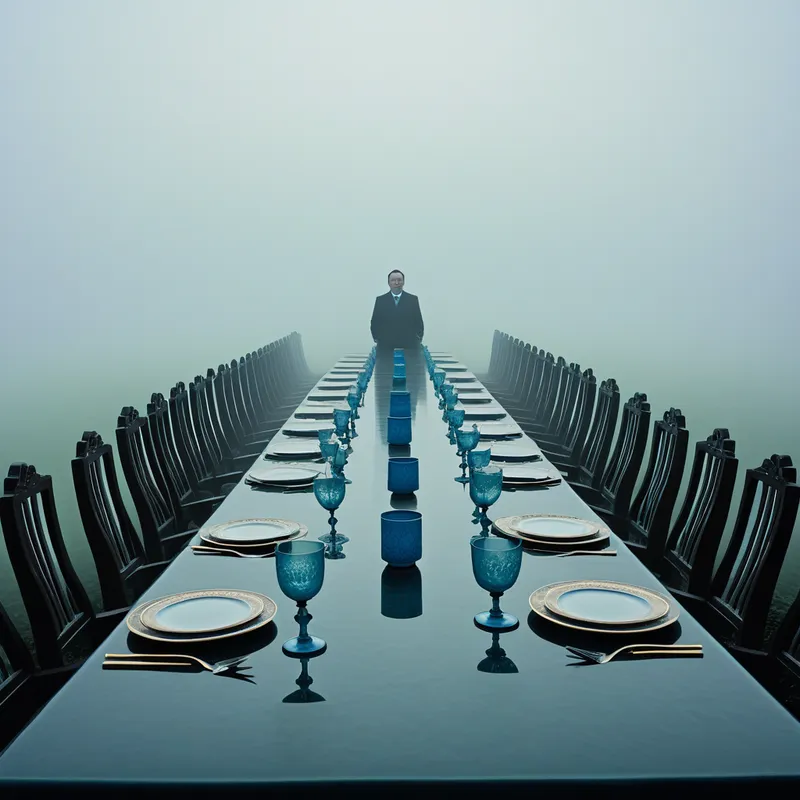
The alchemical journey modeled here is the nigredo—the essential, dark first stage where the old, ordered consciousness must be dissolved into chaos. Alice’s journey to the party is the soul's descent into this necessary madness.
The Hatter’s crime—"murdering time"—is the ego’s attempt to control the opus, to rush or halt the soul's natural rhythms. The punishment is the ultimate stasis: the circulatio without transformation. The party is the psyche caught in this loop. The alchemical fire is not under the teapot, but in the friction of Alice’s logical mind against the Hatter’s illogic.
The transmutation begins not with an answer, but with the acceptance of the riddle’s insolubility. It is the moment the seeker stops trying to fix the broken clock and instead asks, "What if time is not broken, but I am asking the wrong question of it?"
Alice’s act of leaving the table is the crucial separatio. She does not solve the party; she distinguishes herself from it. This is the birth of consciousness that can observe the madness without being consumed by it. For the modern individual, the alchemical translation is this: we all host inner tea parties of repetitive thought, outdated rituals, and circular anxieties. Individuation does not require us to clean the infinite table, but to first recognize we are at one, then to find the courage to stand up, declare it rude, and walk into the next, unknown part of the garden. The broken watch remains, but we are no longer its prisoner. We move from being a guest at the mad table to becoming the wanderer in our own story, carrying the memory of the chaos, but no longer bound to serve it.
Associated Symbols
Explore related symbols from the CaleaDream lexicon: