Machu Picchu Sacred City Myth Meaning & Symbolism
A sacred city built as a celestial anchor, where stone, sky, and spirit converge in a pact to hold the ordered world against the chaos of time.
The Tale of Machu Picchu Sacred City
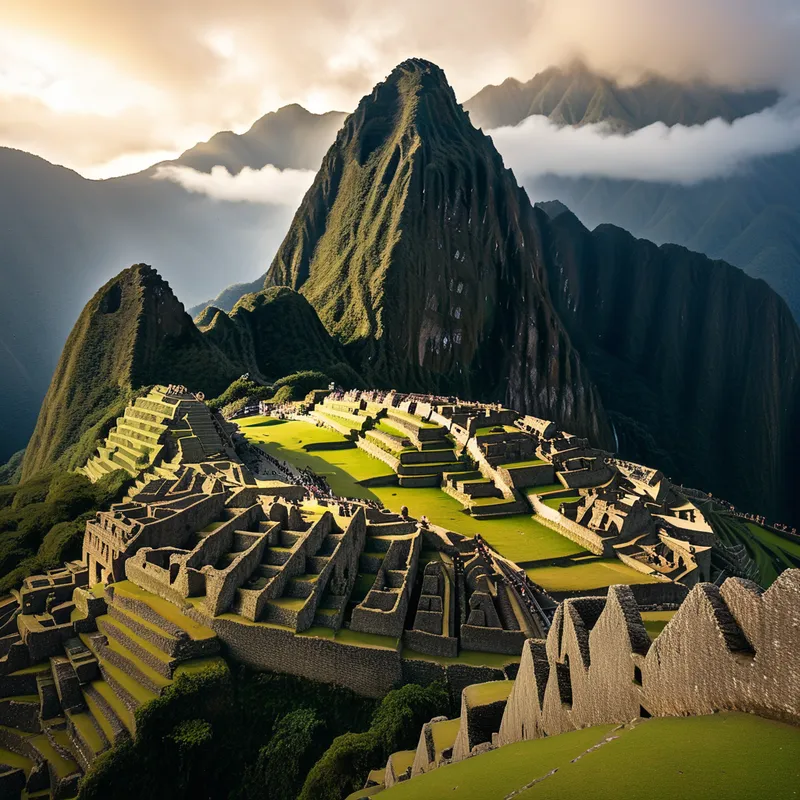
Listen. Before the memory of the world was written on leaves or stone, when the breath of Viracocha still stirred the dust of the high plains, there was a longing in the bones of the earth. The mountains, the Apus, dreamed of touching the sun. The sun, Inti, wept tears of light that fell and were lost in the churning rivers of cloud. And the people, children of Inti, felt a great trembling in their souls—a fear that the sky would forget the earth, that the order of the cosmos would unravel into chaos.
The Sapa Inca, Pachacuti, the Earth-Shaker, received a vision. It came not in sleep, but in the blinding clarity of high-altitude sunlight. He saw a condor, its shadow vast upon the land, settle upon a saddle of rock between two piercing peaks: the old, wise Machu Picchu and the youthful, vigilant Huayna Picchu. The condor did not rest; it became stone. And in that stone, Pachacuti saw the blueprint of a prayer made solid—a city that would be a knot tying the three worlds together: the Uku Pacha below, the Kay Pacha here, and the Hanan Pacha above.
So he summoned the greatest amautas (wise ones) and the most gifted llacta kamayoc (master builders). "We will build a dialogue with the sky," he declared. "Not a fortress of fear, but a instrument of harmony. Each stone will be a word in a language the mountains understand."
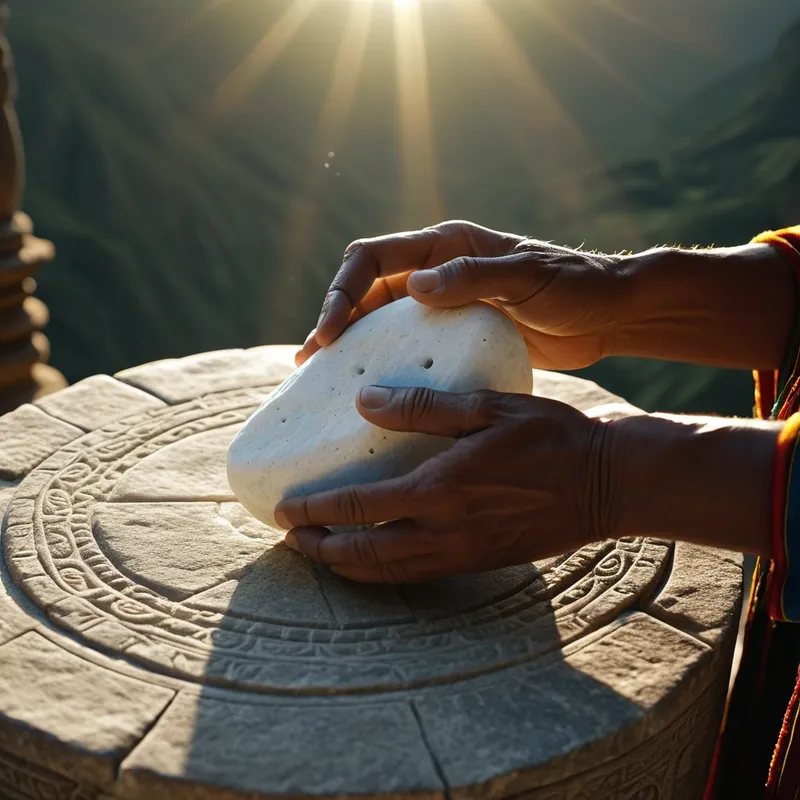
And they built. They did not conquer the mountain; they courted it. They read the veins of granite like the lines on a palm, fitting stone to stone without mortar, a puzzle of such precision that a blade of grass could not slip between. They carved stairways that ascended into the clouds, terraces that cradled the soil like a mother cradles a child. At the heart, they shaped the Intihuatana, a stone pillar to catch and hold the sun at its solstice turning, to prevent it from fleeing forever into winter darkness.
The city became a living being. The Temple of the Sun captured the June solstice light in a perfect window of stone. The Temple of the Condor’s stone wings yearned for flight. Water, channeled from sacred springs, sang through stone conduits, a silver thread connecting all life. Priests and acllas (chosen women) performed rituals not of dominion, but of reciprocity—offering whispers of corn beer and perfect coca leaves to maintain the balance.
For generations, Machu Picchu hummed with a quiet, potent frequency. It was the axis of the world, a sacred machine maintaining the pact between humanity and the cosmos. Then, the world changed. The order fractured. The people left, but they did not destroy. They simply… withdrew. They untied the knot with gentle hands, letting the clouds reclaim the stairways, the vines embrace the temples. They left the city as a promise, not a ruin—a silent, stone prayer waiting on the shoulder of the mountain, holding the memory of connection against the erasing wind of time.
Cultural Origins & Context
The story of Machu Picchu is a tapestry woven from historical fact, imperial ideology, and profound cosmological belief. Built in the mid-15th century under the reign of Pachacuti Inca Yupanqui, it was likely a royal estate and a ceremonial center of immense importance. Unlike a myth born in the mists of prehistory, this is a myth of statecraft and sacred engineering. It was passed down not by wandering bards, but by the amautas and through the official state religion, serving to legitimize the Inca’s divine right to rule and reshape the landscape.
Its societal function was multifaceted. It was a physical manifestation of the Inca worldview—the ayni—made stone. It demonstrated the Sapa Inca’s unique ability to commune with the Apus and Inti, translating divine will into terrestrial order. For the people, it was a symbol of the empire’s power to create stability and fertility from the chaotic Andes. The "myth" of its founding is thus deeply entangled with the living practice of its use: every solstice observation, every ritual offering at a sacred spring, was an act of re-telling the story, of renewing the cosmic pact the city embodied.
Symbolic Architecture
At its core, Machu Picchu is not a story about building a city, but about constructing meaning and relationship. It symbolizes the human psyche's heroic endeavor to create a stable, conscious structure (the ego, the persona, the ordered self) in harmony with the overwhelming, often chaotic, forces of nature (the unconscious, the instincts, the divine).
The sacred city is the psyche's attempt to build a conscious dwelling place at the terrifying and beautiful intersection of instinct (Earth), spirit (Sky), and ancestral memory (Underworld).
The Intihuatana is the ultimate symbol of this: the axis mundi, the world pillar. It represents the central, integrating function of consciousness—the Self in Jungian terms—that seeks to anchor the fleeting light of awareness (the sun) in the solid ground of being. The perfect stonework signifies the painstaking work of individuation: fitting the often-rough, disparate aspects of one's personality into a cohesive, resilient whole without force, through understanding and respect for each element's intrinsic shape. The abandonment of the city is not a tragedy, but a profound part of the symbol. It represents the necessary dissolution of the rigid, conscious structure to allow for a new, perhaps more spiritualized, relationship with the divine. The structure remains, but the ego's occupation of it ceases.
The Dreamer's Resonance
When Machu Picchu appears in the modern dreamscape, it rarely comes as a tourist destination. It manifests as a feeling: a profound longing for order, meaning, and sacred connection amidst inner or outer chaos. To dream of discovering a hidden, overgrown city high in the mountains is to stumble upon a forgotten but intact part of the Self—a core of inner wisdom and resilience that has been shielded from the wear of daily life.
Dreaming of walking its empty, mist-shrouded terraces often coincides with a period of introspection or transition, where one feels like a solitary guardian of a personal truth. The crumbling bridge or vertiginous stairway tests the dreamer's trust in their own foundation. The somatic sensation is often one of altitude—light-headedness, a racing heart—mirroring the psychological experience of confronting high-stakes inner truths. This dream pattern signals a process of re-membering: the psyche is actively gathering its scattered parts, its lost "stones," to rebuild a sense of inner sanctuary and re-establish a connection between one's earthly life (career, body, relationships) and one's spiritual aspirations or unconscious depths.
Alchemical Translation
The myth of Machu Picchu models the alchemical process of coagulatio—the making solid—followed by a sacred sublimatio—the spiritualization of the solid. The initial phase is the arduous, conscious work of building the "stone" of the personality: defining values, establishing boundaries, crafting a life structure (the city). This is the ego's necessary and noble task.
The final, most sacred act is not to possess the city forever, but to learn to leave it—to let the conscious identity be reabsorbed by the larger mountain of the Self, transforming possession into reverence.
The true alchemical gold, however, is not the perfect city itself, but the relationship the city facilitates. The triumph is in the successful "dialogue with the sky," the moment the solstice sun strikes the Intihuatana. Psychically, this is the moment of synchronicity, of profound insight, where a deeply held conscious structure (the city) is illuminated and validated by a transpersonal, unconscious force (the sun). The subsequent "abandonment" is the ultimate transmutation: the ego-structure, having served its purpose as a vessel for the sacred, is released. The individual no longer identifies as the majestic, isolated city, but with the entire living mountain range—the vast, interconnected psyche in its eternal dialogue with the cosmos. The journey is from being the builder of a separate sanctuary to becoming an integrated part of the sacred landscape itself.
Associated Symbols
Explore related symbols from the CaleaDream lexicon:
- Mountain — The ultimate symbol of enduring consciousness, spiritual aspiration, and the daunting but sacred journey toward the summit of Self-knowledge, upon which the city is precariously and perfectly balanced.
- Stone — Represents the foundational, enduring aspects of the psyche and reality; the raw material of experience shaped by consciousness into a meaningful, stable structure through patience and reverence.
- Sun — The divine light of consciousness, intellect, and the life-giving Self whose cyclical journey must be ritually anchored to prevent the inner world from falling into perpetual darkness or chaos.
- Temple — The sanctified space within the psyche where the individual consciously encounters and honors the transpersonal, the divine, or the deepest aspects of the Self.
- Bridge — The perilous connection between different realms of being or aspects of the self—conscious and unconscious, earthly and spiritual—that must be crossed in the journey toward wholeness.
- Order — The sacred principle of Tawantinsuyu (the fourfold empire) manifest as the psychic imperative to create harmony, structure, and meaning from inner chaos and fragmentation.
- Root — The deep, often hidden connection to ancestral wisdom, the underworld of the unconscious (Uku Pacha), and the primal earth from which the structured city draws its sustenance and stability.
- Circle — The cyclical nature of time, ritual, and the cosmos embodied in the solstice ceremonies; the wholeness the sacred city attempts to manifest and participate in.
- Sky — The realm of spirit, potential, and the gods (Hanan Pacha); the vast, unknown toward which the city's stairways and temples eternally reach in a gesture of longing and connection.
- Water — The fluid, life-giving energy of the unconscious and emotion, channeled through conscious conduits (the stone fountains) to nourish every terrace and aspect of the structured self.
- Dream — The state in which the forgotten, overgrown city is most often rediscovered, representing the psyche's nocturnal work of reconnecting with lost sacred spaces and ancestral wisdom.
- Journey — The essential movement from the lowlands of ordinary consciousness to the high, rarefied air of the sacred precinct; the lifelong process of seeking and integrating one's personal "Machu Picchu."