Lydia of Thyatira Myth Meaning & Symbolism
A wealthy merchant of purple cloth encounters a foreign teacher by a river, opening her heart and home, becoming the first European convert and a cornerstone of community.
The Tale of Lydia of Thyatira
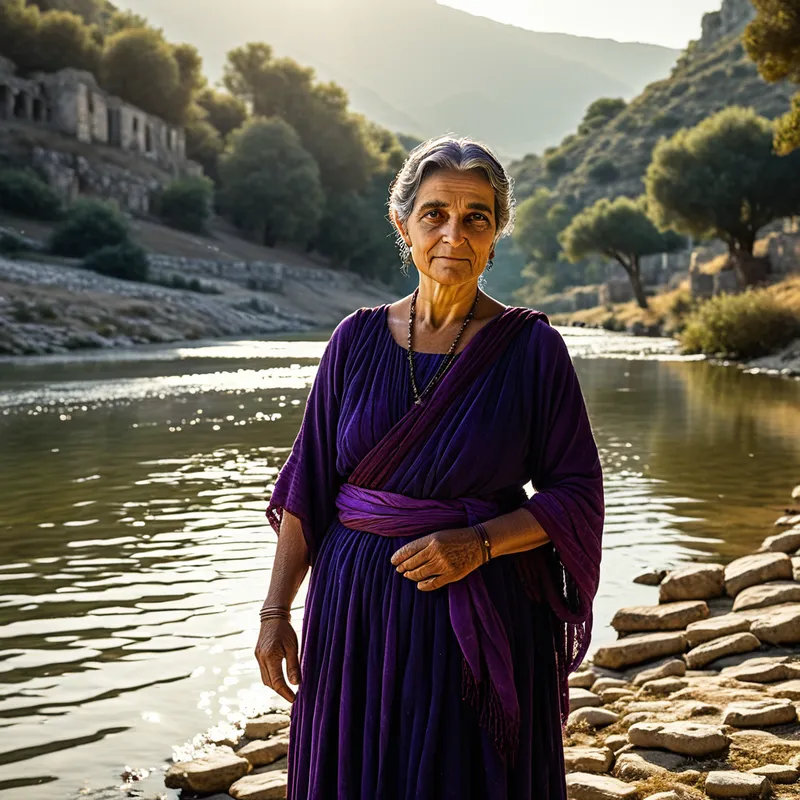
Listen, and hear the tale whispered by the reeds of the Gangites. It begins not in a temple, but in the marketplace, in the scent of sea salt and crushed murex shells. Her name was Lydia, and her hands were stained with empire—the deep, resonant purple of kings and consuls, a color worth its weight in silver. She was a merchant of Thyatira, a stranger in the Macedonian city of Philippi, a woman of substance in a world of stone and transaction.
But on the day the story turns, she was not counting coins or inspecting bolts of cloth. She was by the river, outside the city gate, where the air was clear of dust and the water murmured old secrets. It was the Sabbath, and with her were other women, a gathering of hearts seeking something the marketplace could not sell. They were praying, their voices a soft counterpoint to the river’s flow.
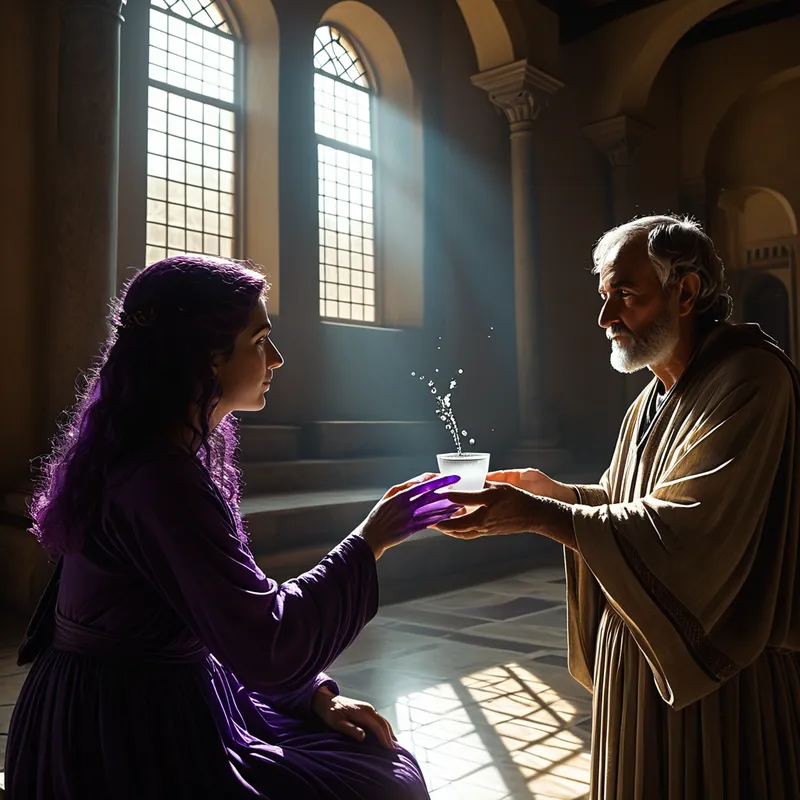
Then, a disturbance in the ordinary light. Two men, travel-worn and purposeful, approached the place of prayer. One was named Paul. He sat and began to speak. His words were not of commerce or Roman law, but of a executed teacher from a distant province, of a love so vast it shattered the chains of death itself. He spoke of a spirit that sought not tribute, but the heart’s own throne.
And as he spoke, a different transaction occurred—one of the soul. The words fell upon Lydia not as sound, but as a key. They turned within her, and the Lord opened her heart. It was not a violent rending, but a graceful unfurling, like the finest purple cloth released to the wind. The careful merchant, the independent woman of means, found herself undone and remade by a story. The river witnessed her baptism, the water washing over her, mingling with the indelible dye on her hands—a new stain of grace upon the old stain of trade.
Rising from the water, her first act was one of fierce hospitality. “If you have judged me to be faithful to the Lord,” she declared to the strangers, “come and stay at my house.” It was not a request, but a claiming. She compelled them. The home she had built with her industry became the first sanctuary, the first hearth of a new community on European soil. Her house was no longer just a dwelling; it was now a threshold between worlds.
Cultural Origins & Context
This story is preserved in the Acts of the Apostles (Chapter 16). It is not a myth in the classical sense, but a foundational narrative within early Christian literature, serving a potent historical and paradigmatic function. It was recorded by the author of Luke-Acts, likely in the late 1st century, as part of the account of Paul’s missionary journeys.
Its societal function was multifaceted. For early communities, Lydia was a prototype: the first documented convert in Europe, symbolizing the faith’s leap from Asia into a new continent. She modeled the ideal convert—receptive, decisive, and immediately committed to community building. Crucially, she represents a demographic central to the early church’s spread: independent women, often merchants or heads of households, who provided material stability, meeting spaces, and social credibility. Her story legitimized female leadership and patronage in a movement that often operated from private homes. It was passed down not by bards, but by evangelists and teachers, as an exemplar of divine calling meeting prepared readiness.
Symbolic Architecture
Lydia’s narrative is a profound study in symbolic thresholds. She operates at the intersection of multiple worlds: Asia and Europe, Judaism (as a God-fearer) and the nascent Christian movement, commerce and spirit, the public riverbank and the private home.
The true dye that colors the soul is not extracted from shellfish, but from the moment of encounter, where preparation meets grace.
Her primary symbol is purple—the color of royalty, wealth, and worldly power. Yet, in her story, it is subverted. The hands that trade in imperial purple become the hands that open a home to a fugitive faith. Her wealth is not renounced but consecrated; its purpose is alchemically shifted from personal accumulation to communal foundation. The river symbolizes the unconscious, the place of prayer and intuition outside the rigid structures (“outside the city gate”) where transformation occurs. Her baptism signifies the integration of this new spirit into her very identity.
Psychologically, Lydia represents the Eros principle in its most grounded form. She is not a mystical ascetic, but a person of practical affairs whose capacity for relationship—for connection, valuation, and hospitality—becomes the vessel for the sacred.

The Dreamer's Resonance
When the pattern of Lydia’s myth stirs in the modern psyche, it often manifests in dreams of thresholds and prepared spaces. One might dream of discovering a room in their own house they never knew existed, perfectly suited for a gathering. Or of their profession’s tools—a laptop, a paintbrush, a ledger—being used to draw sacred symbols or to build an altar.
The somatic sensation is often one of opening—a warmth in the chest, a sense of the heart as a physical chamber unsealing. This signifies the psychological process of receptive initiation. The dreamer is at a point where a long-held personal resource (skill, wealth, independence) is ready to be offered to a larger purpose. There may be anxiety about “staining” this resource, contaminating hard-earned security with something uncertain. The Lydia dream reassures: your preparation is not accidental; your practical competence is the very ground upon which the new spirit will build.

Alchemical Translation
The alchemical process modeled here is the transmutation of the personal into the transpersonal, the sacralization of one’s native ground. Lydia’s journey is not an odyssey to a foreign land, but a profound deepening right where she stands.
Stage 1 (The Prepared Substance): Lydia is already a refined product of her own efforts—a successful merchant, a spiritual seeker (“a worshiper of God”). Her life represents the prima materia that is ripe for change.
Stage 2 (The Solutio – Dissolution at the River): The rigid identity of “merchant” and “stranger” is softened by the waters of the spirit (Paul’s teaching) and the emotional river of her own opened heart. This is not destruction, but a freeing from fixed form.
Stage 3 (The Coagulatio – Re-formation as Sanctuary): The dissolved elements re-coagulate into a new, more complex compound. Her house, the symbol of her self-contained world, is re-formed as a domus ecclesiae (house church). Her self-sufficiency becomes community-sufficiency.
Individuation is not about leaving your city, but about building a gate in its wall where the river can enter, and from which a new kind of commerce can begin.
For the modern individual, the “alchemical translation” is this: your career, your skills, your home—your “purple”—are not obstacles to the spiritual life. They are its intended raw materials. The work is to go to your own “riverbank,” the place of quiet listening outside the noise of your achievements, and allow your heart to be opened to a purpose that will compel you to use everything you have and are in its service. The goal is not to escape your story, but to become its most gracious and foundational host.
Associated Symbols
Explore related symbols from the CaleaDream lexicon: