
Luoshu Myth Meaning & Symbolism
A sacred turtle emerges from the Luo River, bearing a cosmic diagram on its shell that reveals the hidden mathematical order of heaven and earth.
The Tale of Luoshu
In the time before time was measured, when the world was a canvas of chaos, the heavens wept. For nine generations, the waters had risen. They swallowed the fields, drowned the mountains, and turned the Middle Kingdom into a vast, churning sea of despair. The people cried out to the Shangdi, but the deluge was a dragon that would not be tamed.
Then came Yu, son of the failed flood-queller. Where his father had built dams, Yu would dig channels. His body became a map of toil—calloused hands, legs scarred by stone and mud, a spirit as relentless as the current he sought to master. For thirteen years, he walked the length of the drowning earth, his only compass a heart aligned with the mandate of heaven.
One fateful night, as he labored near the banks of the swollen Luo River, the sky tore open. Rain fell not as drops, but as spears. The river, a beast awakened, roared and churned. Just as despair threatened to swallow Yu’s resolve, the waters at the river’s center began to swirl in a contrary motion. A vortex of calm opened in the heart of the storm.
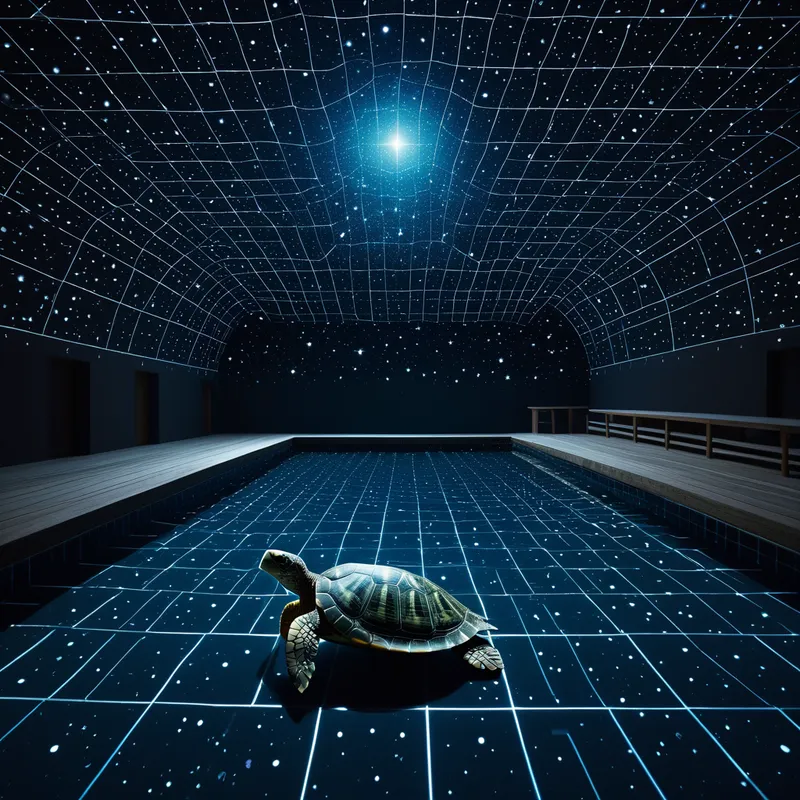
From the profound depths, a presence emerged. It was not a monster, but an ancient one—a colossal turtle, its carapace a landscape of moss and stone, etched by the ages. It moved with a slow, tectonic certainty, its eyes holding the patience of the deep earth. It did not speak, for its message was not in sound. As it drew near the bank where Yu stood, rivulets of water streamed from its shell, revealing not random cracks, but a pattern.
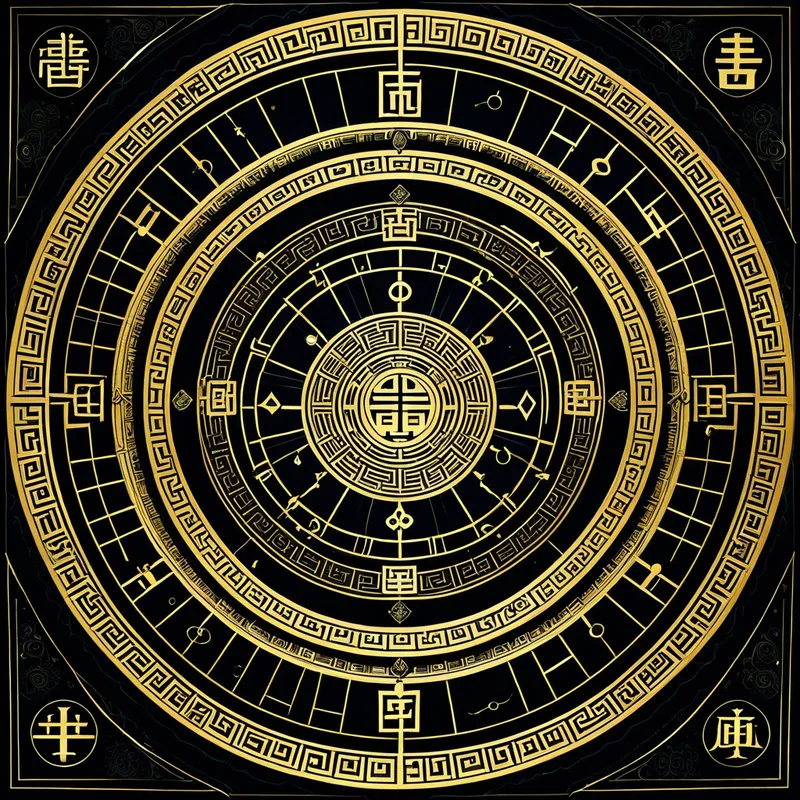
There, illuminated by a strange, inner light that defied the storm’s darkness, was a grid of nine numbers. Dots of luminous white and void-like black were arranged in three rows and three columns, a perfect square. Yet its magic was in the sum: every line—horizontal, vertical, diagonal—added to the same sacred number, fifteen. It was a vision of perfect equilibrium, a silent hymn of mathematical harmony rising from the primal mud.
Yu fell to his knees, not in fatigue, but in revelation. He saw in that pattern the blueprint of the cosmos—the movement of the stars, the flow of the waters, the balance of Yin and Yang. This was the Luoshu, Heaven’s own design, delivered by the creature of the deep earth. With this celestial key, Yu understood. He did not fight the water; he guided it. He carved the nine provinces of the land in accordance with the nine squares of the turtle’s back, channeling the flood into rivers and valleys, imposing the eternal order of heaven upon the formless chaos of earth. The dragon was tamed, not by force, but by wisdom.

Cultural Origins & Context
The myth of the Luoshu is not merely a story; it is a foundational pillar of Chinese cosmological thought. Its earliest known references appear in texts from the late Xia dynasty and are elaborated in the I Ching (Book of Changes) commentaries. Unlike myths centered on personal drama, the Luoshu narrative is one of cosmic revelation. It was passed down by court historians, diviners, and philosophers—the Mandarin sages—for whom it served a critical societal function: to explain and legitimize the divine origin of political and natural order.
The turtle, a creature that inhabits both water (chaos, the unknown) and land (order, the known), was a potent symbol of the axis between worlds. Its shell was seen as a model of the cosmos—the domed carapace representing the vault of heaven, the flat plastron the square earth. The emergence of the Luoshu from this creature during the Great Flood situates it as the ultimate antidote to chaos. It provided the mythological and philosophical basis for the Mandate of Heaven, suggesting that true sovereignty and the ability to bring order (like Yu’s flood control) stem from understanding and aligning with these hidden, celestial patterns.
Symbolic Architecture
At its core, the Luoshu is a symbol of the archetypal pattern underlying apparent chaos. It represents the discovery of innate, pre-existing order. The flood is the overwhelming, undifferentiated psyche—the unconscious in a state of traumatic activation, where emotions and psychic contents flood the conscious mind.
The pattern does not come from outside to impose order; it is revealed from within the chaos itself, waiting to be recognized.
The turtle is the Self archetype emerging from the depths of the collective unconscious. It is the ancient, enduring, and instinctual wisdom of the psyche that surfaces during a crisis of meaning. Yu is the ego-consciousness, tasked with an impossible burden. His triumph is not one of heroic conquest, but of receptive understanding. He does not slay the turtle; he learns from it. His labor transforms from brute struggle to informed, graceful action—a shift from fighting against nature to working with its intrinsic logic.
The magic square itself, with its constant sum of fifteen, is a perfect mandala of balance. It symbolizes the dynamic equilibrium of opposites—Yin and Yang, odd and even, heaven and earth—held in a stable, rotating tension. It is the psychic blueprint for wholeness, where every aspect of the personality finds its necessary place and contributes to the harmony of the total system.
The Dreamer's Resonance
When the Luoshu pattern surfaces in modern dreams, it rarely appears as a literal turtle with numbers. Its manifestations are more subtle and somatic. One might dream of being lost in a terrible flood or storm (a life crisis, emotional overwhelm) and suddenly noticing a geometric pattern in the swirling water, on a wall, or in the arrangement of stars. There is a profound moment of recognition—a deep, intuitive click that brings instant calm amidst the turbulence.
Psychologically, this signals a critical shift from a state of being victimized by unconscious contents to beginning to perceive their underlying structure. The dreamer is not yet solving the problem, but they are glimpsing the logic of it. This is the moment the unconscious starts to offer up its own ordering principle. Somatic sensations accompanying such dreams often include a sudden release of tension in the chest or gut, a feeling of "everything falling into place," or a visceral sense of awe. The dream marks the transition from pure anxiety to a numinous, pattern-seeking curiosity.
Alchemical Translation
The alchemical journey modeled by the Luoshu myth is the opus of finding order within the prima materia of one’s personal chaos. The initial stage is the nigredo—the blackening, the flood, the period of dissolution and despair where all former structures fail. Yu’s thirteen years of labor represent the long, often hopeless-feeling work of confronting this inner deluge.
The appearance of the turtle is the albedo—the whitening, the revelation. It is the moment of grace in analysis or deep introspection when a core complex reveals its structure, when a repetitive life pattern suddenly shows its mathematical certainty. The ego (Yu) must practice a sacred receptivity; it must stop trying to create a solution and instead learn to read the solution that the Self is presenting.
Individuation is not about inventing a new self, but deciphering the ancient script already written in the soul's substance.
Finally, Yu’s application of the pattern to tame the waters is the rubedo—the reddening, the integration. The psychic energy that was once a destructive flood (uncontained anger, grief, passion) is now channeled into life-giving rivers. The chaotic forces are not eliminated; they are given direction and purpose according to the deeper, reconciling pattern of the Self. The modern individual completes this alchemy when they stop fighting their nature and start organizing their life—their work, relationships, and inner world—in alignment with the unique, harmonic "magic square" of their own inherent wholeness. They become, like Yu, a master of flows, a sovereign who rules by understanding the celestial mathematics of their own soul.
Associated Symbols
Explore related symbols from the CaleaDream lexicon: