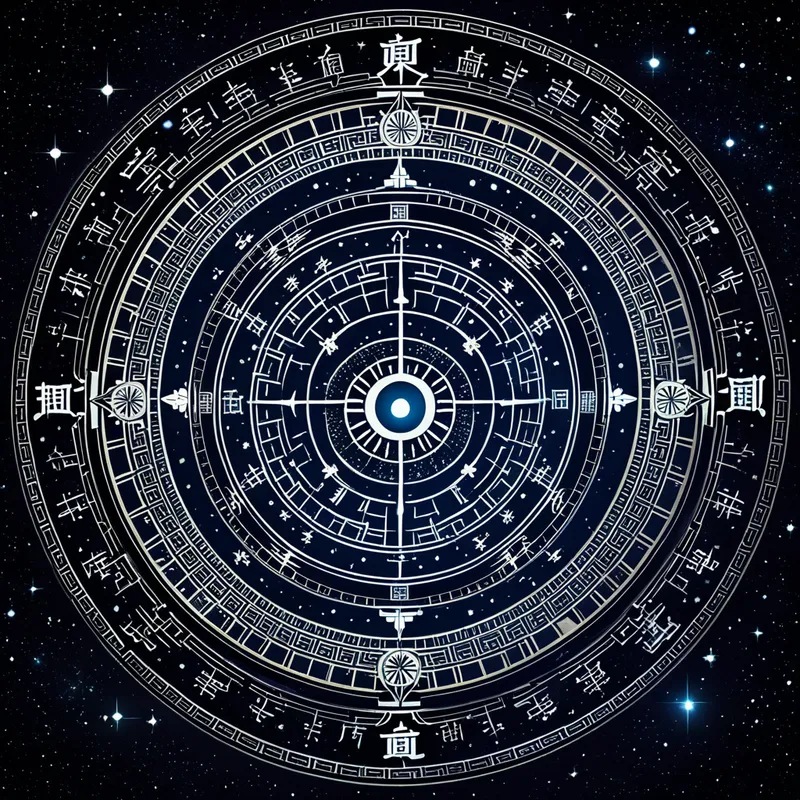
Luopan Myth Meaning & Symbolism
The story of the celestial compass forged from cosmic order, a tool for aligning human life with the hidden patterns of heaven and earth.
The Tale of Luopan
In the time before time was measured, when the Qi of heaven was still tangled with the breath of earth, there was a great dissonance. Humanity dwelled in confusion, building their homes upon dragon lines of ill intent, planting their seeds in fields starved of nourishing currents, their lives a stumbling dance out of step with the cosmos. The celestial emperor looked upon this discord with a heavy heart. The symphony of the San Cai was frayed, its melody broken by ignorance.
He summoned the great sage, Huang Di, and presented him with a vision: a disk of night sky, condensed into jade, upon which were etched the secret pathways of the stars and the subterranean veins of the earth. "Forge a key," whispered the emperor, "a mirror to reflect the hidden order. Let it be a bridge between the will of heaven and the actions of man."
Huang Di descended to the mortal realm, to the sacred peak of Kunlun. There, he gathered the essence of the Wu Xing: the unyielding strength of the mountain's core (Earth), the boundless flow of its glacial melt (Water), the fierce resilience of its ancient pines (Wood), the refining heat of its deepest fires (Fire), and the precise structure of its metallic ores (Metal). He fused them in a crucible cooled by the breath of the Qing Long and fired by the gaze of the Zhu Que.
But the disk was inert, a beautiful corpse. It held the map, but possessed no pointer. In despair, Huang Di fasted and meditated for forty-nine days, seeking the soul of the instrument. On the final night, a comet streaked across the heavens, a needle of pure celestial intent. Its core, a fragment of the lodestone that orients the northern star itself, fell as a burning tear into the center of the jade disk. With a sound like a plucked star, the disk awoke. The needle trembled, not to the pull of common stone, but to the invisible currents of Feng Shui—the dragon's breath of the land and the celestial winds from above.
Huang Di held the first Luopan. He journeyed forth, and where he placed it, chaos resolved into pattern. He showed the people how to align their gates with benevolent energies, how to site their ancestors to rest in harmony, how to weave their lives into the great tapestry of Dao. The Luopan became the silent tongue through which the earth and sky spoke to humankind, a compass not for crossing seas, but for navigating the invisible geography of fate and fortune.

Cultural Origins & Context
The Luopan is less a figure from a single, codified myth and more the crystallized artifact of a profound and ancient worldview. Its story is woven from the threads of early Chinese cosmology, astronomy, and geomancy (Feng Shui). It emerged from the practical and spiritual needs of agrarian and imperial society. The "myth" was passed down not by bards, but by masters and practitioners—the Feng Shui shi—who guarded its complex symbology as a sacred science.
Its societal function was foundational: to ensure harmony between human activities and the cosmic environment. It was used to site cities (like the planning of ancient capitals), orient temples and palaces, select auspicious dates for ceremonies and battles, and locate harmonious burial grounds (Yin Zhai). The Luopan was the tool that operationalized the philosophy of unity between humanity and nature, making the abstract principles of Yin-Yang and the Wu Xing applicable to the concrete world of dwelling, governance, and destiny.
Symbolic Architecture
The Luopan is a mandala of the cosmos, a symbolic microcosm. Its central magnetic needle represents the unwavering axis of the self, the true core that orients us. The concentric rings are the layers of reality—celestial cycles, terrestrial directions, symbolic animals, and hexagrams of change from the I Ching.
The Luopan does not create order; it reveals the order that is already there, hidden beneath the surface of apparent chaos.
Psychologically, it symbolizes the quest for orientation within the complexity of existence. The hero is not a warrior, but the Sage who learns to read the subtle patterns. The "conflict" is the human experience of being lost, out of sync, or in a state of psychological Xiong Sha. The Luopan represents the cognitive and intuitive faculties needed to map the inner landscape—the instincts, complexes, archetypal forces, and timing of the psyche—and to find one's correct place within it. It is the tool for achieving inner Sheng Qi.
The Dreamer's Resonance
To dream of a Luopan is to dream of seeking orientation during a profound life transition or a period of internal confusion. The somatic sensation is often one of vertigo or disorientation giving way to a deep, magnetic pull towards a specific direction or choice.
If the Luopan in the dream is spinning wildly, it reflects a psyche overwhelmed by conflicting information, choices, or external pressures—a loss of inner north. If the needle is stuck or broken, it may indicate a deep blockage, a refusal to acknowledge one's true calling or nature, often tied to a rigid ego structure. To dream of successfully reading a Luopan, of seeing its symbols glow with meaning, signals a moment of profound psychic integration. The dreamer is beginning to decipher their own unconscious patterns, to understand the "geography" of their soul—where their energy flows freely and where it is blocked, and what personal "direction" aligns with their deepest nature.

Alchemical Translation
The individuation process, the alchemical Opus, is precisely the work of the Luopan master applied to the self. The first step is Calibration: finding one's central, authentic axis—the Self beyond the persona. This is the true magnetic north, often obscured by the iron pulls of societal expectation and personal history.
The alchemical gold is not found by wandering randomly, but by aligning one's vessel with the secret meridians of the soul.
Next is Layering the Rings: confronting and integrating the concentric circles of the psyche. The outer rings are the persona, the adaptable face to the world. Inward layers represent the personal unconscious, familial patterns, and cultural complexes (the Di Zhi). Deeper still are the archetypal forces, the celestial patterns (Tian Gan), and the primordial laws of change (the Gua). The work is to understand how these layers interact within one's own life.
Finally, Taking the Reading: This is the act of conscious living from this integrated place. It is making choices—where to live, what work to do, when to act—that are in harmony with this intricate inner cosmology. The triumph is not conquest, but resonance. The modern individual becomes the sage of their own life, using the inner Luopan to navigate career shifts, relationships, and creative endeavors in a way that feels not just successful, but profoundly correct and harmonious, weaving their unique thread seamlessly into the great pattern of being.
Associated Symbols
Explore related symbols from the CaleaDream lexicon: