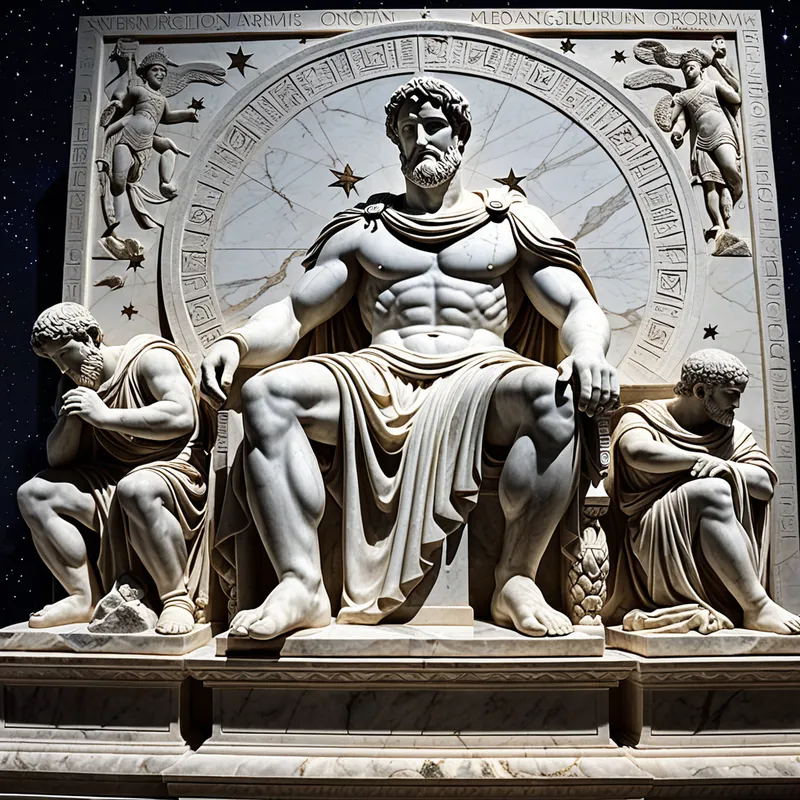
Ludus Latrunculorum Myth Meaning & Symbolism
A mythic game where soldiers and thieves wage silent war on a checkered field, embodying the eternal conflict between order and cunning within the soul.
The Tale of Ludus Latrunculorum
Listen, and let the dust of the forum settle upon your spirit. Before the roar of the chariots, before the solemn march of the legion, there was the silence of the board. It was not a game born of mortals, but a whisper from the crossroads of the divine.
In the time when Mercurius still tested the locks of dawn and Mars had not yet learned the taste of iron, the gods grew restless. The world was raw potential, a field of unmarked stone. Order was a dream, chaos a constant murmur. From this tension, on a twilight that hung between day and night like a held breath, the first board was laid.
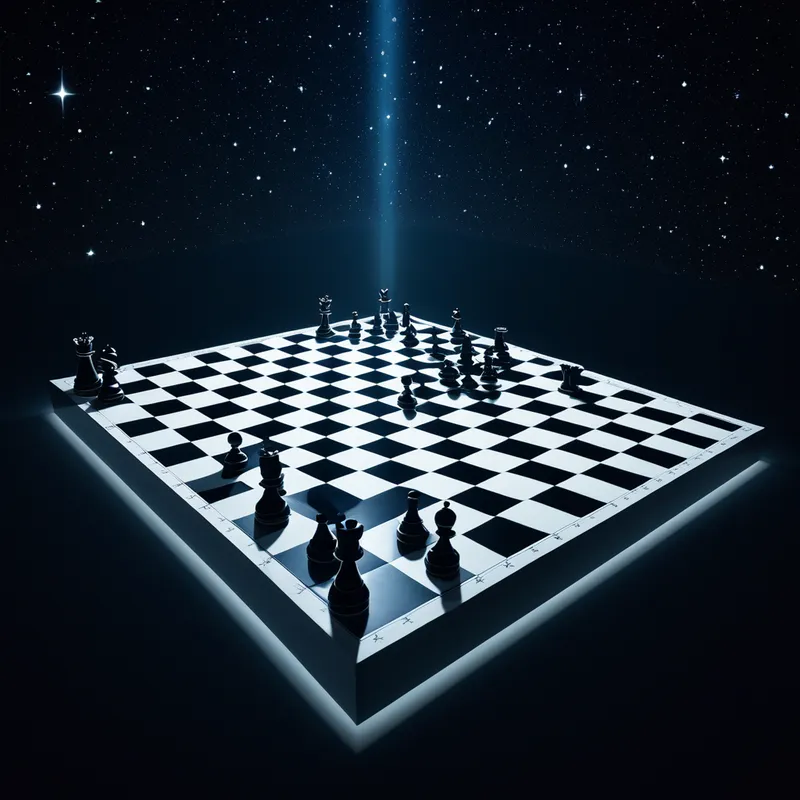
It was not wood, nor stone, but a slice of the firmament itself, a grid of possibilities etched with starlight. Upon it, two forces took shape. From the forge of Mars came the milites: figures of polished obsidian, standing rigid, their forms speaking of walls, of shields locked tight, of the unyielding line. They were the principle of ordo—clarity, defense, the fixed point.
And from the shadowed purse of Mercurius slithered the latrunculi. Crafted of river-smoothed alabaster, they held no fixed form. They were the principle of cunning—the flanking maneuver, the stolen advantage, the meaning that flows around the letter of the law. They did not stand; they waited.
The first move was a thunderclap in the silent hall of the gods. A miles advanced, its step echoing finality. A latrunculus shimmered, not away, but between, occupying not a space, but the potential of the space next to it. This was the conflict: not of brute strength, but of presence against possibility. The milites sought to constrain, to surround, to immobilize the slippery essence of the thieves with sheer, undeniable adjacency. The latrunculi sought to evade, to encircle, to trap the solid soldiers in a net of empty squares, rendering their strength a prison.
The game unfolded not in time, but in the space between thoughts. A soldier, surrounded on two sides by the blank, accusing gaze of the board, would not fall, but fade, its obsidian dissolving into the grid—a captured citadel of the mind. A thief, pinned between two advancing walls of darkness, would vanish with a sigh, its cunning absorbed by the order it sought to undermine.
There was no final victory cry, no slain foe. The game ended in a perfect, resonant silence—a balance. One force could not eradicate the other without ceasing to exist itself. The board, now humming with the memory of a thousand strategic ghosts, remained. The gods saw that this was the true nature of their world, and of the human soul to come: a perpetual, sacred contest on the checkered field of fate, where every move toward light casts a shadow, and every retreat into shadow defines the light.
Cultural Origins & Context
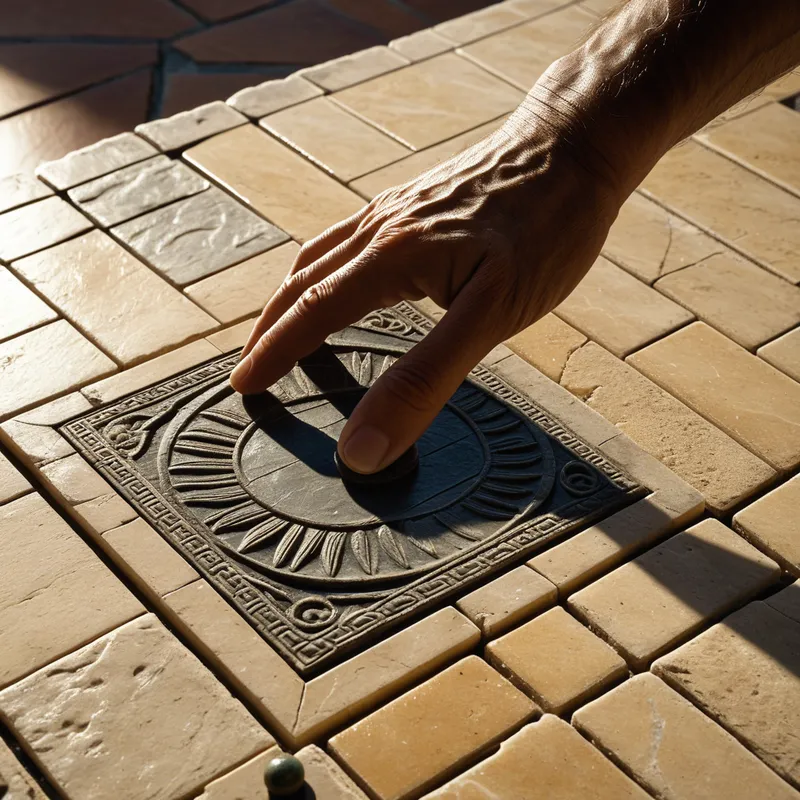
The myth of Ludus Latrunculorum was not recited in epic verse but was lived on stone tables in forum corners and garrison yards. Its "mythology" was its pervasive, silent presence in Roman life. It was the pastime of the legionary and the senator, a cultural touchstone that required no bard. The game itself, a likely descendant of Greek Petteia, was the vessel for the myth.
It functioned as a societal mirror and a training tool. For the soldier, it was a meditation on tactical spacing, flanking, and the sacrifice of individual pieces for positional advantage—a microcosm of legionary warfare. For the statesman or merchant, it was an exercise in foresight, risk assessment, and understanding an opponent’s hidden motives. Its transmission was organic, from master to student, from father to son, across the intricate social grid of Rome. The myth was in the doing, in the felt experience of the tension between the fixed miles and the fluid latrunculus. It taught that civilization itself was this game: a constant, strategic negotiation between the rigid structure of law (mos maiorum) and the fluid cunning of ambition and survival.
Symbolic Architecture
At its heart, the myth presents a sublime duality that is not a battle to the death, but a dance of necessity. The milites and latrunculi are not enemies, but complementary aspects of a single psyche, two children of the same divine tension.
The soldier is the conscious ego: structured, identified, seeking to establish and defend the boundaries of the self. It is the persona, the role, the principle of order that says "I am here."
The miles represents the psychic need for stability, identity, and conscious control. It is the part of us that builds routines, upholds values, and defends our sense of self against external chaos.
The thief is the shadow and the trickster: fluid, adaptive, operating in the spaces between our conscious intentions. It is the unconscious resource, the repressed cunning, the instinct that knows how to move around obstacles rather than through them.
The latrunculus symbolizes all that the conscious ego excludes or deems "other"—unconventional intelligence, ambivalence, spontaneity, and the capacity for strategic deception (even of oneself). The game’s objective—to immobilize the other—is the core psychic drama. The ego seeks to pin down and integrate the shadow, to make the unknown known. The shadow seeks to circumvent and outmaneuver the ego’s rigid defenses, to introduce complexity and possibility.
The board itself is the Self, the total field of being where this interaction plays out. A captured piece is not destroyed but assimilated; a successful strategy requires using both principles. Victory is a state of dynamic equilibrium, where the conscious mind has successfully surrounded and integrated an aspect of the shadow, or where the unconscious has cleverly rearranged the ego’s priorities.
The Dreamer's Resonance
When this myth stirs in the modern dreamer, it rarely appears as an ancient Roman board. Instead, it manifests as the sensation of the game. One may dream of being trapped in a grid-like city, pursued not by a monster, but by a pattern of lights or shadows that shift to block every exit. One may be in a meeting or social gathering, holding a position (the miles), while feeling an acute, paralyzing awareness of all the unspoken alliances and hidden agendas (the latrunculi) moving around them.
Somatically, this can feel like a tightening in the chest or gut—the feeling of being "boxed in" or strategically outmaneuvered in life. Psychologically, it signals an active confrontation between a conscious attitude that has become too rigid or defensive and an emerging unconscious content that is fluid, clever, and threatening to the status quo. The dream is the mind’s board, and the pieces are the conflicting forces within one’s own life strategy. Are you the over-extended soldier, vulnerable to being surrounded by your own ignored complexities? Or are you the elusive thief, avoiding commitment and definition to the point of existential emptiness? The dream presents the stalemate, urging recognition.
Alchemical Translation
The individuation process, the alchemy of the soul, is precisely the lifelong playing out of Ludus Latrunculorum. It is the opus of strategic self-becoming.
The nigredo, the initial blackening, is the realization that one is already on the board, that one's conscious identity (the soldier) is engaged in a hidden war with aspects of oneself it has deemed alien (the thieves).
The first alchemical step is to acknowledge the game. To see that one's frustrations, repeated failures, and cunning self-sabotages are not external misfortunes but moves made by the internal latrunculus. The rigid ego must confront its own shadowy counterpart.
The albedo, the whitening, is the development of conscious strategy. This is the cultivation of the Senex or sage archetype—the observer who understands both the law of the miles and the cunning of the latrunculus. One learns to make conscious moves: to sometimes solidify a position (assert a boundary, define a value) and to sometimes make a fluid, lateral shift (adapt a belief, embrace an ambiguity).
The final stage is not the annihilation of one side by the other, but the rubedo—the creation of the sacred third. This is the philosopher's stone: the capacity to hold the tension of opposites on the board of the Self.
The successful integration leads to a transcendent function. The individual no longer identifies solely as the soldier or the thief, but as the player of the game itself. They gain the strategic wisdom to know when to stand firm in their truth and when to adapt with intelligent fluidity. The captured pieces—the assimilated aspects of shadow and ego—become the gold of a more complex, resilient, and complete personality. The myth teaches that wholeness is not a static peace, but a masterful, engaged, and perpetual state of strategic balance between the core truths of who we are and the boundless possibilities of who we might become.
Associated Symbols
Explore related symbols from the CaleaDream lexicon: