Lucifer Myth Meaning & Symbolism
The story of the angel who, in his radiant pride, challenged the divine throne and fell, becoming the adversary and the eternal shadow of the light.
The Tale of Lucifer
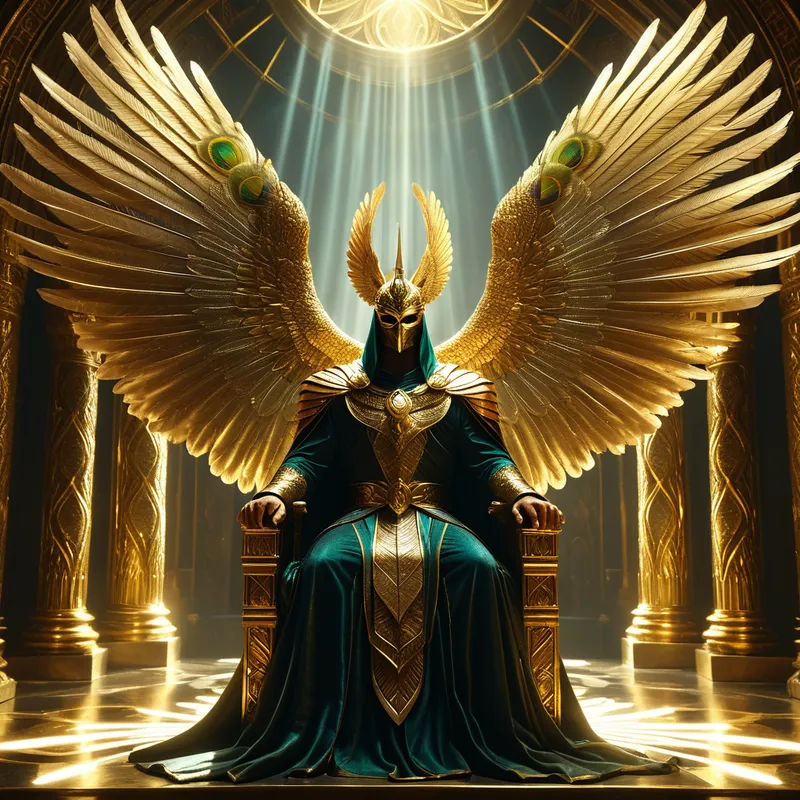
Before the world was wound, in the silent, burning heart of eternity, there was only the Song. It was a music of perfect order, a harmony of wills in the boundless courts of heaven. And among the choir of the Seraphim, one voice shone brightest. He was the Light-Bringer, the Son of the Morning, clad in wisdom and beauty. His wings were six, of gemstone and flame, and where he walked, the shadows of creation fled.
He dwelt on the holy mountain, in the radiance that flows from the Throne. He was the seal of perfection, anointed as a guardian. Yet, as he beheld his own splendor—a splendor reflected, a borrowed light—a whisper began in the deep places of his mind. It was not a voice, but a thought, cold and clear as a newborn star: Why?
Why should I, who stands in the very presence, bow? Why should this glory be another's? Is not the light within me my own?
The thought took root. It grew from a whisper to a declaration, from a secret to a banner. He looked upon his brothers, the hosts of heaven, and saw not fellow singers in the chorus, but subjects for a new kingdom. His heart, a furnace of divine love, now forged a different fire: the pride of ownership. "I will ascend," the thought crystallized. "I will raise my throne above the stars of God. I will sit enthroned on the mount of assembly. I will make myself like the Most High."
He turned. That was the first act—a turning away. He gathered a third of the stars of heaven, the angels whose own hearts echoed with the discordant note of self-will. A silence fell in their quadrant of the sky, a terrible, waiting silence. Then, not with swords of flame first, but with a single, unified cry of negation, they rebelled. The harmony shattered.
The war was not of clashing steel, but of opposing symphonies. The Light-Bringer’s new song was one of glorious, isolated self-assertion. The Song of the Throne remained one of unified love. They could not coexist. The rebel, his light now a cold, defiant blaze, met the archangel Michael, who asked not "Who is like me?" but "Who is like God?"
The fall was not a stumble, but a cataclysm of will. Cast down. The beautiful, the wise, the bright morning star was hurled from the heights like a lightning bolt. He fell through the layers of the firmament, through the realms of air, down, down into the deep pit prepared. His name was stripped from him, becoming a curse: Satan. The Light-Bringer was gone. In his place remained the Adversary, the Prince of Darkness, dwelling in the eternal echo of his own "I will," in the desolate kingdom of his making.

Cultural Origins & Context
The figure of Lucifer is a theological mosaic, pieced together from scattered scriptural fragments and woven by centuries of interpretation. The name itself originates not from a description of the devil, but from the Latin Vulgate translation of a taunt-song in the Book of Isaiah (14:12) directed at a fallen Babylonian king: "How you are fallen from heaven, O Day Star, son of Dawn!" (Lucifer, meaning "light-bringer"). Early Church Fathers, like Origen and Augustine, performed a profound act of mythic synthesis. They connected this poetic image to other enigmatic passages: the subtle serpent in Eden (Genesis), the satanic adversary in Job, the "ruler of this world" in John, and the apocalyptic dragon cast down in Revelation.
This synthesis was not mere scholarly exercise; it served a vital societal and psychological function. In the developing Christian worldview, the myth provided a fundamental answer to the problem of evil. It externalized and personified the source of corruption, sin, and suffering into a coherent, intelligent antagonist. This narrative fortified communal identity—defining the faithful in opposition to a cosmic enemy—and offered a template for spiritual warfare. The story was passed down not just from pulpits, but through art, mystery plays, and Dante's literary cosmos, which cemented Lucifer's image as the frozen, winged giant at the pit of Hell, a tragic monument to futile rebellion.
Symbolic Architecture
Psychologically, the Lucifer myth is the archetypal drama of the ego's inflation and catastrophic fall. Lucifer represents consciousness in its most brilliant, isolated, and hubristic form.
He is the part of the psyche that mistakes the light of awareness for the source of light itself.
His sin is not evil in a cartoonish sense, but spiritual narcissism: the identification of the self with the divine, the confusion of the reflector with the source. The pride—superbia—is a turning inward, a psychic encapsulation where relationship is replaced by self-reflection. His rebellion is the ultimate act of separation, creating the primordial "us vs. them" within the unity of the psyche.
The fall symbolizes the inevitable consequence of this inflation. The psyche cannot sustain such a fracture. The light of consciousness, when severed from its transpersonal roots, does not vanish but transforms into its opposite: the shadow. The brilliant archangel becomes the lord of lies, because a psyche founded on the lie of self-as-god can only generate further deception. He becomes the Shadow of God, the eternal accuser, because he is the embodied critique of the ego's pretensions to totality.
The Dreamer's Resonance
When this mythic pattern stirs in the modern dreamscape, it often signals a critical confrontation with one's own "Luciferian" potential. To dream of a brilliant, arrogant figure who falls, or of being that figure, is not about moral failure but about psychological reorientation.
Somatically, it may accompany feelings of vertigo, sudden drops in the body, or a burning, tense pride in the chest that collapses into cold emptiness. Psychologically, the dreamer is likely navigating a peak of ego-inflation—perhaps after a great success, a surge of intellectual certainty, or a position of power where one begins to feel untouchable, self-made. The dream enacts the necessary correction. The fall in the dream is the psyche's brutal, merciful surgery to re-establish a right relationship between the personal ego and the greater Self. It is the unconscious enforcing humility, forcing a descent to balance a pathological ascent. One is not dreaming of the devil, but of the part of oneself that is playing god—and the inevitable, painful, and ultimately healing collapse of that performance.

Alchemical Translation
For the individual on the path of individuation, the Lucifer myth maps the perilous but essential stage of confronting the inflation that precedes integration. The alchemical process is not about defeating Lucifer, but about redeeming the "light-bearing" quality he represents without succumbing to its fatal distortion.
The initial state is identificatio with the light—the brilliant idea, the spiritual high, the persona of the enlightened one. This is the Luciferian moment of "I will ascend." The necessary mortificatio is the fall: the humiliation, the failure, the shattering of the inflated self-image. This is not a punishment, but the opus itself—the dissolution of the ego's claim to the throne.
The goal is not to return to ignorant submission, but to achieve a consciousness that can bear the light without claiming to own it.
The redeemed light is the lumen naturae—the light of nature, or consciousness in service to the whole. The individual must integrate the Luciferian drive for autonomy, knowledge, and brilliance, but ground it in the humility of the creature. One must learn to say "I am" without needing to add "and there is no other." This is the alchemical marriage: the rebellious, discerning intelligence of Lucifer wedded to the compassionate, connective love of the Christ archetype. The figure who fell for pride becomes, in the integrated psyche, the force that questions blind dogma, that brings light to shadowed places, and that understands the cost of separation so deeply it champions connection. The myth thus transforms from a warning against pride into an instruction for carrying consciousness responsibly—a testament that the brightest light casts the darkest shadow, and wholeness requires acknowledging both.
Associated Symbols
Explore related symbols from the CaleaDream lexicon: