Lotus Sutra Myth Meaning & Symbolism
A cosmic revelation where the Buddha unveils a single, ultimate path to enlightenment, declaring all beings possess the potential to become a Buddha.
The Tale of Lotus Sutra
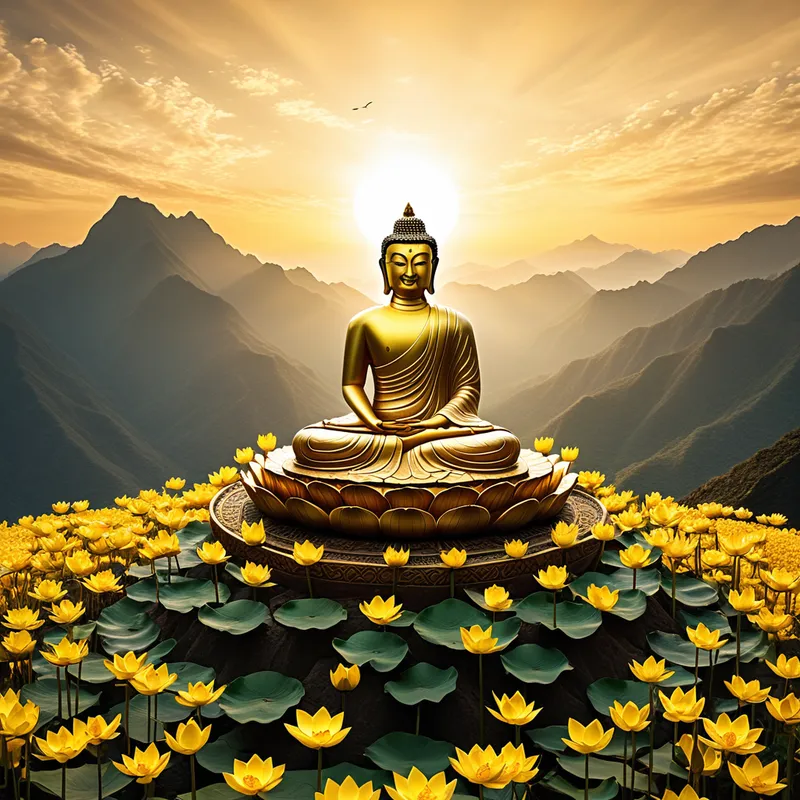
Listen. The air on Vulture Peak is thin, charged with a silence that hums. The assembly is vast—monks, nuns, laypeople, celestial beings, dragons, and asuras—all gathered, their breaths held. The Buddha, Shakyamuni, sits in the lotus posture, a mountain of calm. But today, his tranquility is of a different order. It is the quiet before the cosmos speaks.
For decades, he has taught provisional paths—the ways of the disciples, the solitary realizers. He spoke of suffering, its cause, its cessation, the path. But now, a profound smile touches his lips. He does not begin to speak. Instead, a beam of light erupts from the curl of hair between his brows, illuminating eighteen thousand worlds in the east, revealing every Buddha in every land, every being in every state of existence. The assembly is struck dumb, adrift in this vision of infinite, interconnected reality.
Then, the voice. It is not loud, yet it fills all space. “Stop, stop!” he says to the wise Shariputra. “Do not speak. The Dharma I have attained is profound, difficult to see, difficult to understand.” He speaks of a wisdom accessible only to Buddhas, a truth so ultimate it has been kept secret. A murmur of confusion ripples through the crowd. Have their previous efforts been in vain?
From this tension, the parable blooms. He tells of a wealthy man whose house is on fire. His children, obsessed with their toys, refuse to leave. So the father, in skillful means, lures them out with promises of greater, specific carts—goat-carts, deer-carts, ox-carts. Once they are safe, he gives them not those lesser vehicles, but one magnificent, jeweled carriage drawn by a great white ox. The promised carts were expedients; the great carriage was his true intent all along.
The revelation deepens. The earth trembles. From beneath the ground, countless bodhisattvas spring forth, golden-hued, having practiced for eons. The disciples are bewildered. Who are these majestic beings? The Buddha declares that these are his true disciples, taught by him in the inconceivably distant past. His lifespan is not the eighty years it appears, but measureless, endless. He, Amitabha, and all Buddhas are ever-present, teaching this single, ultimate vehicle.
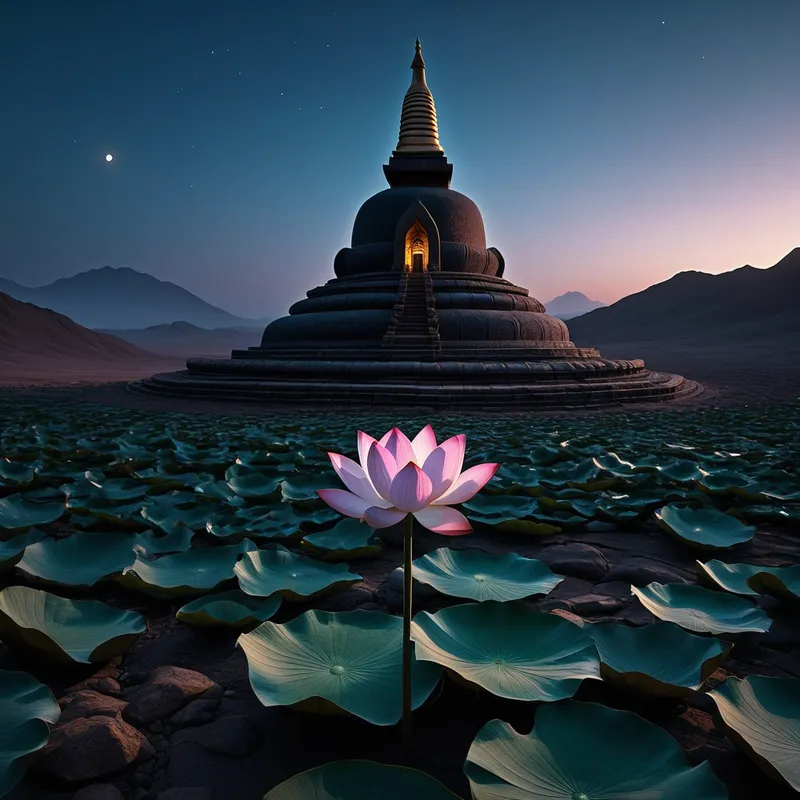
The climax is a vision of unity. A stupa, adorned with seven treasures, rises into the sky. Within it sits Prabhutaratna, a Buddha who attained nirvana long ago. He makes a vow: wherever the Lotus Sutra is taught, his stupa will appear in witness. Shakyamuni Buddha then ascends into the stupa, sharing the lion’s seat with Prabhutaratna. Two Buddhas, past and present, sit side by side—a timeless, indivisible testament to the one truth. The sutra closes not with an end, but with an opening: the promise that all who hear, rejoice, and practice even a single verse are assured of the supreme awakening. The lotus has bloomed; its perfume is the universe itself.
Cultural Origins & Context
The Saddharma Puṇḍarīka Sūtra, or Lotus Sutra, is a Mahayana Buddhist text whose origins are shrouded in the creative ferment of early Indian Mahayana, likely composed between the 1st century BCE and the 2nd century CE. It did not emerge from a single historical event but from a profound theological and philosophical revolution. It was a text of the sangha (community) and for the sangha, but it radically redefined that community to include every single being.
Passed down initially orally and then in written Sanskrit, its transmission was an act of devotion. It was carried along the Silk Road, translated into Chinese by scholars like Kumarajiva in 406 CE, whose poetic version became definitive in East Asia. In China, it inspired the Tiantai school, and in Japan, it became the central scripture for Nichiren Buddhism. Its societal function was explosive: it democratized enlightenment. It declared that the monastic elite did not hold a monopoly on the ultimate truth, and that laypeople, women, and even beings in lower realms all inherently possessed the Buddha-nature. It was a mythic charter for universal spiritual dignity.
Symbolic Architecture
The myth’s symbolic architecture is a mandala of radical inclusivity and latent potential. At its heart is the Lotus Flower. It grows from the mud, blooms pristine above the water, and seeds simultaneously—a perfect emblem for the awakening that emerges from suffering (samsara) without being stained by it.
The ultimate vehicle is not a destination to be reached, but a nature to be recognized. The journey is the realization that you have always been riding.
The Three Carts and the Great White Ox Cart symbolize the upaya, or skillful means. The Buddha’s earlier teachings are not false; they are necessary, compassionate adaptations to the limited understanding of his listeners. The One Vehicle—the great cart—is the integrative truth that contains and transcends all provisional paths. Psychologically, this represents the movement from a fragmented self (identifying with one role, one trauma, one talent) to an integrated Self that holds all contradictions.
The Emerging Bodhisattvas from the Earth are the myth’s most potent symbol of the deep, often unconscious, psychic resources within. They do not descend from a pure heaven; they erupt from the “earth,” the grounded, often ignored substrate of our being—the body, the instincts, the ancestral wisdom, the shadow. They represent the timeless, committed aspect of the psyche (the bodhisattva vow) that has been working toward wholeness long before the conscious ego was aware of it.
The Stupa of Prabhutaratna and the Two Buddhas Seated Together symbolize the reconciliation of time and eternity, the historical and the transcendental. It is the moment when one’s fleeting, personal story (Shakyamuni) meets the eternal, archetypal pattern of wisdom (Prabhutaratna). This is the psychic experience of synchronicity, where inner truth and outer event align, revealing a timeless order within the flow of time.
The Dreamer's Resonance
When this myth stirs in the modern dreamer, it often manifests as dreams of hidden rooms in a familiar house, forgotten books containing vital personal knowledge, or unexpected guides (often humble or earthy figures) offering a key. The somatic sensation is one of expansion—a feeling of the chest opening, or the ground becoming strangely solid and supportive beneath one’s feet.
Psychologically, this is the process of the ego confronting its own limited narrative. The dreamer who has identified as a “healer,” a “victim,” or a “thinker” (the three carts) is being shown that these are provisional identities. The emergence of the earth bodhisattvas in a dream might appear as a group of determined, unknown helpers who arrive from a cellar or a cave to assist in a crisis, symbolizing the mobilization of latent strengths and deep resilience the conscious mind had discounted. The dream is orchestrating a revelation of the dreamer’s own “One Vehicle”—their unique, integrative path to wholeness that has been present all along.

Alchemical Translation
The alchemical process modeled by the Lotus Sutra is the transmutation of provisional identity into essential nature. The modern individual begins life collecting “carts”—social roles, academic degrees, relationship statuses, trauma responses. These are not worthless; they are the upaya that get us moving. The crisis comes when these vehicles break down or converge in a traffic jam of the soul, on the Vulture Peak of midlife, burnout, or profound loss.
The mud of your suffering is not an obstacle to the lotus; it is its sole nutrient. The alchemy occurs in the refusal to reject any part of your experience.
The “fire of the house” is the acute suffering that finally makes the old toys unbearable. The alchemical work is to heed the call to leave, even without knowing the destination. Then comes the crucial, often misunderstood stage: sitting in the confusion. This is the period after the parables, before the earth opens—the fertile void where the old maps are gone and the new one is not yet visible. It is a dark, psychic incubation.
From this fertile void, the “bodhisattvas from the earth” emerge—the buried talents, the repressed grief that holds love, the anger that guards boundaries, the body’s wisdom. Their leader is named Vishishtacharitra, “He of Superior Conduct.” This is not moral superiority, but the conduct of wholeness, the action that springs from the integrated Self.
The final transmutation is the ascension into the stupa. Psychically, this is the experience of no longer being merely in your life story, but simultaneously witnessing it from a timeless perspective. The historical self (Shakyamuni) and the eternal Self (Prabhutaratna) sit together. You become both the process and the witness, the seeker and the found. The promise of the Lotus is that this is not a rare achievement for the few; it is the latent, inevitable flowering of the seed (tathagatagarbha) within the mud of every human experience. Your very seeking is the proof of the bloom.
Associated Symbols
Explore related symbols from the CaleaDream lexicon: