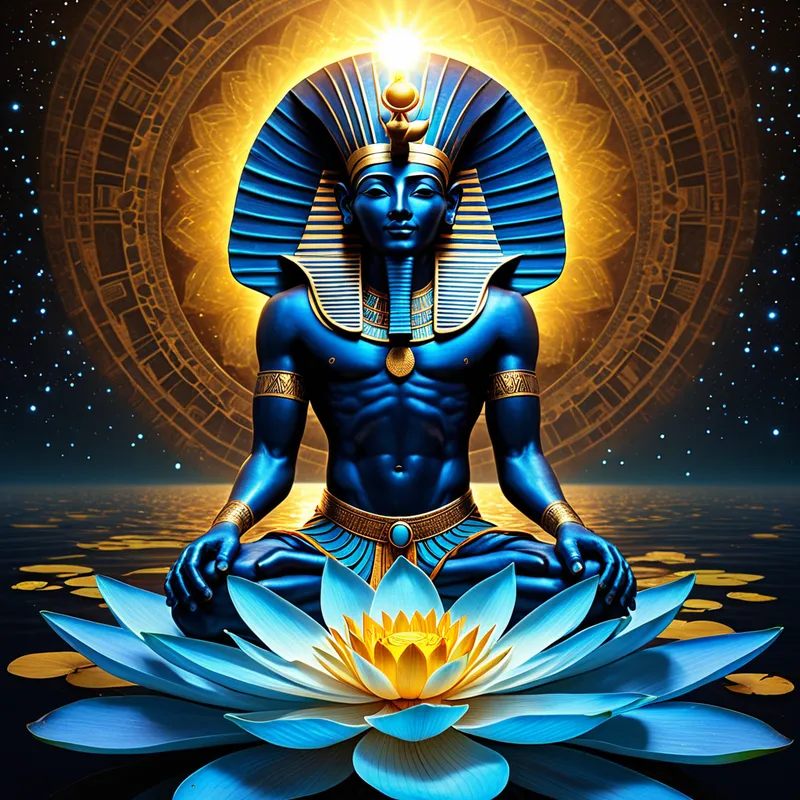
Lotus Crown Myth Meaning & Symbolism
A myth of the sun's nightly rebirth from a celestial lotus, symbolizing the soul's journey through darkness to return as an integrated, illuminated whole.
The Tale of Lotus Crown
Listen, and hear the tale whispered on the wind from the Kemet. Before the first dawn, there was only Nun, the endless, silent dark water. And in that water, a longing stirred. A potential. A seed of light.
From the fathomless deep, a mound of earth arose—the first land. And upon that mound, a miracle unfolded. A single, perfect blue lotus bud, the seshen, pierced the surface of Nun. Its stem was the pillar of the world. Its leaves cradled the silence of before-time. For an eternity it rested, holding its breath.
Then, as the first moment trembled into being, the petals began to part. Not with a sound, but with an expansion of being. From the golden heart of the blossom, from its very fragrance, light was born. It was Ra, the self-created, emerging in his first, glorious form. The light was his body; the lotus was his throne and his mother. He rose, wearing the crown of his own radiance, and his first gaze painted the sky with the colors of dawn. The world was spoken into existence by his light.
But the story does not end with dawn. It is written in the eternal cycle. For Ra, in his majesty, must journey. His golden barque sails the sky, but as age touches even the divine, he descends. He enters the Duat, the terrifying, serpent-infested land of night. Here, Ra is old, frail, a sun dimmed. He is Auf, and the chaotic serpent Apep seeks daily to devour him, to return all to Nun.
The barque struggles through the twelve caverns of night. The crew of gods fights a desperate, silent battle. And at the deepest hour, the darkest moment before the turning, a miracle is prepared. From the protective hull of the night barque, a new lotus bud is conjured—a seed of the first creation held within the vessel of dissolution. As Ra, weary unto death, passes through this ultimate threshold, he enters the bud.
He is swallowed by the flower. He is seed again. In that perfect, dark womb of petals, the old sun dies. The crown of light is extinguished. All is potential, all is waiting.
And then… in the eastern horizon, the Bakhu, the water stirs. A blue lotus rises, breaking the surface of the celestial Nile. The petals tremble, and then, they open. From within steps not the old, weary Auf, but Khepri, the reborn one, fresh and mighty. He wears the Lotus Crown anew—not as a memory, but as a living fact of his regeneration. The dawn breaks. The cycle is secured. Life continues. The lotus has crowned the sun once more.

Cultural Origins & Context
This is not a single myth from one papyrus, but a foundational pattern woven into the very fabric of ancient Egyptian thought. The imagery of the sun born from a lotus is etched into temple walls at Karnak and Abu Simbel. It is whispered in the Pyramid Texts and elaborated in the Book of the Dead. The myth was the property of priests and pharaohs, a cosmic blueprint that justified the divine order (Maat). The Pharaoh was the living embodiment of this cycle; his coronation was a re-enactment of Ra’s emergence, his nightly rituals a participation in the solar journey through the Duat. To know this story was to understand why the world existed and how it was perpetually saved from chaos. It was the ultimate argument against despair, performed daily by the cosmos itself.
Symbolic Architecture
The Lotus Crown is not merely a floral diadem; it is a complete map of psychic transformation. The lotus, rooted in the mud of Nun (the unconscious), rising through the water (the realm of emotion and the personal psyche), to bloom in the air (consciousness), is the soul’s journey.
The crown is not placed upon the head from without; it is grown from within, through the ordeal of the dark water.
The night journey in the Duat represents the necessary descent into the personal and collective unconscious—the confrontation with one’s own shadow, symbolized by Apep. This is not a failure but a required phase of dissolution. The old, rigid identity (the aged sun) must be deconstructed. The closed lotus bud in the barque is the protective, containing space for this disintegration. It is the temenos, the sacred vessel where the old self is broken down into its essential elements. The rebirth as Khepri is the emergence of a new, more integrated consciousness—one that has assimilated the darkness and now creates itself anew, from its own core.
The Dreamer's Resonance
When this myth stirs in the modern dreamer, it often manifests not as a clear narrative, but as potent, visceral symbols. To dream of being trapped in a dark, watery place, yet seeing or holding a single, luminous flower, speaks to this archetype. The sensation is one of profound containment, even entombment, coupled with a quiet, inexplicable certainty of imminent emergence.
Somatically, one might experience this as a tightness in the chest or solar plexus (the closed bud) that gradually releases into a feeling of expansive warmth (the blooming). Psychologically, it marks a period of introversion, depression, or "dark night of the soul," where conscious achievements feel meaningless. The ego is in the Duat. The dream is assuring the psyche that this is not an end, but a gestation. The lotus in the dream is the Self’s promise to the ego: I am still here, preparing the new form. Hold on.
Alchemical Translation
The alchemical process mirrored here is solve et coagula—dissolve and coagulate. The myth provides a grand model for individuation. Our conscious personality, like the daytime sun, is brilliant but inevitably becomes fatigued, one-sided, and disconnected from its roots. The work is to consciously embark on the night sea journey—to willingly engage with therapy, shadow work, creative blocks, or life crises that dismantle our worn-out "crown."
The true Lotus Crown is forged in the humility of dissolution, not the pride of achievement.
We must enter our own Duat and face our Apep—our repressed angers, shamed desires, and forgotten wounds. This is the solve. The "lotus bud" is the act of holding that process with compassion and patience, not fleeing into old patterns. It is the containing vessel of reflection, journaling, or mindful suffering. Finally, the coagula: the rebirth. This is not a return to the old self, but the emergence of Khepri—a self that is more authentic, resilient, and creative because it has integrated the darkness. Your new "crown" is not an external accolade, but the quiet, unshakable authority of one who has been remade from the inside out, who creates their world anew each day from the deep, muddy roots of their own experience. You become, at last, the gardener and the flower, the navigator and the sun, the one who is crowned by your own becoming.
Associated Symbols
Explore related symbols from the CaleaDream lexicon: