Lotus Myth Meaning & Symbolism
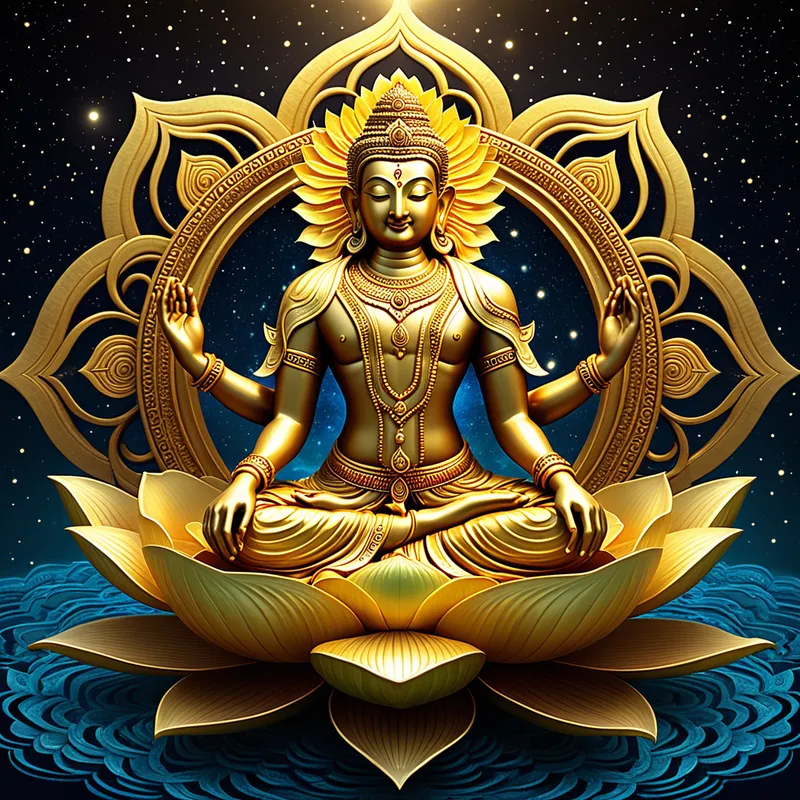
The cosmic lotus blooms from primordial waters, cradling the creator Brahma, symbolizing the soul's ascent from unconscious depths to enlightened consciousness.
The Tale of Lotus
In the beginning, there was neither existence nor non-existence. There was only the One, the Brahman, resting in its own infinite potential. Then, a vibration—a desire to become many. From that desire, a soundless sound echoed: Aum.
And then, there was water. A vast, endless, dark ocean of potential, without light, without form, without shore. This was the Narayana, the abode of the divine. Upon these waters, on the great serpent Ananta Shesha, lay Vishnu, deep in a yogic sleep. From his navel, a light began to stir. It was not a light that illuminated, for there was nothing yet to see. It was the light of pure consciousness, gathering itself.
This light grew, stretching like a radiant stem from the divine navel, pushing upward through the dark, silent waters. It climbed, a pillar of intention, until it breached the surface of the boundless ocean. And there, upon the waters, it blossomed.
It was a lotus. A flower of such sublime beauty that its petals held the promise of all colors, all forms. Its stem was the axis of the yet-unborn worlds. At its heart, glowing with the light of a thousand suns yet gentle as dawn, sat a being. This was Brahma. He opened his eyes—not two, but four, gazing into the four directions of the universe yet to be. In his hands, he held the sacred knowledge, the Vedas.
Brahma looked out from his lotus throne. He saw only the flower, the stem, and the infinite dark waters below. A profound loneliness touched him, the loneliness of the first consciousness. From this feeling, the desire to create was born. He began to sing, and his song was the vibration of creation. From the petals of the lotus, the realms unfolded. From its fragrance, the senses were born. The mud below, the Tamas, remained, but the lotus rose above it, pure and untouched, the seat from which all life would spring.
Cultural Origins & Context
The myth of the cosmic lotus is not a single story bound to one text, but a foundational image woven into the very fabric of Hindu thought. Its earliest seeds are found in the Vedas, particularly in the creation hymns of the Rigveda, which speak of the golden embryo (Hiranyagarbha) floating on the primordial waters. The image crystallizes in the later Puranas, like the Vishnu Purana and Brahma Purana, where the lotus-navel of Vishnu and the birth of Brahma are described in vivid detail.
This myth was passed down through an oral tradition of sages (Rishis) and storytellers, and later inscribed in temple architecture. Every curved stone lotus on a temple pillar, every painted lotus beneath the feet of a deity, retells this story. Its societal function was multifaceted: it was a cosmological map explaining the origin of the ordered universe from chaos; a theological statement about the divine source of creation; and a profound spiritual metaphor accessible to both the philosopher and the farmer. It established a visual and conceptual anchor for the understanding of purity, divine authority, and the soul's origin.
Symbolic Architecture
The lotus is perhaps the most densely packed symbol in the Hindu imaginal world. Its architecture is one of paradoxical unity.
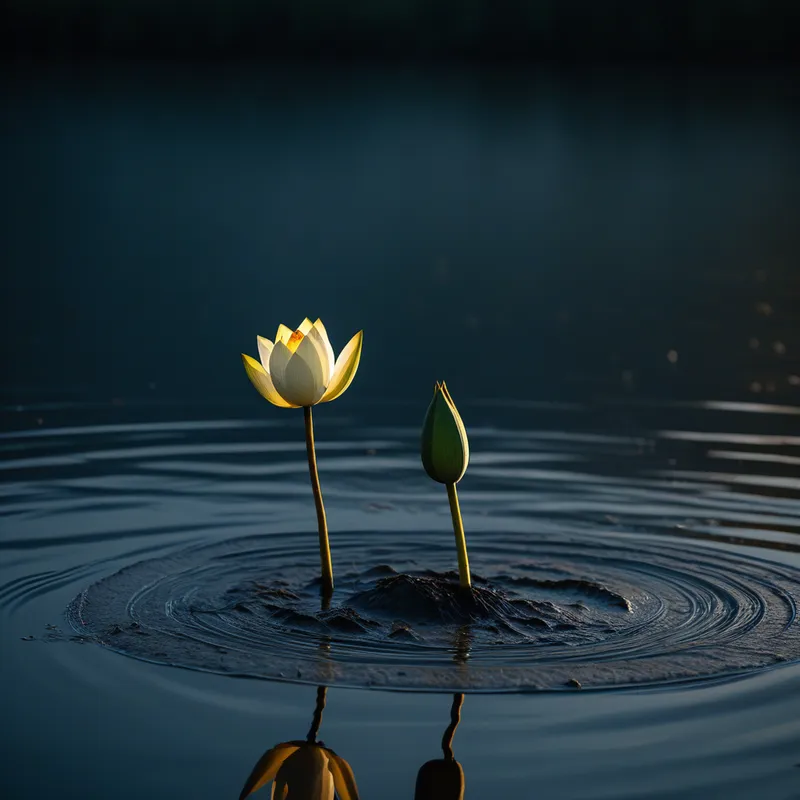
The lotus does not deny the mud; it is defined by it. Its beauty is the direct result of the darkness from which it ascends.
Psychologically, the lotus represents the birth of consciousness itself from the unconscious, murky waters of the psyche. The stem is the Atman's connection to the divine source (Brahman). The mud is the raw, unformed material of our instincts, memories, and shadow—the necessary substrate. The water is the medium of the collective unconscious, the shared psychic ocean. The bloom is the individuated ego, or higher Self, achieving a state of awareness that is in the world but not stained by it.
Brahma, born from the lotus, symbolizes the creative principle of the mind. His four heads represent the four functions of consciousness—thinking, feeling, sensation, and intuition—or the four directions of manifest reality. He is the archetypal Creator, but his creation begins from a place of serene centeredness upon the lotus, implying that true creation arises from a connection to the sacred, not from chaotic impulse.
The Dreamer's Resonance
When the lotus blooms in a modern dream, it is rarely a mere flower. It is a signal from the deep psyche. To dream of a closed lotus bud in dark water speaks of potential unrealized, of a nascent Self gestating in the inner darkness. There is often a somatic feeling of pressure, of waiting, or of being submerged in a challenging emotional state.
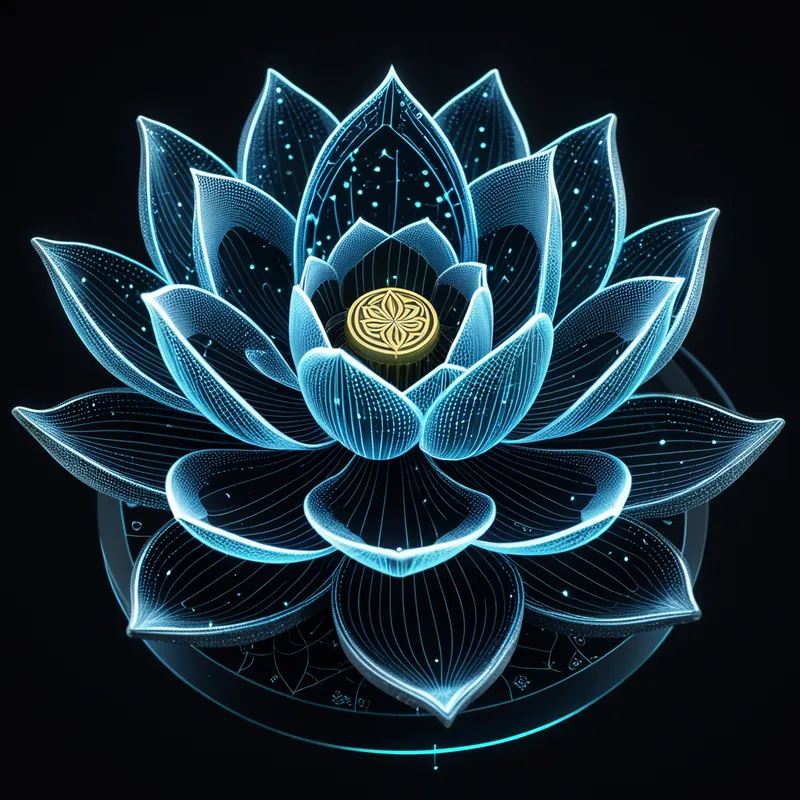
To dream of a lotus in full bloom, especially one that is radiant or glowing, marks a moment of psychic awakening. This could follow a period of intense difficulty ("the mud"). The dreamer may be integrating a shadow aspect, achieving a new perspective, or experiencing spiritual insight. The somatic resonance is often one of lightness, expansion in the chest, or a feeling of clarity and cleanliness, even if the dream's surroundings are chaotic. A lotus growing from an unexpected place—from the heart, a wound, or a machine—indicates the irrepressible urge of consciousness to find form and beauty, to transform base experience into meaning.

Alchemical Translation
The myth of the lotus provides a complete alchemical map for psychic transmutation, or individuation. The process is not one of escape, but of rooted transformation.
The first stage is Nigredo: the primal, dark waters. In the individual, this is the confrontation with the shadow, with depression, with the unresolved material of the personal and collective unconscious. It feels like formless chaos. The second stage is Albedo: the emergence of the stem, the axis. This is the development of a connecting principle—often a spiritual practice, therapy, or a core value—that provides a vertical link between the murky depths and a higher purpose. It is the birth of seeking.
The culmination is Rubedo: the golden bloom. This is not the end of the process but its flowering. The ego, having consciously integrated material from the depths, no longer identifies with the mud (the complexes) or the water (the collective tides of emotion and trend). It rests upon them, connected yet distinct. It achieves a state of mindful presence.
The alchemical gold is not a state of perpetual bliss, but of unwavering connection. The lotus is always fed by the mud; the enlightened mind is always informed by the shadow.
For the modern individual, the myth teaches that our greatest beauty and creativity do not arise in spite of our struggles, but because of them. The goal is not to become "pure" by rejecting the dark, messy parts of life, but to become like the lotus: to develop a consciousness that can process, transform, and rise above, all while remaining authentically connected to the rich, fertile darkness from which we all grow. We are invited to find our own navel-center, our connection to the divine within, and from that anchored seat, to create our world.
Associated Symbols
Explore related symbols from the CaleaDream lexicon: