
Loki's Salmon Myth Meaning & Symbolism
A tale of Loki's shape-shifting into a salmon, his capture, and the binding of his fate, symbolizing the inescapable confrontation with the shadow self.
The Tale of Loki's Salmon
Hear now of the laughter that curdled, of the mirth that turned to ash. The mead of celebration had soured in the hall of Odin. For the gods, the shining Æsir, had crossed a line from which there was no return. They had slain Kvasir, the wisest among them, and from his blood brewed the mead of poetry—a draught of stolen inspiration. And they had bound the gentle giantess, Angrboða, and taken her children: the serpent Jörmungandr, the half-corpse Hel, and the wolf Fenrir. These acts, born of fear and cunning, hung in the air like a coming storm.
And at the center of the storm’s eye was Loki. He who had sired those monstrous children. He who had orchestrated and laughed at every scheme. He felt the weight of the gods’ collective guilt shift, a slow and terrible pivot, toward him. The feast at Ægir’s hall was the last straw. There, Loki insulted every god and goddess, unveiling their secrets and shames. He had gone too far. The love-hate was spent; only hate remained.
Knowing the hunt was upon him, Loki fled. He built a house by the waterfall of Franangrsfors, a house with four doors so he could watch all ways. His mind, the sharpest in all the worlds, raced like a trapped thing. He saw the threads of fate tightening. In a flash of desperate genius, he thought of the one form that could slip through any net, that could navigate the hidden currents of the world: the salmon.
He shed his god-shape at the water’s edge. His skin shimmered, his form compressed, elongating into sleek, silver muscle. He became the salmon, the leaper, the dweller in deep, unknowable pools. He vanished into the cold, rushing embrace of the waterfall, thinking himself free.
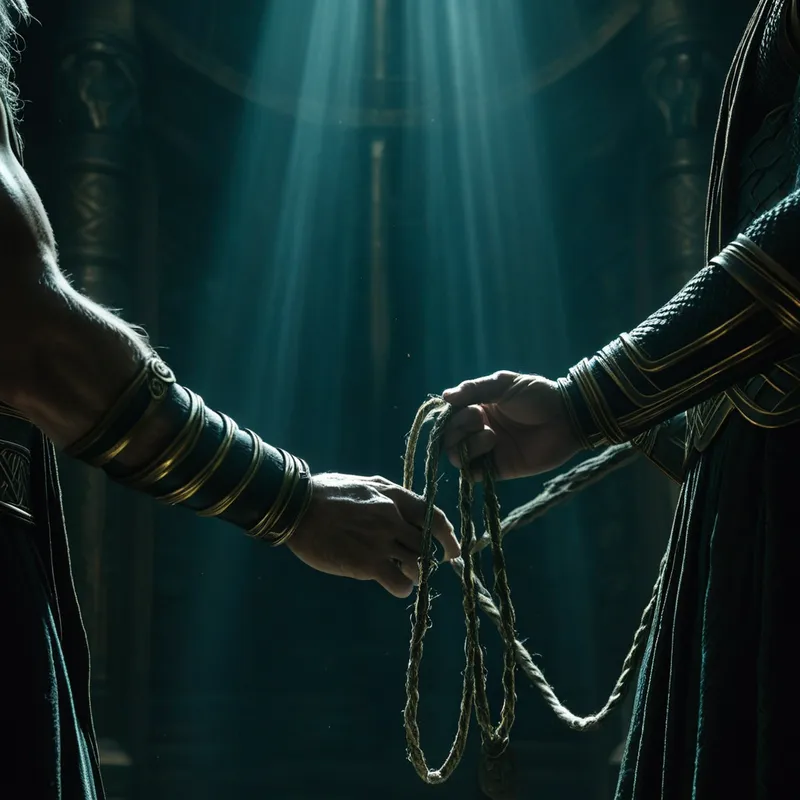
But the gods had Forseti with them, and the net of law is fine-meshed. They too knew cunning. From the sinews of Loki’s own son, Narfi, they fashioned a cord no magic could break, a binding woven from his own bloodline’s pain. And they began to drag the river.
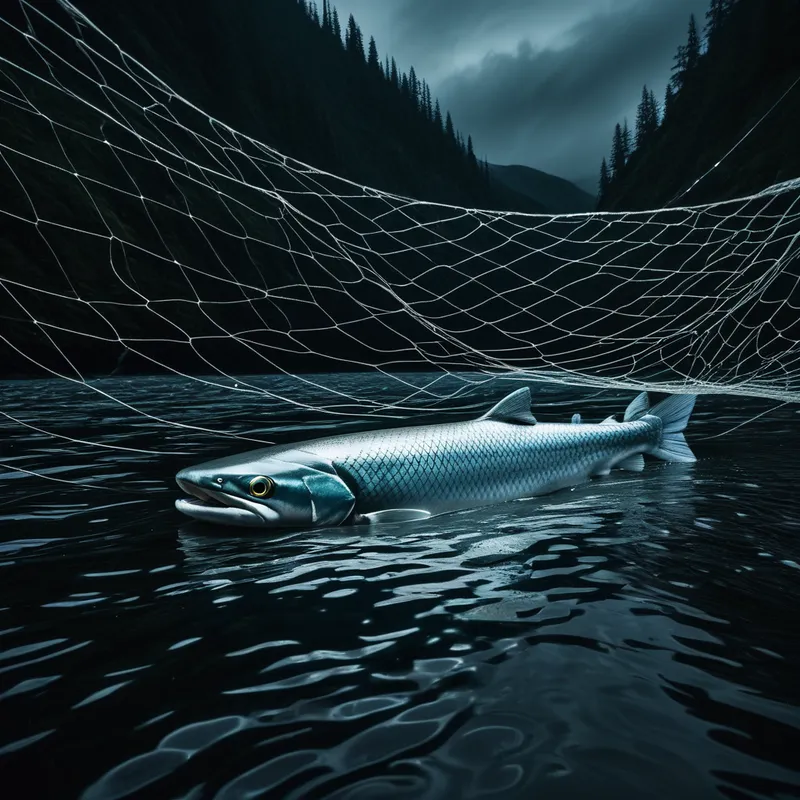
Loki the salmon felt the net’s shadow before he saw it. He darted, a silver thought in the dark water. He hid beneath a stone at the waterfall’s base, heart pounding a frantic rhythm against the riverbed. But the net of fate is patient. It swept the river again, and this time, Loki knew he must leap to survive. He gathered his strength and shot upwards, a bolt of living silver against the white foam, soaring over the net’s rim.
It was then that Thor, mighty and direct, saw the gleam. His hand, quick as lightning, shot out and caught the salmon mid-air, his grip closing just before the tail. The struggle was immense—the god of thunder versus the essence of slippery escape. But Thor’s grip was the grip of inevitability. The salmon was caught. The shape-shifter was pinned. The laughter was finally, utterly, stilled.
Cultural Origins & Context
This tale is preserved primarily in the Prose Edda, written by Snorri Sturluson in the 13th century. Snorri drew upon older skaldic poetry and oral traditions that were already fading in the face of Christianity. The story of Loki’s capture is not a standalone myth but the pivotal climax in the long saga of his relationship with the Æsir, leading directly to his binding and the prophesied chaos of Ragnarök.
Societally, this myth functioned as a profound narrative about the limits of social order. Loki embodies the necessary and destructive element of chaos within the system—the joke that goes too far, the innovative thought that becomes treason, the outsider whose integration is never complete. His capture and binding were a mythic expression of the community’s attempt to restrain the un-restrainable aspects of itself. It was told not as a simple victory of good over evil, but as a tragic necessity that stored up greater catastrophe for the future. The storyteller, by the fireside, would weave a tale that acknowledged the cunning of the outcast, the terror of the gods’ vengeance, and the grim truth that some breaches cannot be mended.
Symbolic Architecture
The salmon is no ordinary fish in the Norse, or indeed the wider Indo-European, imagination. It is the creature of wisdom, known for swimming upstream to the source of all things, to the well of Mímisbrunnr. For Loki to choose this form is the ultimate act of trickster intelligence: he becomes the symbol of profound, instinctual wisdom and elusive life-force to affect his escape.
The shadow, when pursued, dons the guise of the very wisdom you seek, making its capture a paradox of self-discovery.
Yet, his capture reveals the deeper symbolism. He is caught by his tail—the very end of him. In many traditions, to hold something by its tail is to have incomplete control, but in this case, it signifies catching the consequence of the thing. Thor does not grasp the head (the thought, the scheme) but the tail (the result, the trailing wake of action). The net, made from his son’s entrails, is the ultimate symbol of karma or wyrd—the binding woven from one’s own actions and their impact on one’s kin. Loki is imprisoned by the literal flesh of his own legacy.
The Dreamer's Resonance
When this myth stirs in the modern dreamer, it often manifests as a profound somatic experience of being cornered by one’s own cleverness. One might dream of being impossibly agile—darting through social situations, rationalizing behaviors, avoiding confrontation—only to feel a sudden, crushing grip. This is not an external punishment, but the psyche’s own enforcement of a law deeper than ego.
The dream may feature water in tumult, a feeling of being both the hunter and the hunted, or a transformative escape that fails at the last second. The somatic signature is often a tightness in the gut or throat—the binding cord, the grasping hand. This dream pattern signals that a long-running pattern of avoidance, shape-shifting to suit circumstances, or using wit as a shield has reached its limit. The unconscious is initiating a netted process: dragging the depths of the personality to bring a slippery, elusive complex—often the trickster shadow—to the surface for conscious integration.
Alchemical Translation
The alchemical process mirrored here is the coagulatio—the fixing of the volatile. Loki is mercurius, the ever-changing, brilliant, and toxic spirit. His flight is the sublimatio, an attempt to rise above consequence through transformation. His capture is the necessary coagulatio, where that spirit is fixed in a specific, tangible form so it can be worked upon.
Individuation requires not the expulsion of the inner trickster, but its conscious binding. Only when the shape-shifter is held fast can its energy be redirected from sabotage to innovation.
For the modern individual, this myth models the painful but essential stage in psychic development where one must stop running from the aspects of the self that cause disruption. The “salmon leap” is the last, brilliant attempt of the ego to avoid the responsibility of its own shadow. The capture is the moment of stark self-awareness: “My own actions have woven the net that holds me.” The subsequent binding—which in the myth chains Loki to a rock with a serpent’s venom dripping above him—translates to the conscious, enduring containment and observation of one’s own destructive potentials. It is not about destroying the Loki-within, but about securing him, so his fiery intelligence, once used solely for evasion and chaos, can be tempered. In this bound state, under the drip of painful awareness, the trickster’s energy is slowly alchemized from pure chaos into a guarded, potent source of critical insight—a necessary, if imprisoned, god awaiting the twilight of the old self.
Associated Symbols
Explore related symbols from the CaleaDream lexicon: