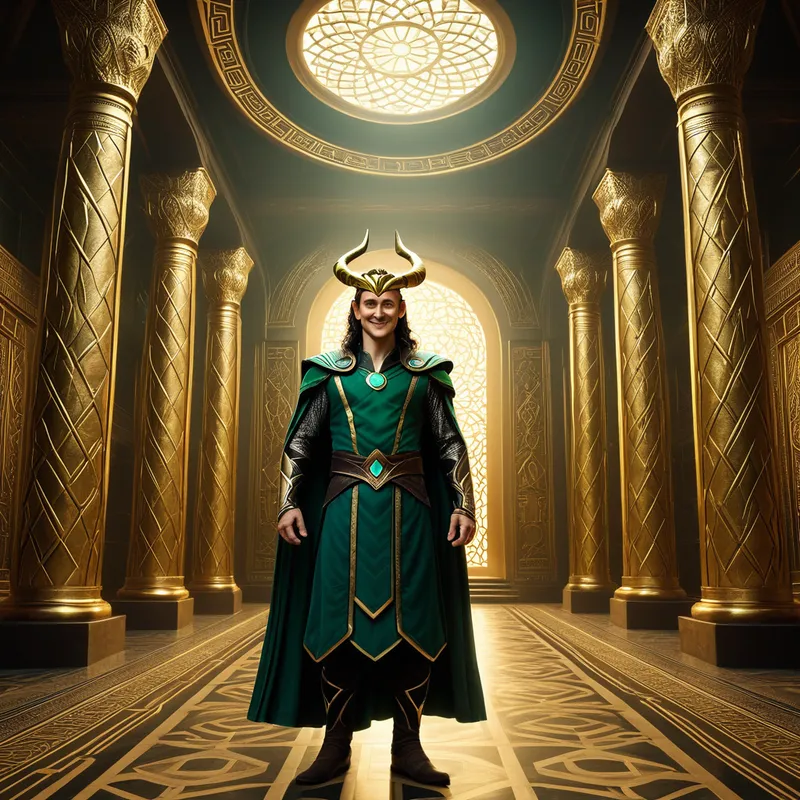
Loki's Laughter Myth Meaning & Symbolism
A myth where the trickster god Loki, through outrageous tales, provokes laughter that breaks a paralyzing grief, restoring life's vital flow.
The Tale of Loki's Laughter
The mead was bitter. The fire in the great hall of Aegir guttered low, casting long, sorrowful shadows. A silence, thick as winter fog, had settled upon the gathered Aesir. No song rose to the rafters, no boast was made, no dice clattered upon the boards. The air was heavy with a grief that had no name, only a shape: the shape of Baldr the Beautiful, whose absence was a cold stone in every heart.
At the threshold stood Skadi, her eyes like chips of glacier ice. She had come for blood-price, for vengeance for her slain father. Her presence was a frost that seeped into the very bones of the hall, freezing the tongues of the gods. They were bound, not by chains, but by a solemn oath: to make her laugh, to melt her wrath with mirth, or face her endless enmity. One by one, the greatest of them had tried. Thor had juggled goats and pulled faces until he was red. The handsome Forseti had told clever tales. All failed. Skadi’s lips remained a grim, unmoving line. The feast was a funeral, and despair was the only guest.
Then, from the shadows where he had been watching, silent as a spider, Loki moved. He did not approach the giantess directly. Instead, he whispered to a servant, and soon a strange procession entered. A grizzled old billy-goat was led to the center of the hall. Loki took a length of cord and tied one end fast to the goat’s scraggly beard. The other end… he tied with a deft, ridiculous knot to his own manhood.
What followed was a spectacle of absurd, escalating agony and noise. The goat bleated and pulled. Loki yelped and scrambled, his face a masterpiece of comic suffering. He was dragged, he pulled back, they strained against each other in a grotesque, squealing tug-of-war. He shrieked curses at the goat, he begged the gods for aid, he rolled in the rushes, all while tethered in the most undignified way imaginable.
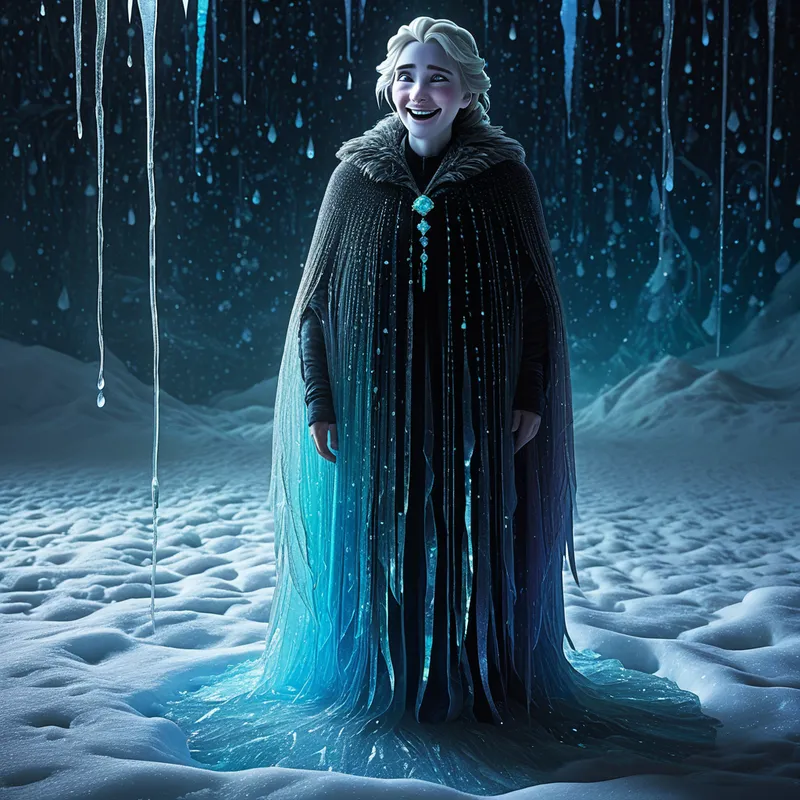
And then, a sound cracked the frozen air. It was sharp, sudden, and utterly human. It was laughter. Skadi, the daughter of the mountain, the embodiment of winter’s wrath, was clutching her sides, tears of mirth streaming from her glacier-eyes. The hall, for a heartbeat, was stunned. Then, like a dam breaking, the laughter spread. A snort from Odin. A great, booming guffaw from Thor. The Aesir roared. The silence shattered into a thousand glittering pieces. The binding grief was broken not by solemnity, but by the sheer, outrageous, humiliating force of Loki’s chaotic joke. Life, messy and loud and vital, rushed back into the hall.
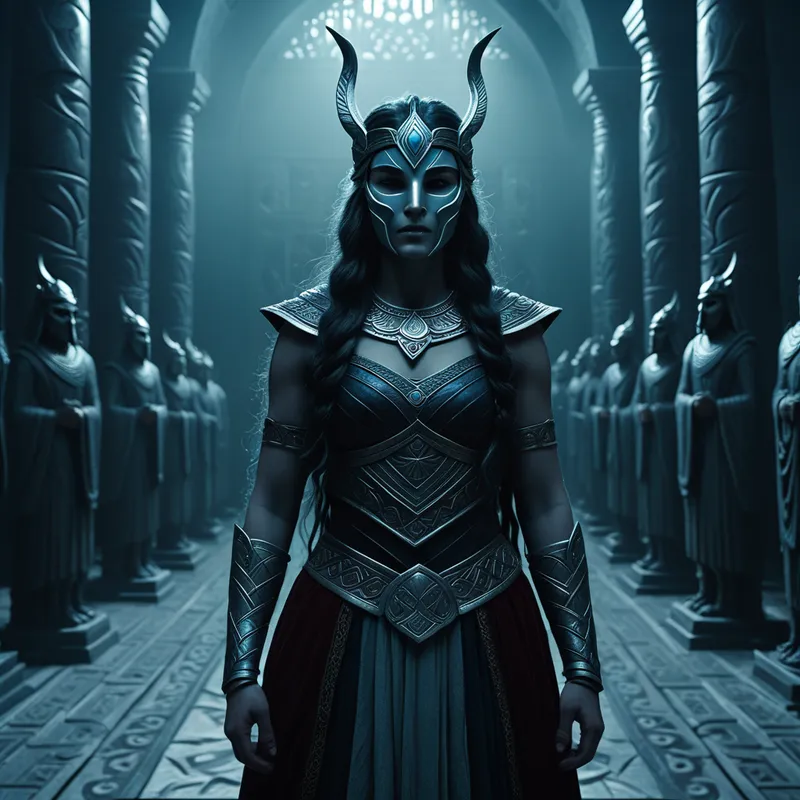
Cultural Origins & Context
This myth, preserved primarily in the Skáldskaparmál section of Snorri Sturluson’s 13th-century Prose Edda, is a brilliant fragment of the Norse worldview. It was not scripture, but a story from a vast oral tradition, told by skalds and poets around fires in longhouses. Its function was multifaceted: it was entertainment, a repository of cultural knowledge explaining why things are the way they are (in this case, perhaps, the origin of a particular type of binding or the nature of truce with giants), and a profound piece of social and psychological technology.
In a culture facing the harsh realities of the North Atlantic—where winter could mean death, where fate (ørlög) was woven by implacable Norns—this myth served a critical purpose. It modeled a necessary survival mechanism. When grief, obligation, or conflict creates a paralyzing stasis, a social and psychic freeze, something must break the pattern. The story legitimizes the role of the disruptive force, the trickster, as a vital, if dangerous, part of the social and cosmic order. It acknowledges that sometimes, healing does not come from a sage’s wisdom or a hero’s strength, but from the jester’s humiliating, boundary-shattering antics.
Symbolic Architecture
At its core, the myth is an allegory of psychic energy and its blockages. Skadi’s grief and demand for vengeance represent a frozen complex—a knot of trauma, rage, and sorrow that has seized the entire psyche (the hall of the gods). The solemn oath of the Aesir symbolizes the ego’s attempts to resolve the complex through conscious, dignified, “proper” means: reason, strength, fairness. These all fail because they operate within the frozen logic of the complex itself.
Loki represents the unconscious trickster archetype, the principle of chaos and enantiodromia (the emergence of the opposite). He does not fight the freeze with heat; he disrupts it with absurdity. The goat is a potent symbol of base instinct, lust, and untamed nature. By tying this raw, animalistic force directly to his own generative organs, Loki performs a shocking act of symbolic self-exposure and connection to the libidinal, life-force energy.
The trickster does not heal the wound; he makes it laugh, breaking the spell of identification with suffering and releasing the energy trapped within it.
His humiliation is the key. The ego’s greatest fear—loss of dignity, of control—is enacted in full view. This total surrender to the ridiculous creates a psychic short-circuit. The tension between the frozen ideal (solemn justice) and the chaotic reality (absurd, embodied life) becomes unbearable and discharges as laughter. This laughter is the sound of energy being liberated, of a complex dissolving, allowing the flow of life to resume.
The Dreamer's Resonance
When this mythic pattern stirs in the modern unconscious, it may manifest in dreams of profound, awkward, or taboo humor in the midst of serious situations. One might dream of laughing uncontrollably at a funeral, of a solemn authority figure slipping on a banana peel, or of a deeply personal shame being exposed in a way that, surprisingly, brings relief rather than ruin.
Somatically, this process often correlates with a felt sense of constriction in the chest or diaphragm—the “weight” of unshed tears or unexpressed anger—suddenly releasing in a gasp, a sigh, or actual laughter. Psychologically, the dreamer is likely grappling with a situation or internal state that has become rigidly fixed: a grudge held too long, a perfectionistic ideal, a grief that has become an identity. The Loki-dream is the psyche’s attempt to introduce a destabilizing element, to mock the tyranny of the complex, and to force a cathartic release of the energy bound up in maintaining the frozen posture.
Alchemical Translation
The alchemical process mirrored here is solutio—the dissolution. In the work of individuation, we inevitably encounter psychic structures that have solidified. These are our cherished wounds, our righteous resentments, our ways of being that have become character armor. The conscious ego, playing the role of the noble Aesir, tries to negotiate with, reason with, or overpower these structures, often to no avail.
The trickster archetype, when integrated, performs the necessary solutio. It is the inner force that willingly engages in the “humiliating” act of seeing our own pretensions, of connecting our highest spiritual aspirations (the gods at feast) to our basest, most instinctual drives (the billy-goat). This is not a dignified process.
Individuation requires not only the courage of the hero, but the humility of the fool—the willingness to be seen as ridiculous in service of a greater truth.
The laughter that results is the psychic gold. It is the moment of insight where we see the absurdity of our own imprisoning narratives. It is the release of identification, where we are no longer only the grieving one, the wronged one, the perfect one. We are also the ridiculous one, tied to a goat, and in that full, humiliating, hilarious acknowledgment, we become more whole. The energy that was locked in maintaining the frozen state is freed to flow back into life, creativity, and connection. The feast of the psyche can begin again, not in perfect harmony, but in dynamic, chaotic, and vital balance.
Associated Symbols
Explore related symbols from the CaleaDream lexicon: