
Lodestone Myth Meaning & Symbolism
A myth of the first magnetic stone, born from the tears of a Titan for his lost love, embodying the soul's irresistible pull toward its divine origin.
The Tale of Lodestone
Hear now a tale not of thunder, but of a silent pull. Not of a god’s wrath, but of a Titan’s enduring sorrow. In the age before heroes, when the earth was still soft from the hands of the Gaia and Ouranos, there walked a Titan named Magnetis. He was a spirit of the deep earth, of the veins of ore that pulse like dark blood beneath the mountains. His domain was the secret affinities of things, the unseen bonds that draw root to water and star to star.
His heart, however, belonged to a Naiad of a singular spring, whose waters were so clear they reflected not the sky, but the music of the spheres. Her name was Helike. Where Magnetis was of the dark, solid below, Helike was of the luminous, flowing above. Yet, they were drawn together with a force that made the Zeus's lightning seem a stray spark. Their union was the marriage of depth and reflection, of steadfastness and flow.
But the Moirai cut a short thread. A drought, born from a quarrel among newer gods, stole the waters of the world. Helike’s spring faded, and with it, her luminous form. She did not die as mortals do, but dissipated, her essence scattered into the yearning winds, a memory of moisture on parched stone.
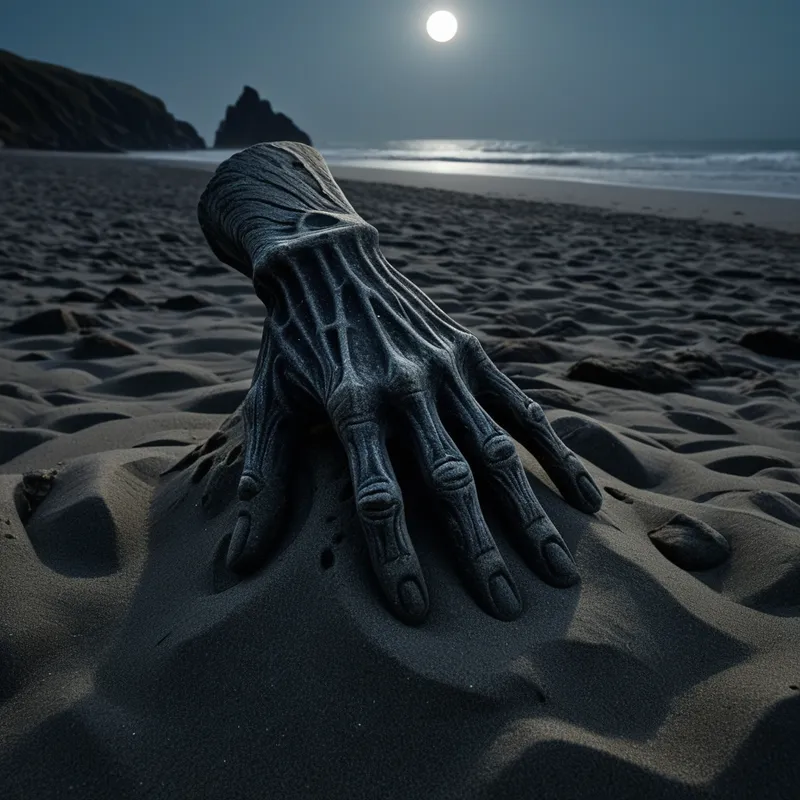
Magnetis was unmoored. He wandered the ravaged earth, his hands, which once could sense the heartbeat of iron in rock, now felt only emptiness. The affinity was gone. The bond was broken. For an age, he traversed deserts and climbed the bare bones of mountains, a colossus of grief. Finally, at the edge of the world, where the stone meets the salt sea, his immense sorrow could no longer be contained. He fell to his knees. Not a roar, but a silence deeper than any chasm swallowed him. And from his one eye, a single tear welled—a tear not of water, but of pure, condensed longing, heavy with the memory of his lost affinity.
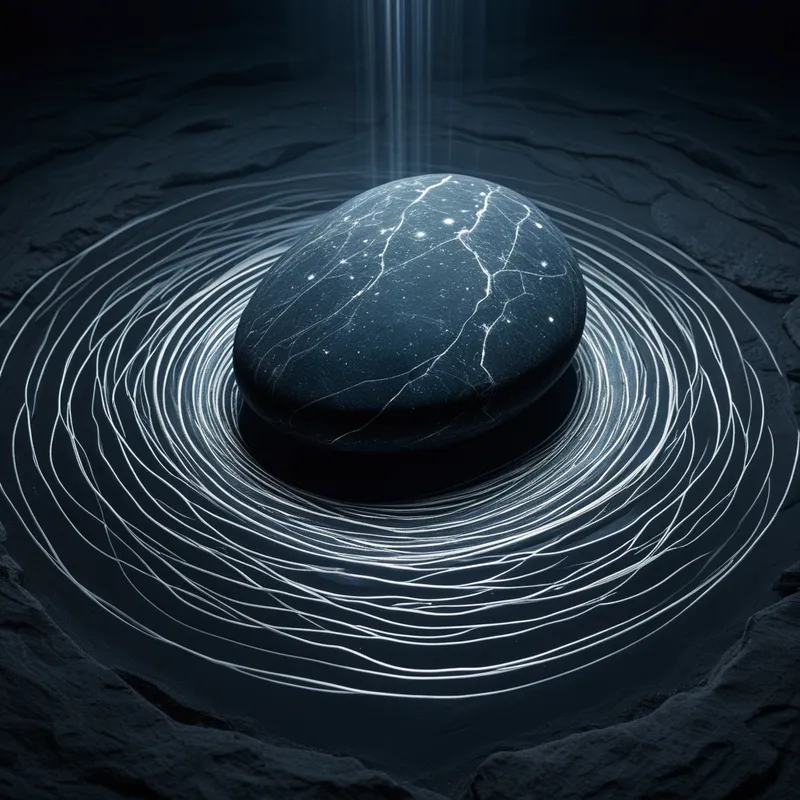
It fell upon the black volcanic rock of the shore. Where it struck, it did not splash, but crystallized. It sank into the stone, transmuting it. When the Titan rose and stumbled away, forever searching, he left behind a curious thing: a rough, dark stone that felt strangely warm to the touch. It was inert to all but one thing. When the rare sliver of iron, a metal born of the same deep earth as the Titan, lay near it, a miracle occurred. The iron would tremble, then stir, and finally move of its own accord, sliding across the ground to press itself against the dark stone. It was as if the stone remembered. As if, within its crystalline heart, it held the indelible pattern of Helike, and reached out for anything that echoed the substance of its lost creator. The first lodestone was born—not a weapon, not a tool, but a fossilized tear of divine attraction, forever pulling its lost beloved home.
Cultural Origins & Context
The myth of the lodestone’s origin is not found in the grand epics of Homer or the systematized theogonies of Hesiod. It is a local myth, a “just-so” story whispered by miners, smiths, and sailors—those who worked directly with the mysterious forces of the earth and sea. It belonged to the oral tradition of practical men who needed to explain the uncanny. The stone’s power to attract iron without touch was magic, pure and simple, and magic in the Greek world demanded a divine story.
Its tellers were likely the Hephaestian artisans and the pilots who used early compass-like devices. For them, the myth served a profound societal function: it sacralized their craft. It transformed a puzzling physical property into a narrative of cosmic pathos, giving their work a depth connected to the primordial loves and losses of the Titans themselves. The lodestone was not just a tool; it was a relic of a time when the world itself was emotionally charged, a tangible piece of a god’s heartache. This story anchored human technological curiosity in the sacred, making the exploration of nature’s secrets an act of participating in an ancient, divine drama.
Symbolic Architecture
At its core, the myth of the Lodestone is the archetypal drama of the Soul and its Source. Magnetis represents the embodied psyche, grounded in the material world (“the deep earth”), yet inherently possessing a faculty for connection (“the secret affinities”). Helike represents the Anima or the spiritual source—the luminous, reflective, nourishing essence that gives life meaning and direction.
The soul is a lodestone, forever imprinted with the signature of its origin. Its every attraction, every longing, is a tremor along the invisible thread that leads back home.
The drought symbolizes a crisis of meaning, a spiritual aridity where the connection to the source is severed. This is the universal experience of alienation, depression, or the “dark night of the soul.” Magnetis’s wandering is the psyche lost, functioning but devoid of its essential magnetism. The creation of the lodestone from a tear is the crucial alchemy. It is not through active seeking, but through the full, authentic surrender to grief—the acknowledgment of profound loss—that the transformative artifact is born. The tear is liquid feeling made solid, memory crystallized into a new, permanent faculty.
The resulting lodestone is the symbol of the heart that has known deep love and deep loss. It is no longer innocent, but it is now potent. Its power is passive yet irresistible; it does not chase, it draws. It represents the law of attraction that operates from a place of wholeness-in-woundness. The iron it attracts is not Helike herself, but all those fragments of the world that resonate with her essence—pieces of the same primordial reality, yearning for reunion.
The Dreamer's Resonance
To dream of a lodestone is to dream from the layer of the psyche where core affinities and primal attachments reside. The dream may present as finding a strange, heavy stone; being pulled toward or repelled from a specific place or person without visible cause; or witnessing metal move of its own volition in a haunting, silent ballet.
Somatically, this dream speaks to a process of magnetic re-alignment. The dreamer may be undergoing a period where old attachments (jobs, relationships, identities) are losing their “charge,” feeling inert and meaningless. Concurrently, new, unexpected affinities are beginning to stir. This can feel unsettling, even frightening, as if an external force is guiding one’s choices. Psychologically, it is the unconscious signaling that the soul’s own intrinsic polarity is reasserting itself after a period of dormancy or false alignment. The dream is an announcement: your central longing, your core pattern of love and meaning, is active again. Pay attention to what, and who, you are now inexplicably drawn to or repelled by. These are not random impulses, but tremors from the lodestone within.
Alchemical Translation
In the vessel of individuation, the myth of the Lodestone maps the transformation from seeking love to becoming love’s anchor. The initial state is the conscious ego (Magnetis) in symbiotic union with its soul-image (Helike). The crisis—the drought—is the inevitable separation, the disillusionment that shatters the projected paradise. The ego is cast into the desert of the world, tasked with carrying the memory of that wholeness alone.
The alchemical work is in the kneeling, in the allowing of the tear. This is the nigredo, the descent into the blackness of genuine grief and acknowledgment of loss. It is the refusal to find a cheap substitute. From this profound acceptance, the lapis philosophorum is born—not as a stone that turns lead to gold, but as a psychic center that turns random experience into meaningful attraction.
The goal is not to refind the lost beloved in another, but to become the stone that, by its very nature, organizes the chaotic metal of life around the true north of the soul.
The integrated individual becomes like the lodestone. They no longer desperately seek their “other half” in the world, for they carry the crystallized memory of completion within. Instead, they emanate a quiet, potent field of authenticity. From this centered place, they naturally and effortlessly draw to themselves the relationships, vocations, and experiences that are in true affinity with their deepest nature. They become a pole star for their own destiny, transforming the base iron of circumstance into the aligned pattern of a life that is irresistibly, magnetically, their own. The search ends not in finding, but in becoming the find.
Associated Symbols
Explore related symbols from the CaleaDream lexicon: