Locust Plague Myth Meaning & Symbolism
A divine judgment of consuming locusts, sent to strip away a kingdom's pride, forcing a confrontation with the shadow and the possibility of liberation.
The Tale of Locust Plague
The air was thick with the scent of lotus and barley, a heavy sweetness that spoke of the river’s bounty. In the halls of the Pharaoh, the air was thicker still—with the incense of pride, the smoke of defiance. The god of the slaves, YHWH, had spoken through his messengers, his voice a low thunder on the horizon: “Let my people go.” And the answer, hammered on gilded thrones, was always the same: “Who is YHWH that I should obey his voice?”
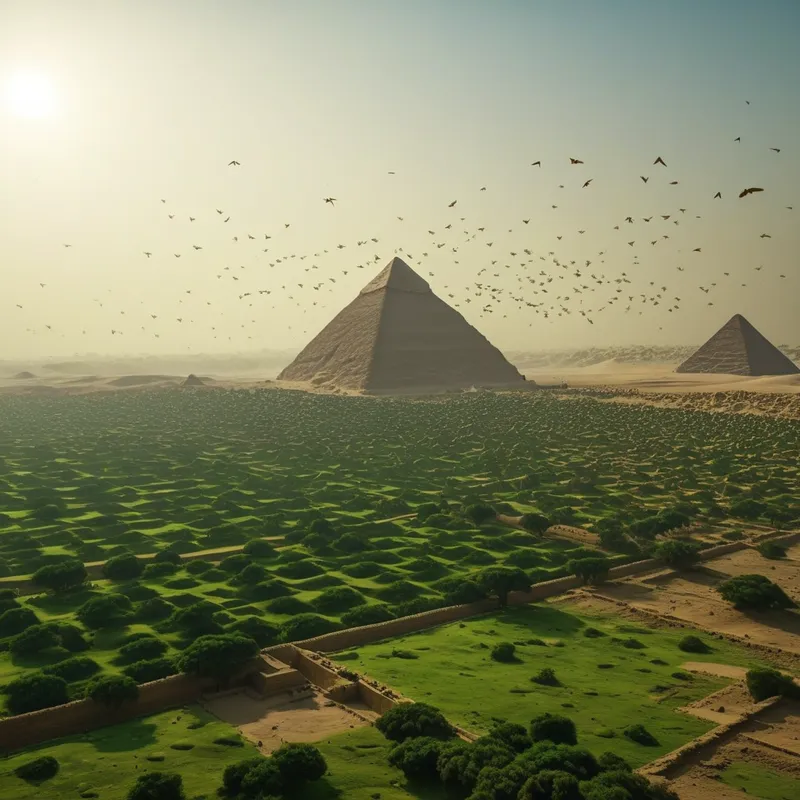
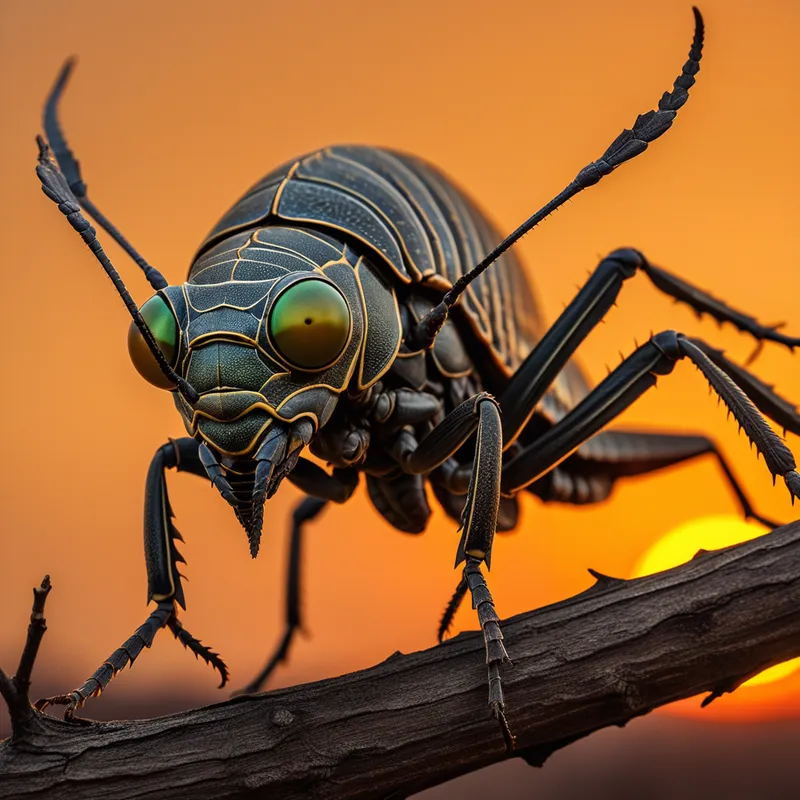
Then came the wind. Not the gentle north wind that cools the brow, but the searing, groaning east wind, howling across the desert for a day and a night, a second night, a second day. It carried a sound that was not its own—a dry rustling, a clicking, a gathering hum that swallowed the wind itself. The people looked up, and the sun died. Not in eclipse, but in a living, churning eclipse of wings and armored bodies. The swarm descended, a single, monstrous entity given a billion forms.
They settled upon the land, a living carpet of hunger. The sound was the sound of the end of green things: a relentless, whispering crunch as every leaf, every shoot, every fruit of the field was consumed. The vines were stripped to skeletal fingers. The fig trees wept sap from bare wounds. Not a blade of grass remained in all the land of Egypt. They filled the houses, the palaces, the beds, the ovens—a crawling, relentless presence in the very bread bowls. The land, moments before a testament to the Pharaoh's power and the grace of the Nile, was rendered a skeletal wasteland, a monument to absolute consumption.
In the Goshen, where the slaves dwelt, there was green. The boundary was as sharp as a knife cut. Here, life; there, death. The Pharaoh, in the heart of the stripped palace, summoned the brothers. “I have sinned against YHWH your God, and against you,” he gasped, the words like ash in his mouth. “Now therefore, forgive my sin, and entreat YHWH your God, that he may take away from me this death.”
And the west wind blew, a mighty breath from the sea. It lifted the swarm, that living shroud of despair, and hurled it into the Sea of Reeds, where not one remained. The silence that followed was more terrible than the hum. It was the silence of a world unmade, a kingdom laid bare, with nothing left to hide behind.
Cultural Origins & Context
This narrative is embedded within the Book of Exodus, a foundational text of the Israelite people composed and redacted over centuries, likely reaching its canonical form during or after the Babylonian Exile. It was not a mere natural history but a sacred history, told and retold at Passover, around family tables, to answer the core question: “How did we become a people?” The locust plague was one of ten “signs and wonders” attributed to YHWH, designed to demonstrate his supreme power over the Egyptian pantheon and the natural order they governed.
Societally, it functioned as a theodicy—a justification of divine justice. It explained the suffering of the oppressor and the liberation of the oppressed as acts of a sovereign, moral deity. For a people often under the heel of empires, it was a story of ultimate reversal: the weapons of the empire (its agricultural wealth, its stubborn pride) turned against it by a force it could not control, bribe, or understand. The storyteller was the community itself, weaving its identity from threads of memory, faith, and the visceral imagery of total desolation followed by deliverance.
Symbolic Architecture
The locust swarm is not merely an insect infestation; it is the embodiment of divine judgment made tangible, a psychic force of correction. It represents the inevitable consequence of hardened consciousness, of a system (be it a kingdom or a psyche) that has become rigid, oppressive, and deaf to appeals for life and freedom.
The plague does not destroy the structures of stone, but devours all that grows from the earth. It is a judgment not on being, but on becoming; not on existence, but on fertility.
Symbolically, the locusts are the agents of the shadow. They are what comes when what has been denied and repressed (the cry of the enslaved, the voice of the marginalized self) can no longer be ignored. They consume the persona—the lush, green, outward-facing identity of Egypt, its pride and its prosperity—leaving only the bare, essential structures. The locusts enact a terrifying but necessary kenosis, an emptying out, so that something new might have space to grow. The stark boundary at Goshen underscores that this judgment is precise; it targets a specific consciousness of oppression, not existence itself.
The Dreamer's Resonance
When this myth appears in modern dreams, it rarely manifests as a literal biblical scene. Instead, one might dream of a thriving career suddenly consumed by a wave of bureaucratic nonsense, a loving relationship stripped bare by a swarm of nagging doubts, or a personal project devoured by anxiety before it can bear fruit. The somatic feeling is one of helplessness, of being overwhelmed by a million tiny, relentless forces. There is a clicking, buzzing anxiety in the body.
This is the psyche signaling that a mode of being has become unsustainable. The “Egypt” in the dream—the job, the habit, the self-image—has become a place of captivity, its ruler (the ego) stubbornly refusing to “let go.” The locusts are the unconscious’s drastic intervention. They are the depressive episode that strips away all false joy, the anxiety attack that dismantles false calm, the life crisis that consumes all superficial security. The dreamer is in the process of having their “green things”—their sources of external validation, comfort, and identity—systematically removed. It is a terrifying but purposeful descent, forcing a confrontation with what remains when everything you have is gone, pointing you toward who you are.

Alchemical Translation
The alchemical journey mirrored here is the nigredo, the blackening, the first and most crucial stage of psychic transmutation. The proud, identified ego (the Pharaoh) must be confronted by its own shadow, made manifest in a form it cannot command. The locust plague is the operation that reduces the prima materia of the personality to a black, chaotic mass. All that was fertile and complex is rendered simple and barren.
The triumph is not in avoiding the swarm, but in surviving the barrenness it creates. The new growth, the promised liberation, can only sprout from soil that has been utterly cleared.
For the modern individual, this myth models the necessity of catastrophic de-identification. Our “Egypts” are the rigid structures of persona, the compulsive identities of achiever, caregiver, or intellectual. Individuation requires that these be challenged, not gently, but sometimes with the force of a plague. The process asks: What must be consumed so that you can be free? What pride must be stripped so your essential self can emerge? The west wind that finally carries the locusts away is the breath of a new attitude, a willingness to surrender the hardened heart. It signals the end of the nigredo and the beginning of the albedo, the whitening, where one stands in the stark, clean silence of the cleared field, no longer a slave to the old kingdom, ready to begin the exodus toward the self.
Associated Symbols
Explore related symbols from the CaleaDream lexicon: