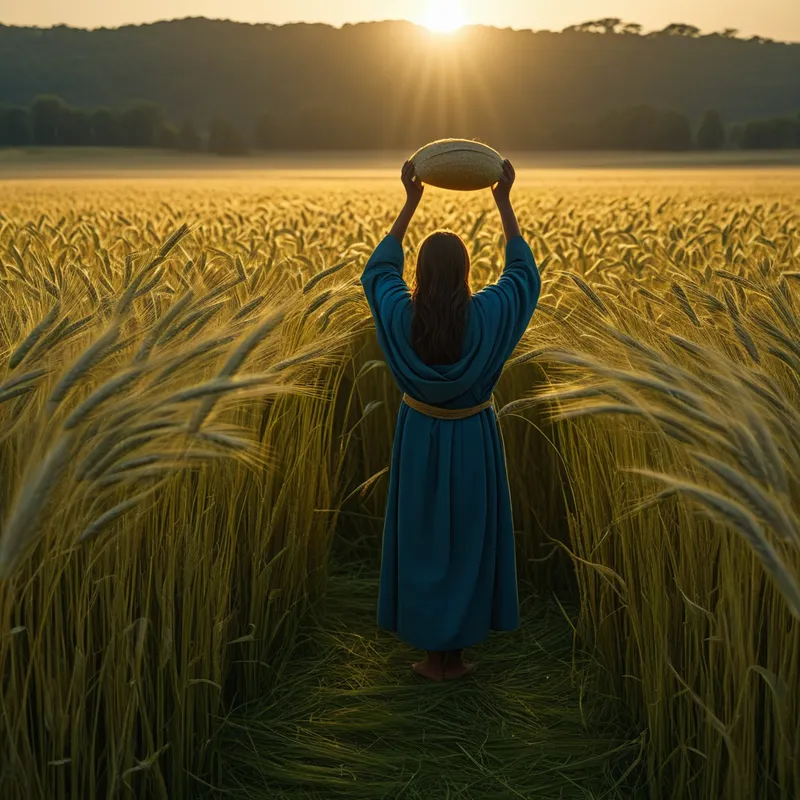
Loaves and Fishes Myth Meaning & Symbolism
A myth where a small offering, blessed and broken, feeds a multitude, revealing the alchemy of trust that transforms perceived lack into boundless nourishment.
The Tale of Loaves and Fishes
The sun was a hammer on the anvil of the sky, beating the green hills into a dusty gold. A great river of humanity, five thousand men and more, not counting the women and children, had followed the voice into the wilderness. They were a sea of need—eyes hollow from walking, bellies tight with hunger, souls parched for a word that was more than word. They had followed him to this lonely place, and now the day was dying, and the wilderness showed its teeth.
The disciples, practical men with the dust of the road in their beards, came to him with the urgency of managers facing a logistical catastrophe. “This is a deserted place,” they said, the worry lining their voices. “Send the crowds away so they can go into the villages and buy food for themselves.” The need of the multitude was a physical weight, a problem of arithmetic and commerce in a place with neither.
But he looked upon the crowd not as a problem to be dispersed, but as a flock to be tended. His words cut through their anxiety: “They do not need to go away; you give them something to eat.” The statement hung in the air, absurd, impossible. A ripple of disbelief passed through the twelve. All they could muster was a census of lack: “We have here only five loaves and two fish.”
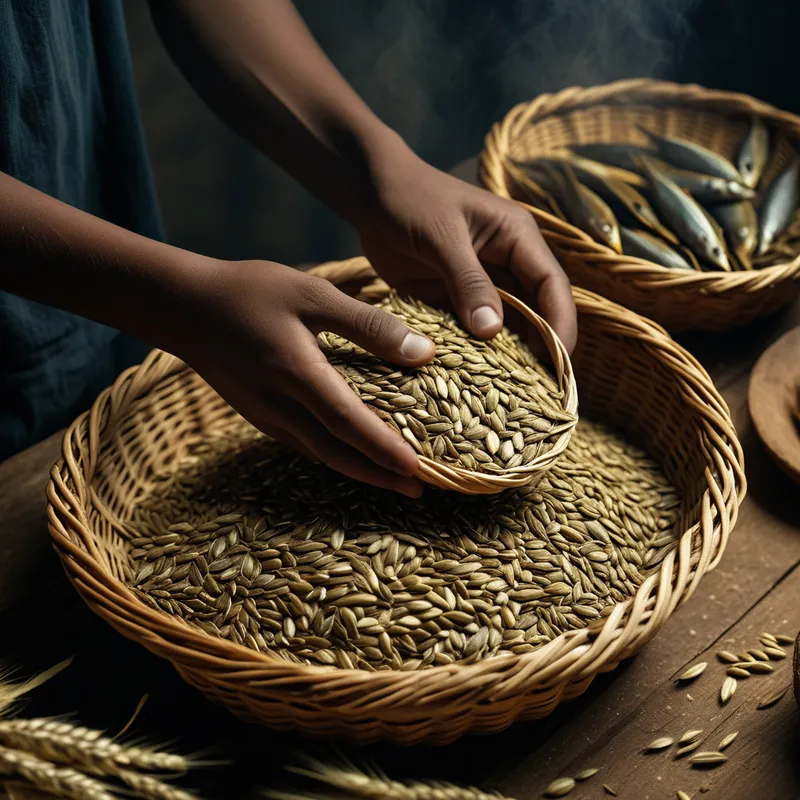
The offering was pitiful. Five flat cakes of barley bread, the food of the poor, coarse and dry. Two small, salted fish—opsaria—little more than relish. They were produced from a boy’s basket, a child’s meager lunch surrendered to the enormity of the need. The disciples saw only the insufficiency, the laughable gap between what was and what was required.
Then, he gave the impossible command. “Bring them here to me.” He took the five loaves and the two fish into his hands. He looked up to the vast dome of heaven, gave thanks, and broke the loaves. The sound of the bread cracking was small in the immensity of the plain. He gave the pieces to the disciples, and the disciples, acting on a trust they did not yet feel, gave them to the crowds.
And a miracle unfolded not with thunder, but with quiet distribution. Hand to hand, basket to basket, the broken pieces passed. A disciple’s hand reached into a basket, expecting to find the bottom, and found instead more bread. The two fish, when broken, became not less, but more. The multitude did not just eat; they ate and were satisfied. The gnawing void in each belly was filled. The anxiety that had crackled in the air dissolved into the gentle murmur of a shared feast on the grass.
As the twilight deepened, he gave another order: “Gather up the leftover fragments so that nothing may be lost.” And they gathered, filling twelve baskets with the broken pieces that remained. From a child’s scant lunch, five thousand were fed, and an abundance was gathered, a tangible testament to a generosity that exceeded all accounting. The wilderness had become a table. Scarcity had dreamed itself into a feast.
Cultural Origins & Context
This story is recorded in all four canonical Gospels, a rarity that underscores its foundational importance in early Christian memory. It is set within the context of the Galilean ministry of Jesus of Nazareth, a time of itinerant teaching and growing crowds drawn by both his words and reports of his deeds.
Societally, it functioned on multiple levels. For early communities facing persecution and material uncertainty, it was a powerful narrative of divine providence—a promise that their own meager resources, when entrusted to God, would be sufficient. It also served as a potent typology, echoing the story of Elisha (2 Kings 4:42-44) and prefiguring the Eucharist, where bread is taken, blessed, broken, and distributed. The story was not merely a report of a past wonder but a living metaphor for the community’s experience of shared sustenance in Christ.
Symbolic Architecture
At its heart, this is a myth about the alchemy of perception. The core conflict is not between Jesus and the crowd, but between two ways of seeing the world: the arithmetic of scarcity and the logic of grace. The disciples represent the former, the ego-consciousness that inventories, calculates, and concludes “not enough.” The five loaves and two fish symbolize the small, concrete reality of our present resources, our skills, our time, our energy—always appearing inadequate before the magnitude of life’s demands or our own inner hunger.
The miracle occurs not in the multiplication of objects, but in the transformation of the relationship between the giver, the gift, and the need. The breaking is the crucial act.
The act of “taking, blessing, breaking, and giving” is the symbolic template for psychic transformation. To take is to consciously acknowledge one’s limited resource. To bless is to imbue it with value and intention, to see it not as a measure of lack but as a vessel of potential. To break is the necessary dissolution—the spending of energy, the sharing of insight, the vulnerability of offering. It is the death of the thing as a hoarded, intact unit. Only through this breaking can the giving become generative.
The twelve baskets of leftovers are profoundly significant. They signify that the process initiated by grace yields a surplus, a residue of meaning and strength that remains after the immediate hunger is met. It is the psychological “leftover”—the increased confidence, the deepened capacity, the unexpected insight—that we gather after we have dared to offer our small self to a large task.
The Dreamer's Resonance
When this myth surfaces in modern dreams, it often signals a profound confrontation with a psychology of scarcity. The dreamer may find themselves in a vast, empty space—a barren boardroom, a desolate party, an endless desert—tasked with feeding a faceless crowd or a hungry part of themselves with only a crumb or a drop of water.
The somatic feeling is one of acute anxiety and crushing responsibility. The dream ego, like the disciples, feels the pressure of an impossible demand. The miracle, if it occurs in the dream, is rarely dramatic. It may be a quiet realization that the small thing in one’s hand is enough, or a sudden influx of help from unexpected figures (the disciples in the dream). More often, the dream ends in the tension, reflecting a waking-life state where the individual feels their resources are being drained without replenishment.
Such a dream invites the dreamer to examine where they are operating from a mindset of lack. Where is the soul being asked to “give them something to eat”—to nurture a relationship, a project, a creative impulse, or their own inner child—while believing fervently that they possess only “five loaves and two fish”? The dream points to the necessity of a shift from ego-based accounting to a trust in a deeper, perhaps unknown, generative principle within the psyche.

Alchemical Translation
For the modern individual on the path of individuation, the Loaves and Fishes myth models the psychic transmutation of the prima materia of personal limitation into the gold of authentic abundance.
The first stage, taking, is the conscious assimilation of one’s shadow. It is saying, “This is what I have: my wounds, my modest talents, my limited time, my flawed humanity.” It is the honest inventory, refusing to fantasize about resources one does not possess. The blessing is the act of withdrawing the projection. We stop seeing our small loaf as worthless because it cannot feed the world, and instead bless it as the unique substance of our own life. We confer dignity upon our starting point.
The alchemical solve (dissolving) is in the breaking. The ego’s desire to remain intact, self-sufficient, and unspent must be dissolved.
To break is to engage with the world, to risk expenditure, to offer one’s insight before it is perfectly formed, to love before guarantees are given. It is the sacrifice of the ego’s hoarding tendency to the larger process of life. In psychological terms, this is the engagement with the Self, which operates on a principle of symbolic abundance rather than literal scarcity.
The final stage, giving, is the act of living from this transformed center. The energy no longer comes solely from the limited storehouse of the personal ego but is sourced from the connection to the transpersonal Self. The result is not exhaustion but a surplus—the twelve baskets. These are the integrated parts of the personality, the new capacities born of the ordeal, the lasting wisdom gathered. The individual discovers that their true resource was never the limited loaf itself, but their capacity to connect it to a source that transcends their own accounting, transforming a story of scarcity into one of sacred, sufficient grace.
Associated Symbols
Explore related symbols from the CaleaDream lexicon: