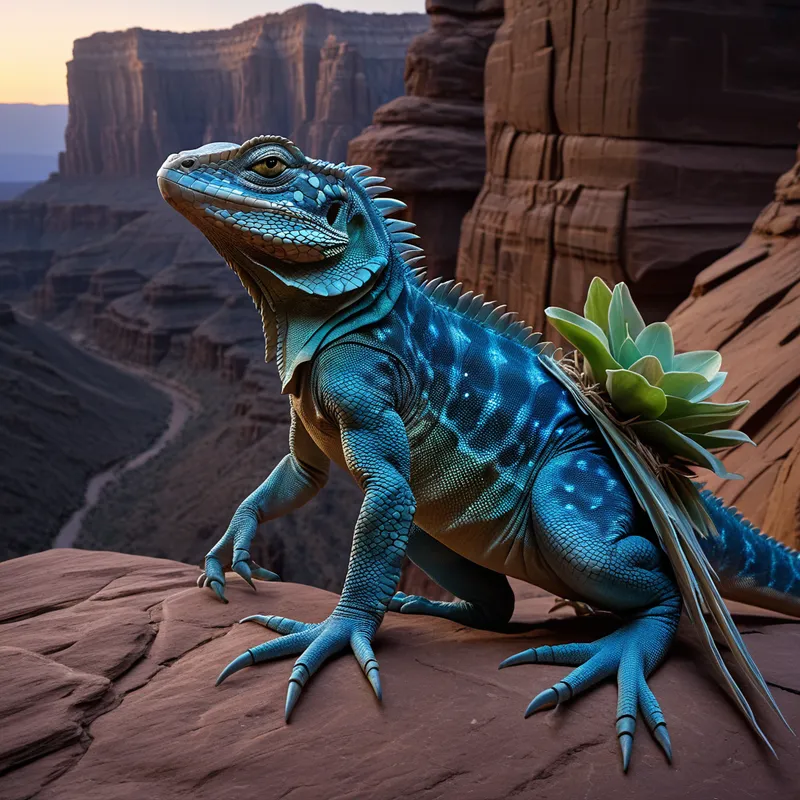
Lizard in Navajo Creation Myth Meaning & Symbolism
In the Navajo creation story, Lizard, a small and wise being, is tasked with selecting the form of human life, shaping our destiny through a profound choice.
The Tale of Lizard in Navajo Creation
In the beginning, there was the First World. It was a place of whispers and shadows, where the Holy People moved through the deep, preparing the way. From this place of emergence, the people journeyed upward, world by world, driven by discord and the longing for harmony. They ascended through the Blue World and the Yellow World, until they stood upon the threshold of the Glittering World.
Here, in this new, sun-drenched realm of canyons and sky, a moment of profound stillness descended. The people who had emerged were not yet as they are now. Their forms were unfinished, their destinies unshaped. They were beings of pure potential, waiting for the final touch of definition. The Holy People gathered in council. The question hung in the dry, clear air: What form shall these beings take? How shall they live and die?
The task was not given to the mighty Tsohanoai, nor to the wise Changing Woman. It was given to a small, quiet being who observed the world with ancient, unblinking eyes. It was given to Lizard.
Lizard was called forward. In its clawed hands were placed two sacred bundles. One bundle contained the skin of a deer. The other held a piece of sacred corn. These were not mere objects; they were the essence of two paths, two destinies for humanity.
The voice of the Holy People was like the wind through canyon walls. "Choose, little one. If you give them the skin of the deer, their lives will be as the deer: swift, beautiful, but fleeting. They will die and return to the earth quickly. If you give them the corn, their lives will be as the cornstalk: rooted, enduring through seasons, but they will grow old, their bodies will weaken and know long suffering."
Lizard sat upon a warm rock, feeling the weight of all futures. It looked at the unfinished people, their eyes reflecting the vast sky. It touched the soft deer hide, feeling the promise of a life lived in a brilliant, merciful flash. It held the hard kernel of corn, understanding the deep, slow rhythm of generations.
There was no sound but the heartbeat of the world. Then, Lizard moved. It did not rush. With a deliberation born of timeless wisdom, it lifted the bundle containing the piece of sacred corn. It presented this choice to the people.
And so it was decided. Humanity would walk the path of the corn. They would know the long arc of life, the joy of children and grandchildren, the slow accumulation of wisdom, and the inevitable, gradual return to the earth. Their skin would not be shed in a season; it would weather and age. In that silent, monumental moment, Lizard, the small sage of the sandstone, shaped the very condition of human existence.
Cultural Origins & Context
This narrative is a vital strand in the Diné Bahane', the Navajo creation story. It is not a mere folktale but a foundational sacred history, a map of identity and moral order. Traditionally, these stories are the province of Hataałii, or medicine people, who learn them through years of rigorous apprenticeship. The stories are recited during specific healing ceremonies, such as the Blessingway, to restore Hózhǫ́.
The telling is an act of power and preservation. Each detail—the order of the worlds, the specific beings, the nature of the choice—is maintained with precision, for the story itself is a medicine. It explains the Navajo relationship to the land (the Glittering World), to their sustenance (corn), and most profoundly, to their own mortality. The myth of Lizard is a cornerstone of this philosophy, embedding the acceptance of life's difficult, beautiful duration into the very origin of the people.
Symbolic Architecture
Lizard is the archetypal intermediary, a creature of the threshold. It dwells between rock and air, between shadow and sun. In this myth, it becomes the psychopomp between the divine and the human, between potential and actuality.
The choice is never between good and evil, but between one form of suffering and another, between one kind of beauty and its counterpart. This is the mature ground of existence.
The two bundles represent the fundamental poles of existential choice. The deer skin symbolizes the ephemeral life: intense, beautiful, and mercifully brief. It is the life of pure instinct and moment, free from the burden of long decay. The corn symbolizes the enduring life: cyclical, generative, and burdened with the knowledge of time. It is the life of culture, memory, and accumulated pain. Lizard’s choice for humanity is a choice for consciousness, for story, for the hard-won wisdom that comes only through endurance.
Lizard itself embodies a paradoxical wisdom. It is small, often overlooked, yet entrusted with the ultimate decision. Its wisdom is not loud or commanding; it is the quiet, cold-blooded clarity that comes from patient observation, from being close to the earth. It represents the part of the psyche that can hold immense contradictions without panic and make a fateful choice from a place of deep, non-human calm.

The Dreamer's Resonance
When this myth pattern stirs in the modern dreamer, it often surfaces at life's existential crossroads. To dream of a lizard in a position of authority, or to be presented with two starkly different objects or paths, signals a profound somatic and psychological process.
The psyche is wrestling with a foundational choice about one's "form of life." This is not about choosing a job or a partner, but about choosing a mode of being. Will I live a life of safe, brief intensity, avoiding long-term commitments? Or will I plant myself, commit to the slow, painful, and generative work of building something that outlives me? The dream lizard’s presence suggests the answer lies not in frantic analysis, but in accessing a deeper, older, more instinctual layer of the self. The anxiety felt is the weight of the bundle in the hand; the resolution comes from that quiet, reptilian certainty within.
Alchemical Translation
For the individual on the path of individuation, the Lizard myth models a critical stage of psychic transmutation. It is the move from unconscious potential to conscious, embodied form.
The "unfinished people" represent the latent Self, full of possibilities but unactualized. The Holy People represent the ordering, demanding principles of reality and the collective unconscious. The alchemical task is to accept the limitation that makes form possible. Lizard is the function within us that can perform this sacred, terrible act of selection.
Individuation is not about having all choices, but about courageously enacting one, thereby sacrificing the ghost of the other to feed the soul of the chosen path.
The modern seeker must become their own Lizard. We must sit on the rock of contemplation, feel the weight of our dual natures—the desire for freedom (deer) and the desire for meaning (corn)—and choose the form of our suffering. To choose the corn is to choose the alchemical opus, the long work. It is to accept aging, responsibility, grief, and the slow transformation of base experience into the gold of wisdom. It is to understand that our mortality is not a flaw, but the very condition that makes our choices sacred. By internalizing Lizard’s calm decisiveness, we move from being passive inhabitants of our lives to the conscious authors of our destined form.
Associated Symbols
Explore related symbols from the CaleaDream lexicon: